
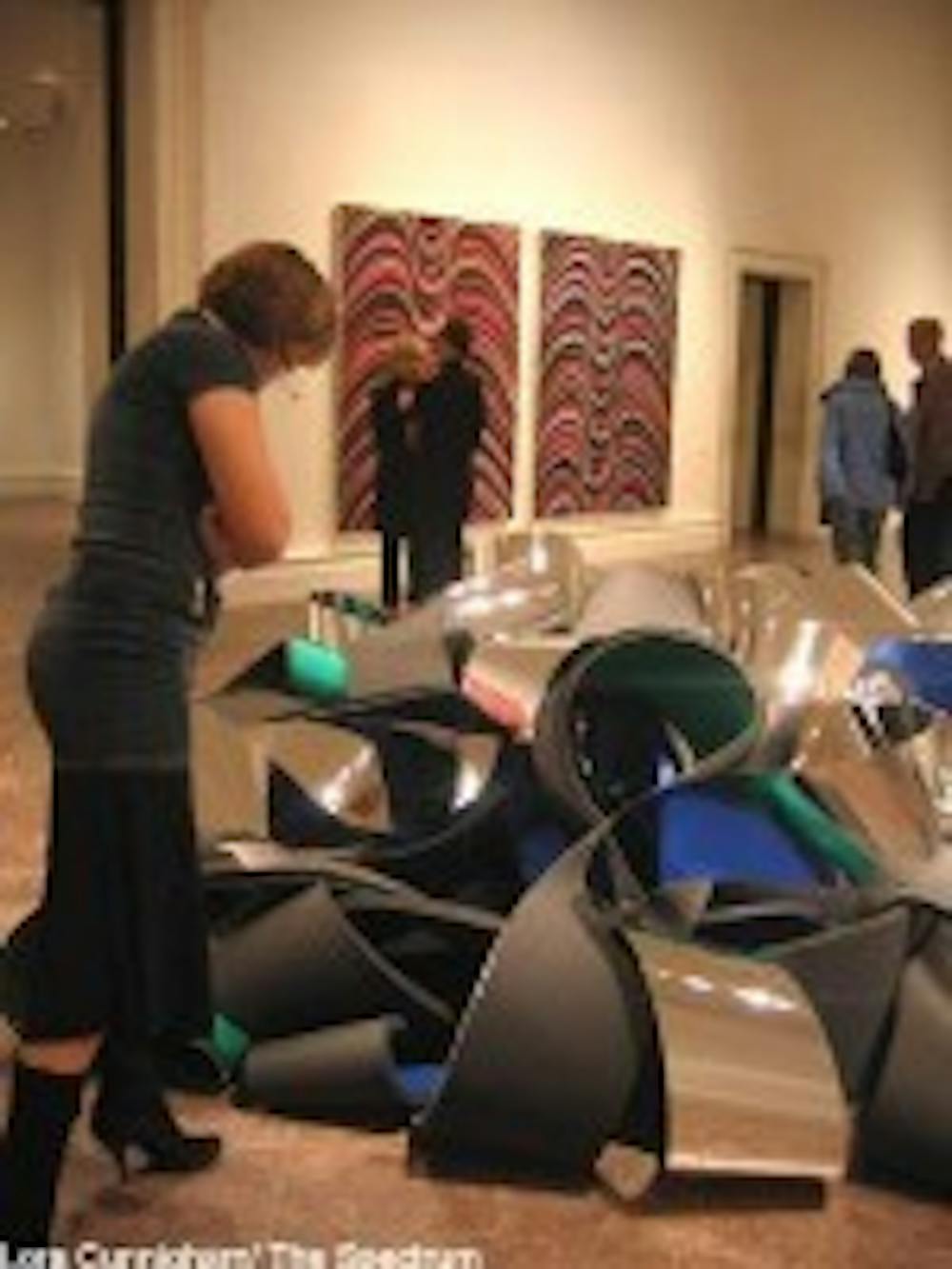
Artist Karin Davie's artwork, a blend of bold colors and fluid lines, is like a strange and stunning combination of Salvador Dali and Jackson Pollock.
Davie's first solo exhibition, "Dangerous Curves," is now on view at the Albright-Knox Art Gallery. For the Toronto-born artist, this exhibition shows almost 15 years worth of work.
Her abstract expressionist style contains both paintings and sculptures that study line and the use of color. In the piece "Symptom: Introduction 1" (2005-06), she uses neoprene (wetsuit material), nylon fabric, zippers, and shiny metal to explore the reflection of image, which is curved so that viewers find themselves mirrored in the piece.
Along with Pollock, Davie's work can be compared to artists such as Clyfford Still and Bridget Riley. But unlike Pollock, who painted with his canvas lying on the floor, Davie's work hangs on a wall as she brushes so that she is in control of the application of her paint. She stays inside the edges of her canvas, which leaves the viewer with a claustrophobic feeling.
Davie's planning board is covered with small drawings and pictures, which she uses as a starting point for all of her work, one of which was a photograph of contoured balloons that later became an inspiration for one of her pieces.
When trying to describe how the artist painted such flowing lines, senior curator Douglas Dreishpoon said to think of the idea of an actual, tangible line running through space, time, and nature. He said to think of Davie having that line connected to her arm.
"She paints as a musician would play," he said.
Davie's work goes beyond what is seen. Her work is mysterious and provocative as it explores how the human body displaces space. In no way is it void of content either; her art always taps into a rich source of thought, or represents an experience she has had.
It is commonly believed that female artists have a feminist agenda. Besides Davie's "Sidewalk Series" in which she depicts the everyday experiences of walking down the street and receiving gazes and catcalls from men, her work avoids having this as an overriding theme.
Many paintings look as if they are still dripping wet, showing the untouched impression of her process. She paints wet on wet with oil and linseed paint. The thickness of the lines is determined by the thickness of the brush she uses. Painting wet on wet is a challenge because colors can easily become mushed and blend together, causing shades of browns and grays different from the eye-catching shades of magenta and lime green that Davie uses.
"We feel Davie's work is extraordinary," agreed Alicia and Daniel Cosentino, art students at Monroe Community College and Rochester Institute of Technology. "We came back because of her piece in the 'Extreme Abstraction' exhibit. The three-dimensional sculpture makes sense and gives creditability to her work and mentality."
"I appreciate modern art, especially in this large open space," said fine arts painter Joseph Czarnota. "The work really feels as if it is alive. I could never live with it though, realism is how I paint. There are so many personalities in the world with so many different types of art that ideally we can all live together even when we don't care for each other's style."
"The color combinations and movements of the lines really caught my attention and kept me captivated," said Aukje Schukken, a sophomore art history major. "Her style is very interpretive and abstract. I like that."
"Dangerous Curves" will be on display at the Albright-Knox Art Gallery now through May 14.



