
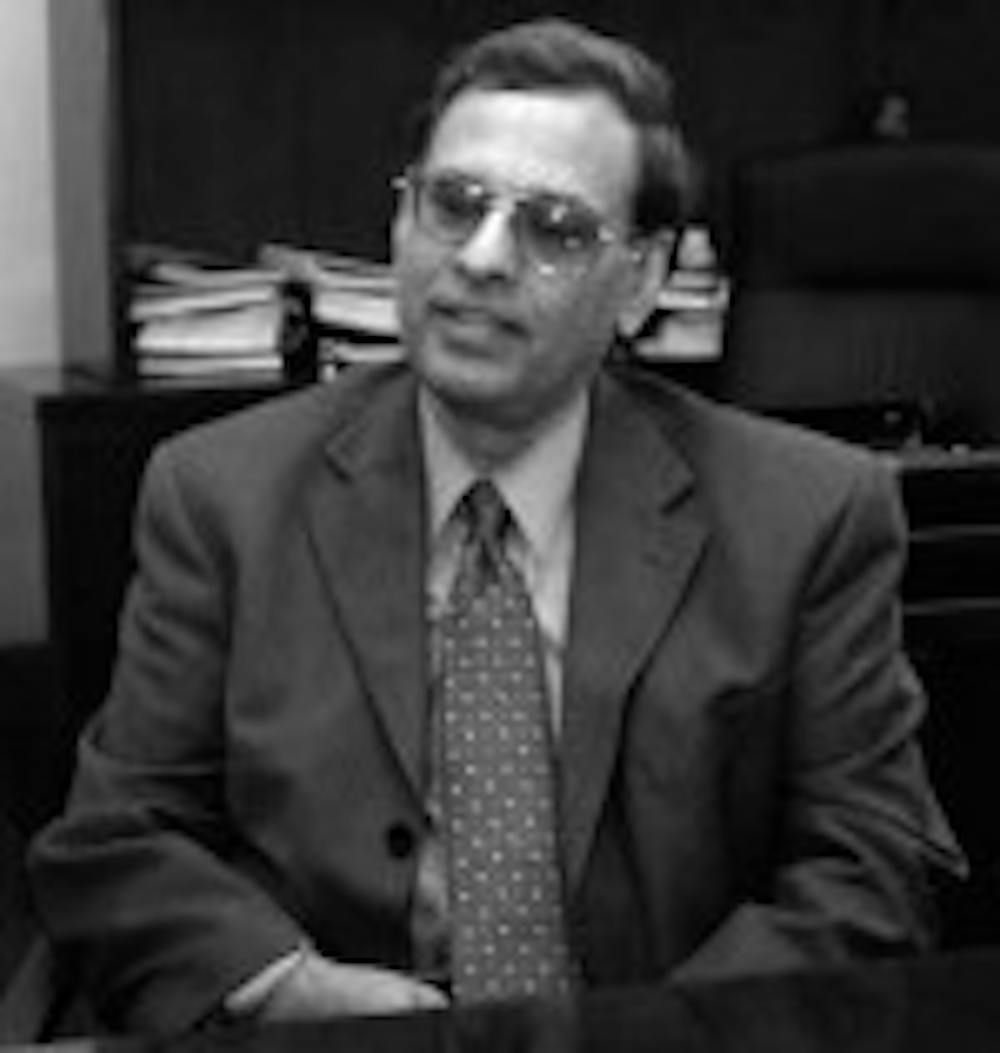
This is the second part in a continuing series, "The changing face of UB," which examines recent student population trends as UB moves forward into the John Simpson era. Today's story steps back from the student body for an interview with President Simpson's right-hand man for everything academic, Provost Satish Tripathi.
From his fifth floor office in Capen Hall, Satish Tripathi has a daily bird's eye view of campus.
On a clear day, he can see the mist of Niagara Falls rising on the horizon, but the view is at its best, Tripathi says, when the leaves change color in the fall.
Now in his second year at UB, Tripathi is watching things change here that are much more important than the leaves on trees. As provost, he not only has a bird's eye view of everything academic, but there is perhaps no person other than President Simpson who is more involved with UB2020, which will directly shape the future of this university.
Tripathi says that UB2020, however, is not about his personal vision for UB, or even Simpson's.
"In order for these to be successful we have to realize that it is the faculty that leads this institution," he said in an interview last week with The Spectrum.
In his first year, Tripathi said he didn't find too many surprises, but he has been overwhelmingly pleased with the level of participation from faculty in UB2020's "envisioning retreats."
"The unexpected part from me was to see the participation of the faculty in everything we're doing," Tripathi said. "And that's something that doesn't happen at many campuses."
The retreats, each of which covers a different topic regarding the state and direction of UB, serve as meetings for brainstorming and goal setting. According to Tripathi, at least 50 percent of the faculty has taken part in at least one of them.
To Tripathi, UB2020's main aim is to "define the ambition of UB" and determine how to achieve it. In the end, he hopes UB2020 won't be just a document, but part of a changing culture both in Amherst and on Main Street.
And it's not that UB's culture is lacking, Tripathi says, but the university has a lot of room to improve its overall performance. It was partly that challenge, to turn an already good academic institution into a great one, which drew Tripathi to UB from his job as a dean at University of California-Riverside.
"The ultimate goal for me is to improve the quality of each of the programs we have," he said.
To do that, UB will be drawing from its strategic strengths identified by UB2020: artistic expression and performing arts, civic engagement and public policy, nanosciences, aging and chronic diseases, clinical sciences and experimental medicine, mitigation of extreme events, information technology, literary and cultural studies and molecular recognition in biological systems.
It's a laundry list of academic jargon, but Tripathi promises all this planning is more than just talk. The work being done now "will impact our next generation of students" and expose them to different experiences never offered before.
"We have to have everything at a good level, and then make some things excellent, and that's how a great university is built," Tripathi said.
Along with the strategic strengths, other details are starting to emerge. Again, there is the faculty, with 104 new faculty members this fall alone, and 175 hired in the past two years. Soft-spoken and reserved, Tripathi is as giddy as he gets when he talks about the influx of ideas from new professors.
"(UB) is not a static environment," he said. "New students come in and they bring their own thoughts, but we're also refurbishing the faculty."
As the university makes a greater push for national diversity, there is also an emerging vision for the student body. "We have more international students than out-of-state students," Tripathi said.
Does that mean UB is looking to become more like public behemoths University of Washington or Ohio State, as Simpson has hinted?
"An institution has to have its own character," Tripathi said. "Each Big Ten school is different."
"It's not going to happen overnight," Tripathi added, "but it will be known at the end of the day where we are building."
For Tripathi, this is the exciting part: after a year of getting settled, a year of restructuring the administration and making a run of hirings, everything is finally in place for the gears to start turning.
"Really if you look at it, putting the leadership in place to move forward, much of that has been done now," Tripathi said, referring to recent hires of two new deans and three vice presidents for faculty affairs, research and undergraduate affairs.
While working to expand upon the undergraduate experience in terms of research, study abroad and community service opportunities, Tripathi said steps are also being taken to solidify the graduate schools. It is a tricky balance, he said, of working on changes that will have an impact now while planning for other long-term ideas.
For starters, UB has raised the minimum graduate stipend by $2,000, which makes UB a more attractive school to graduate students.
"Now we are competitive," Tripathi said in a quote that could sum up the status of UB as a whole. "We are not at the top or the bottom, but we are competitive."
Overall, Tripathi says he believes UB is on the right track, but he wishes his responsibilities on the fifth floor of Capen didn't keep him as much as they do from connecting with students.
As a dean, he had much more student interaction, which is something Tripathi says he misses and will make a conscious effort to increase in his second year.
When he's not enjoying his view of the university from above, Tripathi said he often walks to lunch at The Commons, or tries to see what's going on at the Center for the Arts. It is rare, he said, that he is recognized. After all, few students know what a provost even does, but that's not unusual.
"That's how it is," Tripathi said. "But you see you see a lot of faces. You see people walking and talking with each other, people shouting at each other, but you get some sense. It really shows how rich the university is."



