
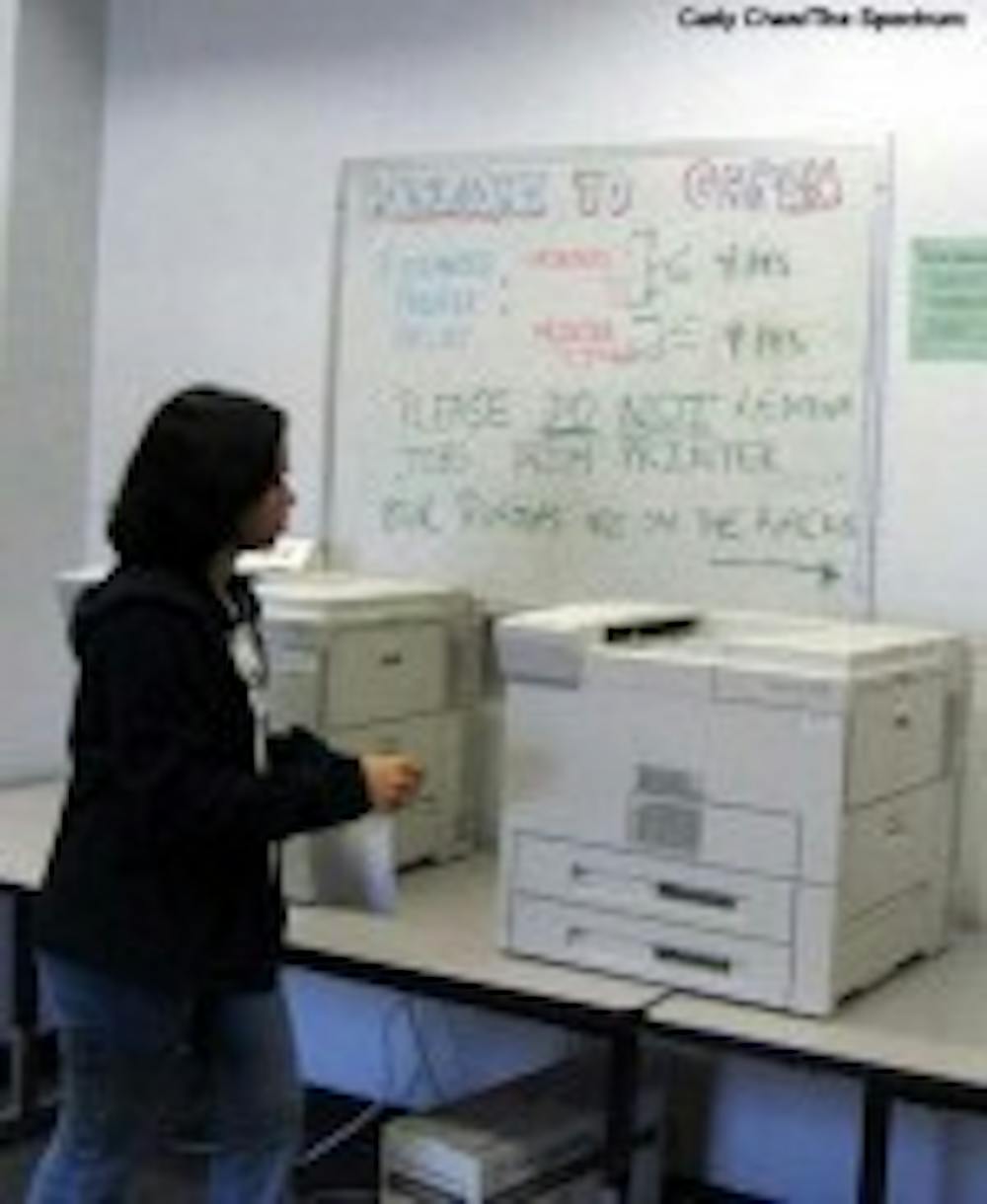
Anybody who's ever tried to print anything at a UB computer center knows to expect the worst.
At their shortest, printing delays are 30 minutes, but more often than not, the delays can last several hours.
According to UB officials, most students fail to recognize the print delays result from their own indiscretion over what and how much they print.
But starting next fall, UB computer centers on both campuses will set a limit on the numbers of pages each student can print per semester. Officials hope the new system, dubbed iprint@ub, will help relieve excruciatingly long print lines and reduce the costs of paper and ink.
According to UB officials, printing quantity and expenses have risen progressively, and last year UB students printed almost 52 million pages, costing nearly $570,000 in paper and toner alone.
Under the new plan, students will get to print a maximum 650 pages per semester, which would reduce UB's max printing potential during the fall and spring by about 17 million pages. Students would also get extra page allocations for summer classes.
"This is a rather important change at UB, but it isn't unique to just our school," said Peter A. Nickerson, chair of the FSEC.
At UB, "students, faculty and staff have enjoyed free and unrestricted printing at public computing locations, libraries and instructional class labs since 1986," said Voldemar Innus, vice president and chief information officer.
According to Innus, SUNY campuses like Albany and Binghamton have already joined Colorado University at Boulder, University of Florida and other schools in implementing a print control system.
The new system at UB would work like this: when a user prompts a print job, they will be asked to accept the cost of the print job and deduct it from his or her total for the semester.
When a user finishes their allocation or sees it dwindling, they can purchase additional pages at a small cost - five cents for one-sided prints and eight cents for double-sided pages, Innus said.
Graduate students and undergraduates will be given the same number of fixed pages, one ream of paper, which costs $25. If students stay within their limit, the technology fee paid at the beginning of the semester will cover the cost. For next semester, UB has proposed a $7 increase to the technology fee.
"You're not just paying for a ream of paper, you're paying for the printing equipment and its maintenance as well," Innus said.
The issue of saving paper was also brought up at Wednesday's Faculty Senate Executive Committee meeting, where Innus gave a report on the progress of iprint@ub.
"Much of the large material that students print is in html and PDF format," said William Baumer, a professor of philosophy and FSEC member. "Students could just download these things onto their computer and not only save paper but save some of the pages in their respective allotments as well."
Students who print in bulk will face the longest waits under the new plan, according to Innus. If a student wants to print five pages, they will get their print job right away. Fifteen pages will have a midterm queue, and longer than 15 pages has a daylong wait, Innus said.
"When I worked at Lockwood Library last year the lines for print jobs sometimes took days, so I'm glad to see that the university plans to remedy the problem for next year," said John Bango, a junior undecided major.
The promise of shorter lines and quicker print outputs is reason enough for many students to support iprint@ub.
"When students aren't just haphazardly printing whatever they want and taking more time to decide whether or not what they want to print is worth using a page for, it saves time for everyone," said Rachel Berg, a sophomore occupational therapy major.
"I use the library computers regularly to print assignments and I noticed that a large number of print jobs aren't even picked up," said Eric Vanderwalker, a junior mechanical engineering major. "It's such a waste of paper."



