
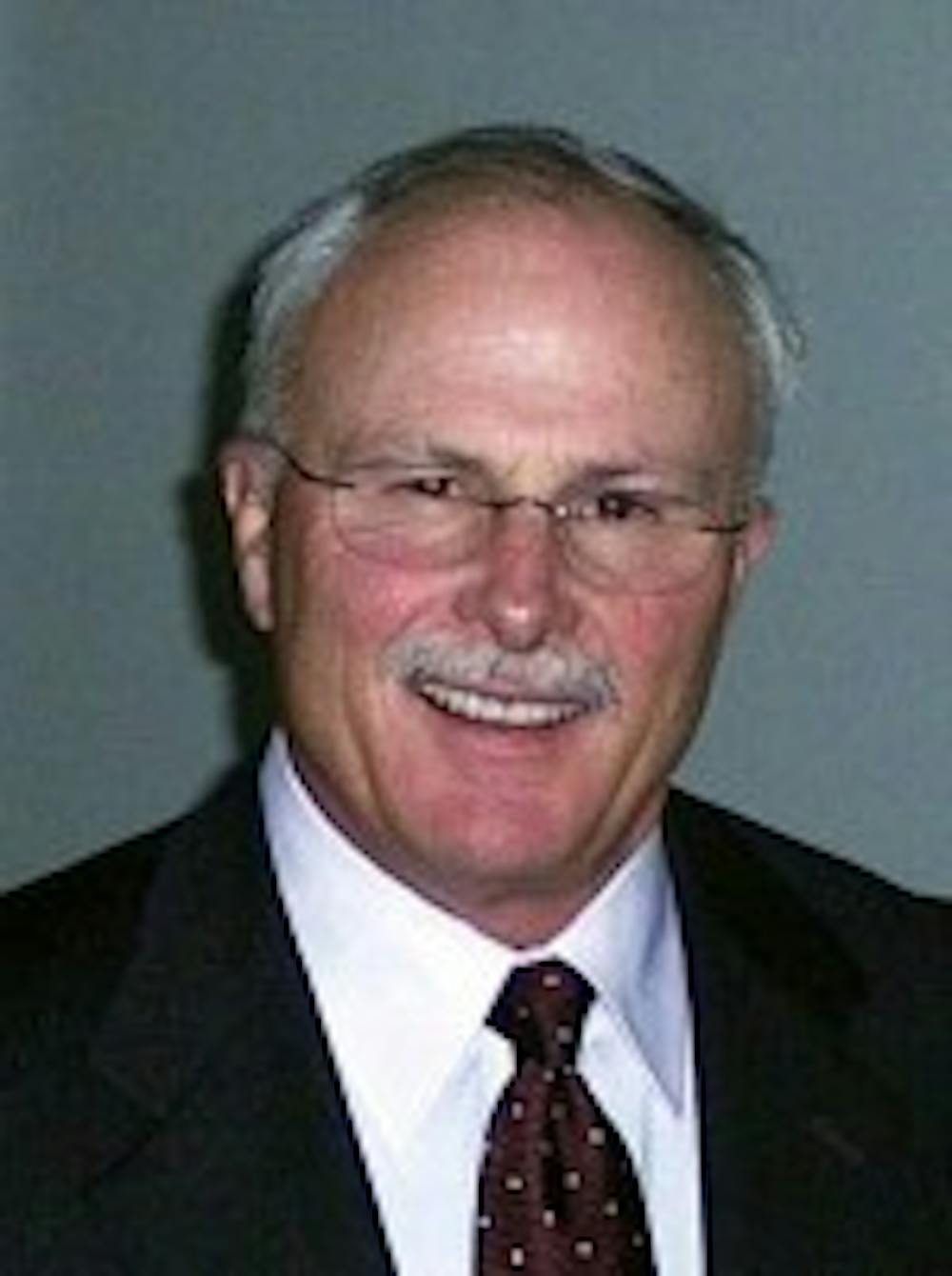
As part of his plan to take UB from a good school to a great school, President John B. Simpson has developed an eight-part plan and made some major personnel changes on the fifth floor of Capen Hall.
In an interview with The Spectrum last week Simpson said UB should be a more accessible school with a strong future vision and a focus on academics first.
Echoing the theme of his inauguration speech, Simpson stressed the importance of access to higher education for people of all ethnic and economic backgrounds.
"Public higher education plays a fundamental role in our society, and I don't want us to ever lose sight of its necessary, critically necessary role in providing access to whoever has the talent," he said.
Now 11 months into his tenure at UB, Simpson has outlined eight guidelines to make UB a stronger institution in the world of higher education. The list starts with having a single, unifying vision, which he said will come from UB2020, a program created to develop a comprehensive strategic plan for UB's future.
Simpson said he considered UB's previous lack of vision a weakness.
"I think that it's time that we thought carefully about who we are and what we ought to do in the future and how to get there," Simpson said. "It's time we think about those questions. I want UB to take its place among the very best public universities."
Simpson said UB has excellent faculty who will help take the university to levels of prominence.
"It's among the good, not the great universities," he said. "We have to get that first sense of what we're trying to do and what our mission is, and that will help the steps towards becoming great."
Simpson added he believes there's always room for improvement. Universities are judged in many ways, but the U.S. News and especially the SATs are insufficient markers, he said.
"In the university, at the end of the day, it's the quality of the academic program that really defines a university's greatness," he said. "We're an academic institution. That's what we do."
Simpson also stressed the need for academic balance between the sciences and humanities, drawing on his previous experience in Washington state.
"The University of Washington was too dependent upon funding for research. It pushed the culture in a direction away from certain parts of the university, like the humanities. The arts would get less funding," he said. "And it draws attention away from issues such as undergraduate education and public service, which in my view have to be part of the university."
Hirings and Firings
During Simpson's time in office, he has made some changes in the vice presidential ranks that he said will mold UB into a committed working environment that will work to achieve greatness together.
Jaylan Turkkan, former vice president for research, left UB over the summer, and last week Simpson fired Jennifer McDonough, vice president for University Advancement.
"What I think the optimal organization for the university is, is intrinsic to what we're trying to do," he added. "And I've made some changes that reflect my view of how that can be done."
Simpson said he feels his changes are beneficial to his co-workers and the university as a whole. "The changes I've made are in line with my view of how you make the central administration as an institutional leadership."
While UB officials have publicly expressed optimism and excitement about the arrival of new leadership, some on the fifth floor of Capen Hall say that with two administrators already cut loose, there is a sense they are all walking on thin ice.
"It's like that old saying, you're waiting for the second shoe to drop, but now two shoes have dropped, is there going to be a third, a fourth, a fifth?" said a source close to the fifth floor.
The source added that Simpson is shaking up the hierarchy to build a staff that's willing to work with him and move UB in the direction he wants.
"He needs to have a team that he's comfortable with, and that's going to make or break his presidency," the source said. "No one else is in a position to make these judgments for him. He's in charge and he's going to make these calls."
Simpson himself said there is now an emphasis on getting the right people in the right jobs.
"I want the very best person I can get, and I'm going to be sure I've got that person by casting my net widely and looking all across the nation," Simpson said. "And the better the quality of the people I have to work with, the better I'm going to be able to do my job.
Simpson said the national searches are in the early stages to find permanent replacements and fill new and interim positions at UB.
"(He wants) a balance of new and old," the source said. "And even people who stay will find themselves doing different jobs in different ways."
Ana Mari Cauce, the chair of the University at Washington's psychology department, worked with Simpson when he first became the dean there of the College of Arts and Sciences. She said that he made similar moves during his time there.
"From my perspective, I wouldn't say it was a wholesale restructuring, but there was definitely ways he upgraded and professionalized," Cauce said.
Cauce said she would be surprised if Simpson fired someone just because they didn't get along or disagreed.
"One of the things that I always appreciated is that when he was putting together a team, he didn't just pull together people that he thought would agree with him," she said.
"I won't say John was uniformly loved, that would be an exaggeration, but he was pretty uniformly respected," Cauce added, saying many faculty members did love Simpson for his willingness to bridge divides.
Finances and Tuition
In an October article in The Buffalo News, UB Council Chairman Jeremy Jacobs expressed concern that with all the planning and administrative hiring, Simpson was biting off more than he could chew. "How many people can you train at the same time?" Jacobs asked.
But at Simpson's investiture, Jacobs said the story was "magnified way out of proportion," and he merely wanted to stress that one has to "manage your ambitions" and keep the funding for grand plans in mind.
Simpson said he recognizes the challenges UB faces financially, but said he doesn't mind spending money on faculty searches that will aid in the greater good of the university.
"The provost and I, and the other administrative leadership in the university, have to be very careful about everything we spend," he said. "Part of the reason the planning process is going forward is to define what our institutional priorities are and how we're going to get there. To do that requires deciding where your resources go."
Simpson called the situation regarding finances and tuition a "local act in a national play" over the last 30 years.
"State taxpayer funding for higher education has been decreased, while universities and colleges are having to find other sources to make up the budgets that fund what they do," he said, adding that in the case of UB, tuition support has crashed through the floor.
With decreasing state support, Simpson said it's up to UB administrators to find alternative sources of funds, but it would be shortsighted for the state to not generate the "best educated population it can."
"The cost of public higher education, in my view, has to be borne by the public," he said. "And it's dangerous when the responsibility for paying for it is on the students."
"If the cost of tuition goes up, the state better be very careful about insuring the students who otherwise would be unable to afford their education and have the talent," he added.
Athletics
On the subject of UB athletics, Simpson said the still-developing Division I program would be closely examined.
"We need to consider what the place is of athletics in our university," he said. "As part in parcel of the planning process, like everything else, we're looking very carefully at our athletic present and our athletic future."
"As for the football program," he added, "it's disappointing that we haven't won more games."
Simpson said he hopes to appoint a permanent athletic director by the end of the school year. Interim athletic director Bill Maher has done an excellent job, Simpson said, but getting the very best candidate means doing a national search, for which Maher is welcome to apply.
"What it's going to do is establish for that person a permanence in a way that ultimately is a benefit to the entire university community," Simpson said.
However, Simpson said that a new athletic director would not be the sole factor in the athletic program's progress.
Similarly, Simpson said he believes that even a new comprehensive plan won't be the sole factor in the overall progress of the university.
"I don't see the university changing in monumental ways," Simpson said. "But I think it will have a better sense of what it's doing and how it's doing it."



