
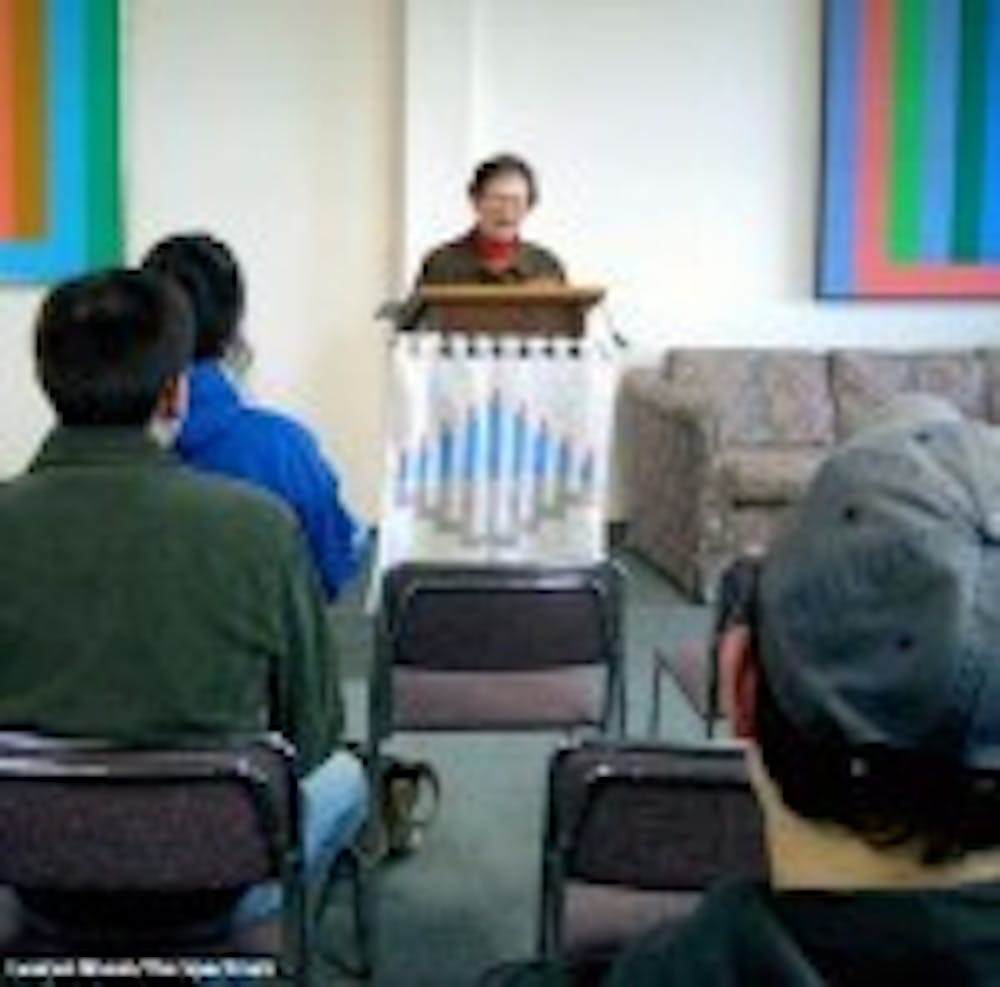
A small and spunky elderly woman stepped up to the podium. Speaking in a gravelly but warm voice broken by a German accent, she began a hopeful tale about surviving the Holocaust.
Working off of an idea presented during the introduction to her speech, the woman reflected on her experience in Germany, saying, "I am still myself, despite the baggage that we all carry around, one way or another."
Marianne Goldstein, a member of the Speaker's Bureau for the Holocaust Resource Center of Buffalo, delivered a powerful tale of survival Tuesday in Room 209 of the Commons as part of a remembrance ceremony for Kristallnacht, or "The Night of Broken Glass," when Germans ravaged local Jewish homes and businesses.
"'Crystal Night' was invented by Nazis as a term of division," said Goldstein. "The term is now permanently out of circulation for any other use."
The event, hosted in part by Hillel of Buffalo, had a twofold purpose - first, to commemorate Kristallnacht, but also to remember the Holocaust, whose official anniversary falls in May when students are out of school.
"What I want you to think about today is the baggage that a Holocaust survivor brings with them. History should never be repeated," said Sylvia Schwartz, executive director of the Holocaust Resource Center of Buffalo and coordinator of the event, during her opening speech.
Goldstein recounted her personal experience with the Holocaust, from her young life growing up in Germany to her emigration to America.
"I was very much aware of the Nazi presence. Thinking about it I still get chills," she said, reflecting on her youth in the 1930s.
She recalled a time when she was traversing a street in southwest Germany in 1938 and saw a few Nazi members look out the window of their Club House at her.
"I was only eleven at the time," she said. "But I saw the Nazis look out the window and I felt that they were snickering at me, this Jewish girl."
The Holocaust survivor also gave a brief history of the creation and execution of the Holocaust, and what she and her family were doing during that time.
"In 1934, when Hitler rose to power, my father was a rabbi and served a number of small congregations," Goldstein said.
Her father was also sent to a camp in Dakow, but was allowed to eventually return to his family.
"When my father came back, he never talked of the conditions in Dakow," she said. "Men came back starved with ill-fitting clothing and with their heads shorn, and many men had lost their toes from standing at attention for all those hours."
When one audience member asked why her father was allowed to leave Dakow, Goldstein responded, "The final solution was not ready for the Jews at the time, meaning that they didn't have enough concentration camps to receive them."
She also recalled other times when men came singing threatening songs by their window during supper.
"German Jews were often criticized for not leaving the country. I never asked my father directly, but when I did, most of the time he would answer something like, 'I'm the head of this congregation, and they need me. Perhaps he was holding onto the hope that things in Germany would change.
Fortunately, Goldstein said that her father's position as a clergyman allowed them passage to America.
"Clergymen could come without a quota number," she said. 'We were very fortunate. In August of 1939 we arrived in the U.S., two days before Hitler invaded Poland. The immigration quota was pretty tight, and there were little racial innuendos even in the immigration laws."
She also spoke of happier times in America, "to lighten things up."
"When we first came to this country in 1939, my brother played the violin, and I played the accordion, and we won " she said. "The big spread in our school paper read, 'Refugee Children Win First Prize!'"
The audience seemed inspired by Goldstein's story.
"I've heard a lot of Holocaust stories before, but I've never heard one of people who got out as soon as she did," said Liz Appel, a sophomore English major and coordinator for Hillel. "She had much more of a positive view."
"I've never heard any story about a survivor from Germany," said Aileen Greenman, a junior political science major. "Her story was uplifting because she did survive."
"She was very insightful. Getting a first person account was one of the most intriguing things about it - it hits you more than just a movie or a book," said Nick Sprague, a junior history major."
"I know people in my family, and I've seen other people speak," said Dan Newcombe, a history major. "It's important that we remember the stories, because in twenty years all the remaining survivors will be gone."



