
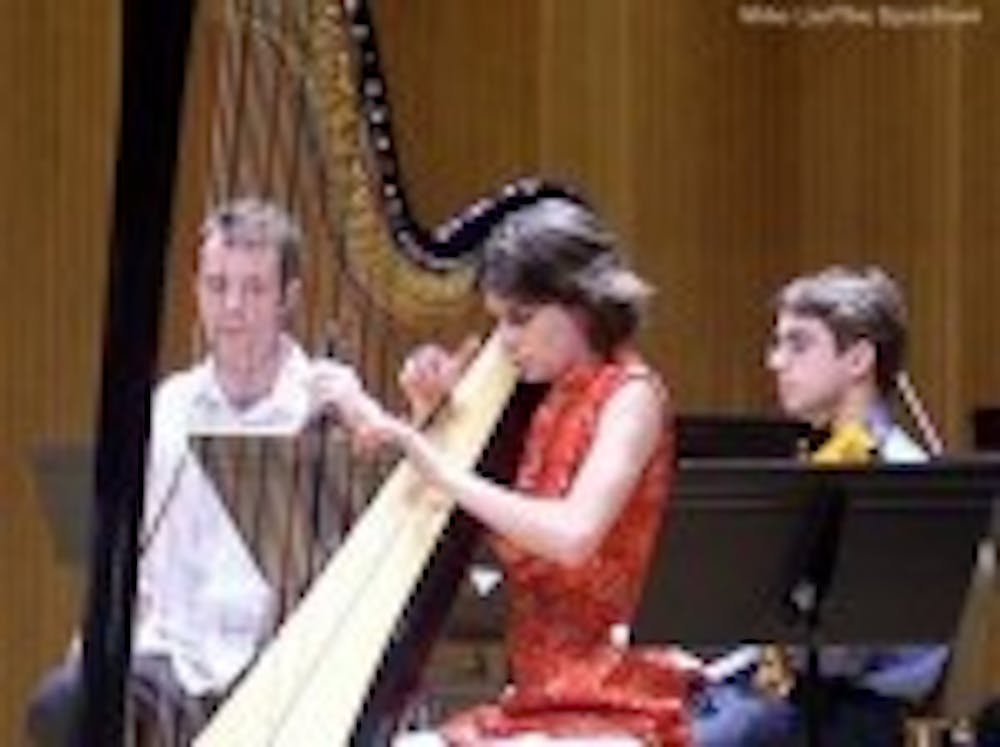
The crowd seated in Slee Hall Tuesday night sat in awe as waves of beautifully played classical music drifted towards them from the stage. The Slee Sinfonietta was offering its fourth installment of their spring concert series.
The concert began with a quartet featuring soprano Tony Arnold, flutist Cheryl Gobbetti Hoffman, cellist Jonathan Golove and pianist Jacob Greenberg. The quartet played "Chansons mad?(c)casses," a three-part piece written by Maurice Ravel.
The first section, "Nahandove," began as a duet between Golove and Arnold singing with meticulous intensity. Arnold's voice sounded painfully beautiful against the cello part, which provided a simple but intense background.
Although the first section set a tranquil and relaxed atmosphere, the next section of the piece, "Aoua" was filled with dramatic intensity. As Arnold sang in French of tyranny and oppression, her three accompanying musicians created a forceful melody, adding much to the piece's intensity.
The final section of the piece returned to a more relaxed tempo and somehow managed to showcase Arnold's exceptional vocal ability even more than the previous two.
The next piece was French composer Claude Debussy's "Danse sacr?(c)e et danse profane." Performed by a chamber orchestra consisting of harpist Catrin Finch as well as the Sinfonietta's violin section, two bassists and three cellists, this piece was intended to be a dance of Debussy, who was a leading exponent of French musical impressionism.
The most amazing thing about this piece was the talent displayed by harpist Finch. As her fingers moved dexterously over her harp, the hall was filled with the beautiful melody that she created. Finch produced a vast plethora of different sounds depending on how she struck her instrument's strings, all of which were beautifully intermixed with those created by the accompanying musicians.
After the audience called Catrin back to the stage multiple times to lavish her in their appreciative applause, the stage was prepared for the last piece of the night, "Pity Paid." Before the piece was played, Jeffrey Stadelman, its composer took the stage and briefly explained his thoughts on the work.
"I intended it to be a short, eventful piece," said Stadelman of his work in a brief introduction.
"Pity Paid" proved to sound eventful and well made. As conductor Magnus Martensson passionately directed the Sinfonietta, the complicated work was played out flawlessly.
The highlight of "Pity Paid" was violin soloist Movses Pogossian. Pogossian stood and energetically played what appeared to be a very intricate and difficult solo part for the entire piece. While his part was distinguishable from the rest of the Sinfonietta, all of its parts blended together to create a powerful and emotionally charged piece.
Each of the three pieces played differed in tempo and sound. However, they shared the common trait of being beautifully played works, a treat for all listeners.



