
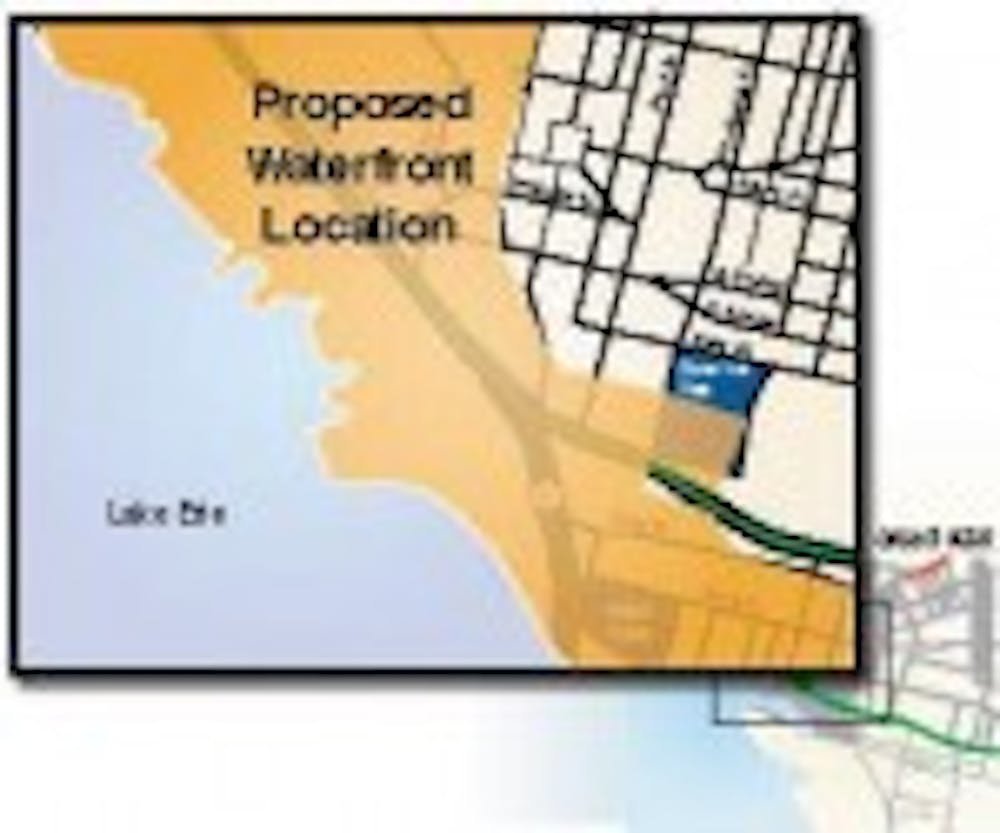
This is the second story in a two-part series that analyzes how the decision to build UB in Amherst, rather than Buffalo's waterfront, has shaped Buffalo's history and the student-community relationship. The first part can be found here.
Thirty-four years ago, New York Governor Nelson Rockefeller plunged a shovel into an Amherst swamp.
What resulted was not only a mud-splattered suit for Rockefeller, but also the start of construction on a much-needed new campus for the University at Buffalo.
At the time, the 1,200 acres on which Rockefeller stood were undeveloped, unimportant and had little to do with the bustling city of Buffalo only three miles away. A lot has changed, however, since that groundbreaking ceremony in 1970.
Land that was undeveloped is now covered with dorms, libraries, eateries and classrooms. A place that was once unimportant is now the heart of UB, a vibrant academic and social community.
And certainly with UB on it, the former Amherst swamp has a lot more to do with Buffalo now than it ever did before.
But whether UB's students have anything more to do with the city of Buffalo is a different question entirely.
A Disconnect
In the eyes of Courtney Mooney, a junior psychology major, there is no connection for most students to Buffalo, let alone anything outside North Campus. Whatever relationship does exist between the two, Mooney said, exists minimally.
"I think a lot of people don't know the opportunities," she said. "They spend their time mostly on campus. Downtown is promoted for its bar atmosphere, and sometimes you really have to know someone from Buffalo to get that feeling (that it isn't all about the bars)."
Mooney attributes the disconnection to "lack of time" and "ignorance" on the students' part, but thinks an effort to know a little more about UB and establish a connection to the city could go a long way.
"I think if you know more about the environment you're in, you're more apt to thrive as an individual and have a greater sense of being," she said.
"A lot of people have a lot of opinions about Buffalo, and most of them aren't very good," Mooney added.
Jamar Holmes, a senior communication major, is one of those people.
"That is the worst downtown I've ever seen in my entire life," he said. "And I'm from Rochester."
Holmes, who lives in Flint Village on North Campus, said he, too, doesn't see any relationship between the student body and the city, and that most students seem to just not care.
"I don't go downtown very much. There's nothing to do there," he said.
Holmes recognizes, however, that without such relationships and connections, UB students are missing out on the experiences that make college worth something.
"To me, college is more than just going to class and reading books," Holmes said.
And had UB been built on the downtown waterfront, Holmes believes the relationship between students and the city would be very different.
Sara Gargiulo, a freshman business major, also recognizes the disconnection between UB and Buffalo. But being from Brooklyn, Gargiulo said the North Campus environment is what she was looking for - something different from New York City.
"(UB) is more about getting to know the students than the city," she said.
Living on North Campus and spending most of her time there, Gargiulo said she feels much more connected to UB than anything Buffalo-related and is happy that way, but sees how such connections would enhance the experience of being a UB student.
"If you take the initiative and find out what Buffalo has to offer, there's a ton," she said.
A Dream Unfulfilled
So if students recognize the benefits of better connections and relationships to the city and even show a desire for those connections, why is there a divide between UB students and Buffalo?
"The disconnect is space," said David Franczyk, president of the Buffalo Common Council. "They're far away, and if they don't have a car, how do they get down here?"
The other culprit, Franczyk said, is the one that created the space in the first place: the 40-year-old decision to place UB's new campus in Amherst instead of downtown.
"No question about it," he said. "Moving (UB) out to Amherst was the biggest mistake made here in 100 years. And there's a whole line of bad mistakes."
According to Franczyk, those who have left the city for the suburbs have lost their idea of a "civic ethos." Plus, he said, when it comes to civic character, UB should be leading the region to bring about positive change, instead of running away from the opportunity.
"The condition of a city is an indication of the health of a civilization," said Franczyk, quoting Louis Mumford. "And our civilization is sick right now."
Robert Coles, a local architect who chaired a community group in the '60s that fought for the placement of UB downtown, echoed Franczyk's sentiments.
"It's the worst thing they ever did," said Coles. "They didn't connect Buffalo to the university."
According to Coles, even if UB wasn't placed downtown, the city's subway could have at least been extended to the Amherst campus.
"They built a $600 million rapid-transit system that runs from a dying downtown to a university campus that doesn't exist anymore," Coles said, referring to South Campus.
Wolfgang Wolck, a distinguished professor in UB's linguistics department, finds the transit situation even worse than the choice to not place UB downtown.
"What's lacking is city transport (from Amherst to downtown). That's much more serious and much sadder," said Wolck, who has been at UB since the 1960s.
Now, said Wolck, thanks to Amherst town politics, Buffalo has a subway that is "hardly ever used."
"It's either a lack of planning or no one having the clout to put their foot down and say let's do it," he said.
According to Coles, there is one big reason why the people of Amherst have always voted down running the light rail to the suburbs: race.
"The people of Amherst will not allow that rapid transit to go out there because if it goes out there, it's going to bring people that look like me out there," said Coles, who is black. "And if it brings people that look like me out there, that means - to them - crime and all kinds of stuff."
"The reason why Buffalo is in such bad shape is because the rich white people moved out. They moved to Amherst," said Franczyk.
Everyone who left the city due to "white flight" took with them the education, jobs, and other institutions necessary to support a city, said Coles.
"The only reason people come downtown most of the time is because they work there and they have to come downtown," he said.
What Still Could Be
As it is with UB's greatest "what if" story - its placement in Amherst - it's all too easy to look at the current disconnection between students and the city and see what there isn't, instead of what there is and what can be in the future.
"I think there is a tremendous interest in Buffalo, Western New York and UB. There is support. There is anticipation," said UB President John Simpson of the current community dynamics that UB and Buffalo have to work with.
"If it's the case that the students orient themselves completely towards UB and North Campus, they're missing a lot of opportunities, opportunities that are obvious," he said.
Simpson noted the arts, restaurants and music as just a few of the reasons why students should want to go downtown.
"I think the students, as citizens, should care about any place they live," he said.
According to Simpson, UB is academically connecting to the community in new ways all the time - from K-12 programs to arts and lecture series to volunteerism and internships.
He also said, like so many others who are asked how to form better bonds between UB students and Buffalo, that there is only so much the school and the city can do before it is up to the students.
"I encourage students to do that, to get out of the classroom and participate in the community," he said.
According to Franczyk, UB's academic connections are a step in the right direction.
"I met with President Simpson, and I suggested that the law school be moved back to the City of Buffalo, and he seemed to be very open to it," Franczyk said.
Franczyk said he also suggested to Simpson a doctoral program in urban planning for UB, which is in a county that suffers from the fourth worst urban sprawl in the United States. He also highlighted the potential future of bioinformatics as a positive academic connection between Buffalo and UB.
Social connections, however, can be a little more complicated to form, according to Franczyk.
"You have to make a conscious effort," he said.
Franczyk suggested the city be "more open" to students and that it advertise itself better with more events and creative incentives for the student population.
On UB's end of establishing those connections, Dean of Students Barbara Ricotta knows how important it is to grab students' attention early on. According to Ricotta, UB makes great efforts at orientation throughout freshman year - offering city tours and Buffalo Bisons games along with its many departmental academic opportunities - to build strong student-community bonds.
"Continuing and building on those relationships is the most important thing we can do. And I think we could probably still do more," she said, especially beyond freshman year.
Ricotta said UB is even working with sanitation officials in the University Heights area to better organize garbage collection of large items when students move out in May.
"Even working with the community to make changes like that is a step in the right direction," she said.
Ricotta said she doesn't entirely understand the disconnection many students have with the community and the city, though she believes the reason lies somewhere in UB's history. Her hope is that by exposing students to Buffalo's festivals, culture and architecture - through both academic and social means - not only will their educations be enriched, but their overall experience here as well.
"Unfortunately you always hear the stories about people who are leaving Buffalo, but I think there are also a lot of people who find they really like Buffalo and want to stay," Ricotta said. "It's a great place to live, so why not keep as many students here



