
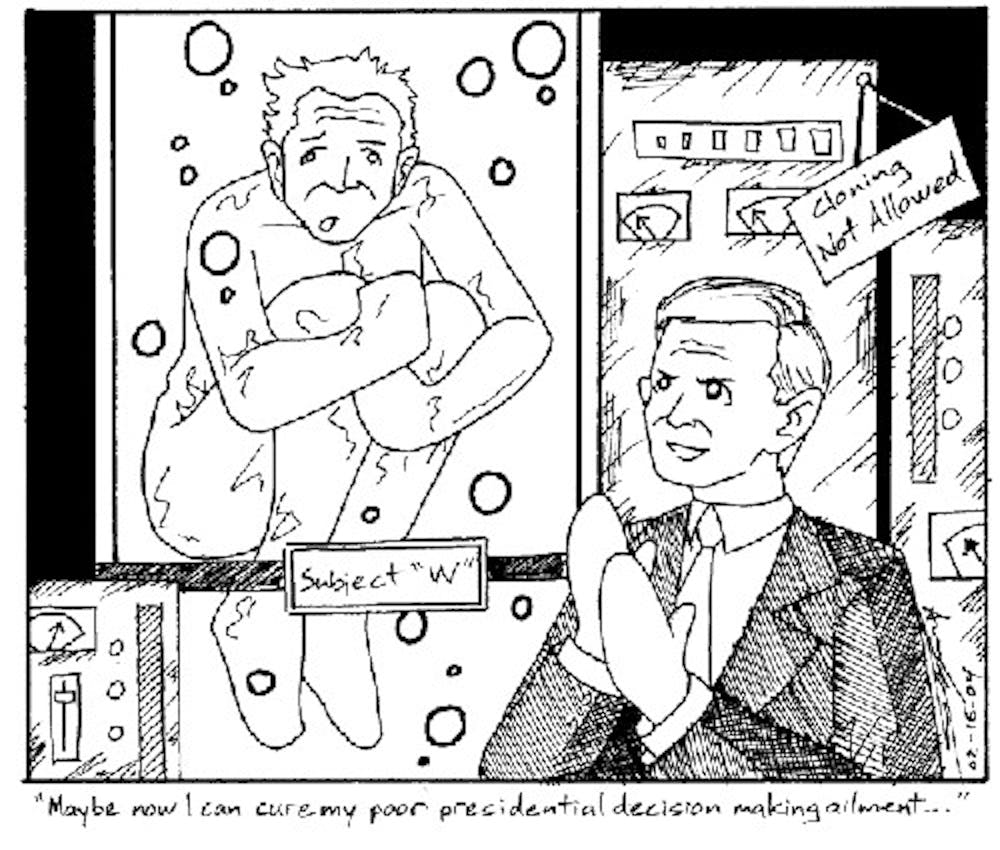
Scientists in Seoul National University, Korea, have harvested stem cells from successfully cloned human embryos. This breakthrough has once again sparked a debate over the moral issues of cloning and shows the United States is no longer the leading country in cloning research - something our country must remedy if it intends to stay up to date with the rest of the scientific world.
The Korean scientists have harvested these cells not as the stepping-stone to create full human clones, but to advance what is known as therapeutic cloning. Therapeutic cloning intends to use stem cells to find potential cures for diseases such as diabetes and Parkinson's disease.
The concept of cloning has been under fire from the pro-life community. Though therapeutic cloning does not create a living, breathing human clone in order to reap its body parts before being destroyed, anti-abortion activists still believe the cloned embryos should not be terminated. Because they believe life begins at conception, these embryos are still considered living things, and harvesting stem cells destroys the embryos.
Aside from overlap with the abortion debate, another conflict has emerged from this recent cloning success. This new overseas breakthrough shows that the United States is falling behind in the cloning research department, mainly because of numerous blockades for U.S. scientists, such as poor political support and ethical battles they must endure from the opposing community. Many religious groups find cloning an unnatural science and strongly push for the halt of the research.
There is also a huge lack of funding to support cloning. According to an article on CNN.com, the federal government limits the amount of money researchers can receive from taxpayer-funded grants, and most research is now funded through private grants.
In addition to the financial troubles, scientists cannot get the resources they need to experiment. President George W. Bush had the National Institute of Health refuse to give out funding to any research being done on stem cells harvested after Aug. 8, 2001. Scientists, however, can work with stem cells acquired before this date, but the few remaining cells they have to work with are not enough to properly squander on trial and error testing.
With the lack of enthusiasm and resources, chances are many scientists will migrate overseas in order to continue their research. Scientists here cannot compare to many of the centers in other countries, which focus entirely on stem cell and cloning research. This scientific "brain drain" will hurt the scientific community, and as more scientists decide to do research outside the United States it will be harder for the nation to catch up to the results made by scientists overseas.
The United Nations has also made it more difficult for the United States to keep up with the growing interest in cloning by not incorporating any type of worldwide cloning ban for the next two years. This decision furthers the overseas competition, many of which do not have the same political and ethical barriers that American scientists must endure.
In the next few years, if other countries' research shows that therapeutic cloning can be used to effectively save lives, the question is whether the United States will be able to catch up and recover due to its limitations placed by the government.
The U.S. must not have so many reservations on cloning if it is done responsibly. As long as scientists show good medical benefits to cloning and stem cell research and if there are no science fiction style cloning experiments, the United States should once again try to regain its title as the head of the scientific world before the crown is too far out of reach.



