
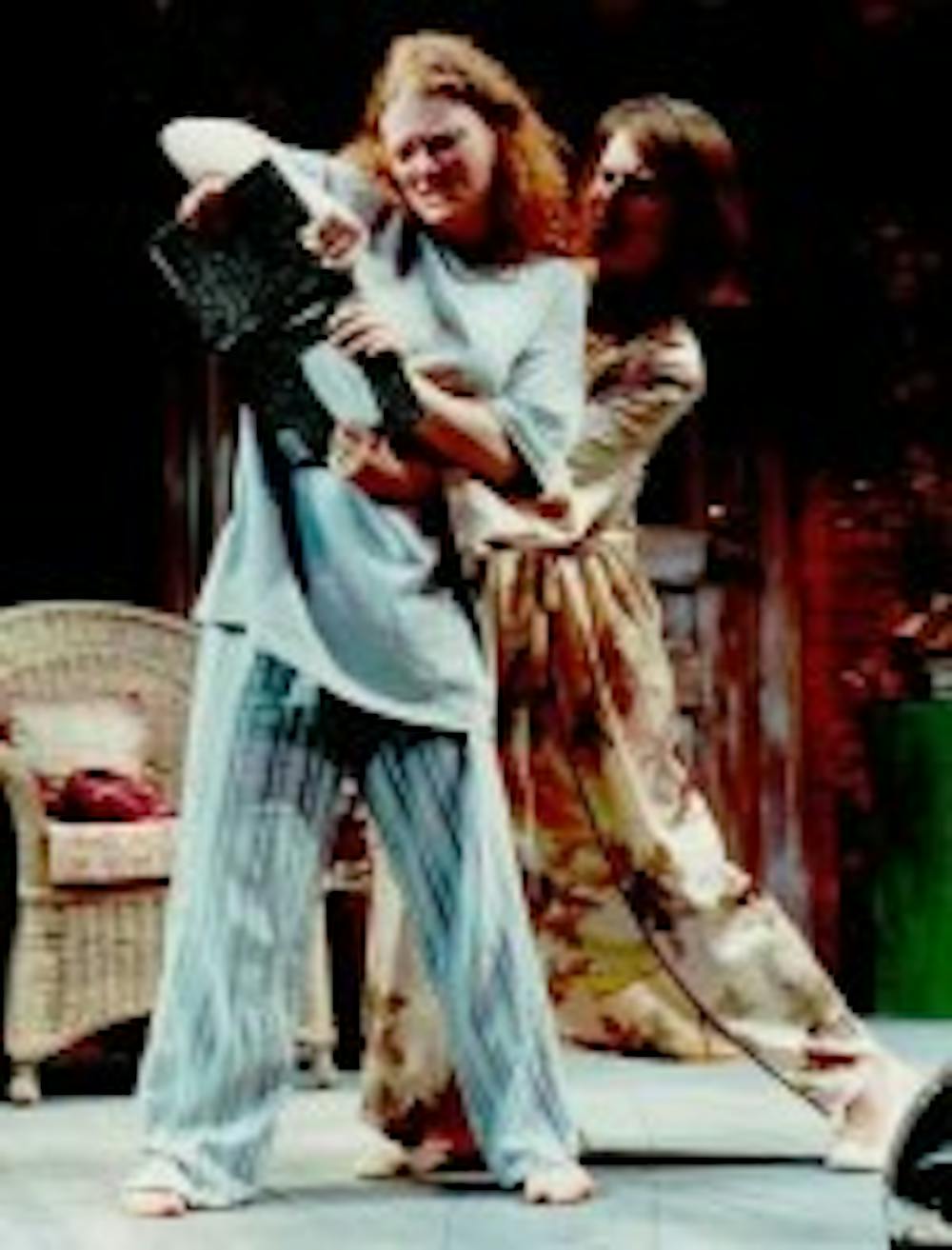
Encountering a mathematical proof on a Friday night wouldn't sound like the ideal start to a weekend to most people. It is quite the contrary, though, when that Friday night is spent seeing the Tony Award-winning play "Proof," now onstage at Studio Arena Theatre through Nov. 9.
The title is a double entendre, as the play sets its sights on family relationships, personal identity and the often-unrecognized life of mathematicians.
Written by David Auburn and directed by Jane Page, "Proof" is a realistic look at the relationship between a father of sketchy mental health and his 25-year-old daughter, who acts as caretaker for her father. A relationship existing through flashbacks and a dream/hallucination, the play begins one week after the family's patriarch, Robert (J.R. Horne), has died of heart failure.
The play is set in Chicago, and while it is takes place entirely upon the family's back porch, that hardly limits the varying situations the characters find themselves in.
Catherine (Natily Blair) is also referred to as Cathy and Katie over the course of the play. She explodes onstage with uncontrollable emotion. Having sacrificed her Northwestern University education to care for her former brilliant professor father years earlier, her disposition reflects resentment.
Cathy's older sister Claire (Patricia Dalen) flies in from New York for the funeral, sweeping in like an Eddie Bauer model and intending to pretend like no time has passed since she moved away. To Cathy, it is a nightmare come true - her overprotective sister asks prodding questions, imposes her own tastes upon her and doesn't believe a word from Catherine's mouth.
Harold "Hal" Dobbs (James Fuetterer) is the loveable nerd and rock band member. He's a 28-year-old math graduate who feels like a has-been that never was. He considers Cathy's father a great role model and pines through every notebook the "graphomaniac" kept in the final years of his life.
For Cathy, it is her bitterness and defensiveness that keeps her from her life and talents. Unfortunately her wild temper makes her appear crazy herself.
After a couple of drinks at the after-funeral house party, Cathy begins to let her guard down. She flirts with Hal and starts to act more or less her age.
"So what do you do for sex?" Cathy playfully asks Hal. This party is the turning point at which each character steps outside his or her normal role, showing a truer version of his or herself.
The morning after also brings new surprises for the audience, including Cathy's disclosure to Hal that a mathematical proof has been locked away in her father's desk. It's a fairly late point in the play to introduce a key plot point, but it is nonetheless important.
The entirety of the second act centers on deciding the ownership of the proof, proving Cathy's sanity, and showing a few heartfelt and father-daughter moments of the past that are relative to plot.
Horne plays his role as Cathy's father with style comparable to that of Jack Nicholson, and adds spice to the somewhat dramatic play. His arguments over such topics as pasta are instant classics.
"You'll be teaching younger, more arrogant versions of yourself in no time," Robert says to Hal.
Cleverly written to incorporate past, present and future in a touching way, "Proof" is dramatic enough to be taken seriously, and light-hearted enough to be thoroughly entertaining.



