
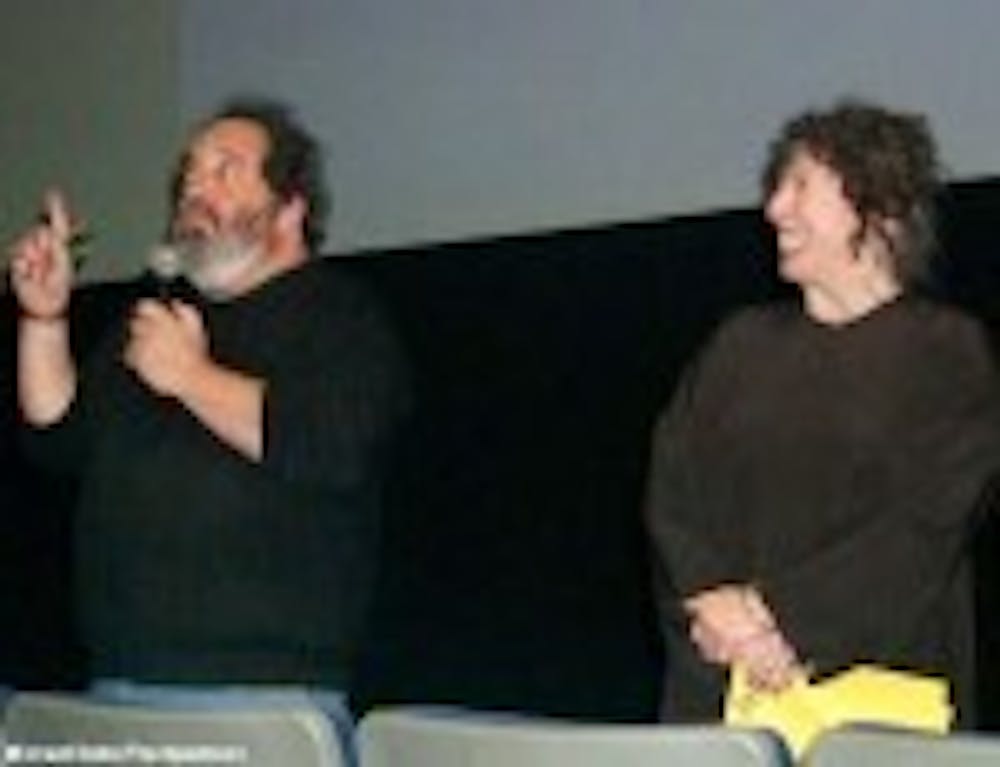
Imagine a class that takes place at a movie theater in downtown Buffalo, where UB students and members of the Buffalo community meet to watch and discuss classic films. Such a class exists, as ENG 441, "Contemporary Cinema," taught by two distinguished professors at UB - Bruce Jackson and Diane Christian.
"Contemporary Cinema" is part of the Buffalo Film Seminar, which takes place every Tuesday night of the semester, starting at 7 p.m. at the Market Arcade Theater located at 639 Main St. in downtown Buffalo. Screenings are structured to allocate time for Jackson and Christian to provide a brief description of the movie before the movie is screened. After the movie, Jackson and Christian organize a discussion about the movie that involves the entire theater in an open forum atmosphere.
The seminar originated four years ago, when the city of Buffalo approached Jackson and Christian to assist in finding a way to bring Buffalo and the UB community together.
"There was a decline of people coming to downtown Buffalo," said Jackson.
Community leaders soon asked Jackson and Christian to take a UB film course and open it at the Market Arcade, offering access to the general public.
According to Jackson, it was not long before the seminar attracted large numbers.
"Word spread very quickly," said Jackson. "We started in a smaller film room (before moving to the Market Arcade)."
According to Jackson, the Market Arcade Theater was the natural venue to hold the seminar, based on its ownership.
"The Market Arcade is owned by the city of Buffalo," said Jackson. "And the city thought that it would be good for UB to work with the city."
As stated on the seminar's Web site, www.buffalofilmseminars.com, "the Market Arcade is the only eight-screen publicly owned film theater in the United States."
UB recently donated $60,000 toward new digital projection equipment for the Market Arcade, which makes it possible to screen films such as Howard Hawks' "Scarface," Alfred Hitchcock's "Vertigo," and Martin Scorsese's "Taxi Driver," all of which were previously available only on DVD.
Adam Goldsmith, a senior communication major, said he took advantage of the Buffalo Film Seminar screening of "Scarface," though he is not registered for the Contemporary Cinema class.
"Seeing that I'm a huge 'Scarface' fan (the 1983 version, starring Al Pacino), I really enjoyed viewing the original 'Scarface,'" said Goldsmith. "However, I thought the discussion (about the film) was not that interesting. I would probably not join the class, but I would go to see the movies."
Though Jackson and Christian choose each of the fifteen movies for the seminar, they take suggestions from the students and other audience members. Past seminars have included a wide variety of films, from John Huston's "The Maltese Falcon," to Stanley Kubrick's "Dr. Strangelove."
"We try to pick great films to show in the course of 15 weeks," said Jackson, adding that the seminar does not focus on one cinematic theme. "We're more interested in (individual) films than anything."
Some students at the seminar said the discussions about the film are just as important as the screening itself.
"Bruce Jackson and Diane Christian are quite impressive (in) how they are able to answer all of my questions without hesitation," said Ross Camel, a senior psychology major.
For certain silent films, such as F.W. Murnau's "Sunrise," the seminar provides musical accompaniment to make the screening as authentic as possible.
"While at the seminar, I had the pleasure of seeing Buster Keaton's "Our Hospitality," said Todd Aferiat, a senior business major. "It was great to see a classic film on the big screen with live accompaniment."
Aferiat agreed with Camel that the discussions about the movie are an integral part of the class.
"The discussion that was conducted (after 'Our Hospitality') taught me a great deal about the movie and the history of the director, whom I am a big fan of," said Aferiat.
Since members of the Buffalo community are invited to attend the Buffalo Film Seminar, many different points of view are offered in the class discussions. As a result, senior audience members can comment on what society was like during the time in which older movies were produced.
Matthew Ringler, a senior English major, believes that the wide variety of age among the audience members is crucial to understanding each movie as a whole.
"The diverse audience is a necessary educational component to this class," said Ringler. "In order to accurately interpret these older films, we need people that have experienced those times."
"'Film is a ribbon of dreams,' said Christian, quoting legendary writer/director/actor Orson Welles, "'which speaks to larger common issues, something we all share on a global level.'"
For Jackson and Christian, screening and discussing classic films is the best medium for educating students about any topic that life has to offer.
"Film incorporates all the other arts, and because of that, they can take advantage of the gifts each of those arts offer," said Jackson. "Film can deal with any subject; from the most trivial to the most profound, from the most public to the most personal."



