
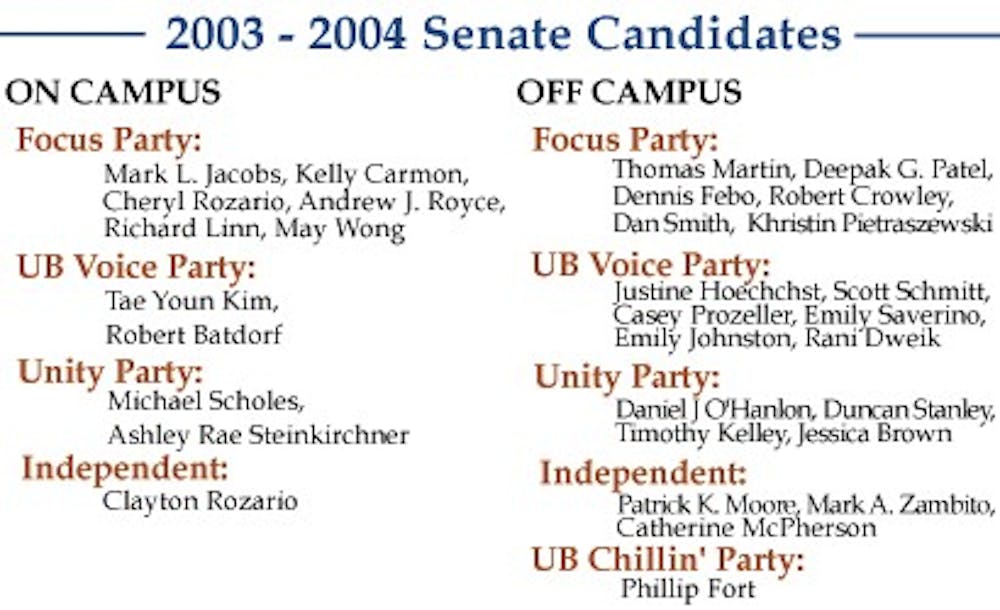
The upcoming Student Association Senate elections are becoming increasingly controversial, as one lawsuit challenges the legality of four candidacies, and one party is investigating a possible betrayal by one of its members.
Duncan Stanley, who is running for Senate as a member of the Unity Party, filed a complaint with the Student-Wide Judiciary claiming the candidacies of four State University of New York Student Assembly delegates - Dennis Febo, Cheryl Rozario, Khristin Pietraszewski and May Wong - violate the separation of powers within SA because he feels they are a part of SA's executive branch.
Meanwhile, the delegates have defended the charge, and say the suit was orchestrated by a member of their own party in an apparent act of political sabotage.
Separation of Powers
Stanley's suit, which was filed last week and argued in front of three SWJ justices Sunday afternoon, claims the four SUNY SA delegates, who were elected by undergraduates in March, are members of the executive branch and thus unable to run for legislative positions.
"There are four people who are running for Senate who should not be," Stanley said at the hearing. "(SA President George Pape) is trying to put his people into the legislative branch, which destroys the separation of powers."
Stanley provided a flow chart taken from the SA Clubs Handbook entitled "SA Executive Branch Flowchart," drawn by Pape, which listed SUNY SA as one of the divisions. Stanley also pointed out that the SA Executive Board sets stipends for the delegates.
Febo argued delegates are not part of the executive branch of SA because they are given no executive powers in the SA Constitution.
The SA constitution states, "The executive authority of the Student Association shall be vested in the president and his/her cabinet." It goes on to explicitly outline members of the president's cabinet - of which SUNY delegates are not included.
Stanley countered that the SUNY SA delegates' job descriptions are listed under the Executive Branch heading in the Constitution, thus making them a part of that branch.
Pape testified the executive board does set stipends for SUNY delegates, but once they are authorized, they are unchangeable. He added that he couldn't fire the delegates at any point, since students elect them.
Stanley said the fact that SUNY delegates have an office in 350 Student Union, along with the Executive Board and SA staff blurs the line between the executive branch and the SUNY SA delegates. According to Pape, the SUNY delegates share the SA office because long-distance phone lines and fax machines are available, and it made sense because he is the fifth SUNY delegate.
The SWJ is expected to release their ruling on the case by 9 a.m. today.
Allegations of Betrayal
During Sunday's SWJ hearing, Stanley attempted to enter several electronic conversations into evidence, which he said were between himself and Andrew Royce, a member of the Focus Party who is also running for Senate.
The three SWJ justices denied Stanley permission to enter the conversations on the grounds Royce had no knowledge they were being logged.
The four SUNY delegates received copies of the conversations, however, and discovered what they believe to be collusion between Royce, a member of their own party, and Stanley in filing the complaint with SWJ.
The conversations, which were logged on America Online Instant Messenger over the period of one week, show two people discussing plans to file suit with SWJ and have the four SUNY delegates removed from the ballot.
In a later interview with The Spectrum, Stanley confirmed the conversations were between himself and Royce, and that Royce orchestrated the suit against four members of his own party.
"I filed this at the encouragement of Andrew (Royce)," Stanley said.
The Spectrum tried repeated times to reach Royce by phone and e-mail after the hearing Sunday. Royce did not return any attempts at contact.
In the conversations, Royce stated if the four delegates were removed from consideration, his own chances of being elected would increase. He encouraged Stanley to file suit, and warned him not to mention his name in connection with the suit.
"He asked me not to speak with him in a personal way," Stanley said in the interview, referring to public contact between the two.
Stanley said he attempted to introduce the conversations into evidence because at one point Royce stated he had had a conversation with the SUNY SA delegates in which they agreed to a "compromise" wherein an amendment to the SA Constitution would take power away from the SA Executive Board to set their stipends.
Stanley said this agreement to compromise, if it happened, would show the delegates know that having their pay set by the Executive Board is wrong.
Stanley said he knew the transcripts would expose Royce to his fellow Focus Party members, but said he felt no loyalty because Royce, who originally founded the Unity Party, left abruptly to join the Focus Party.
Febo said that upon reading the transcripts, the delegates repeatedly tried to contact Royce, but he did not answer his phone. He was in the meeting when Stanley attempted to enter the conversations into evidence, but left immediately.
The SUNY delegates said they feel betrayed, and now question the motives of a complaint they earlier regarded as reasonable.
"Just to know it (the complaint with SWJ) was done out of malice and not concern for the students is very disturbing," said Rozario.



