Skip to Content, Navigation, or Footer.
The independent student publication of The University at Buffalo, since 1950

News

NEWS

CHAOS ON NORTH CAMPUS

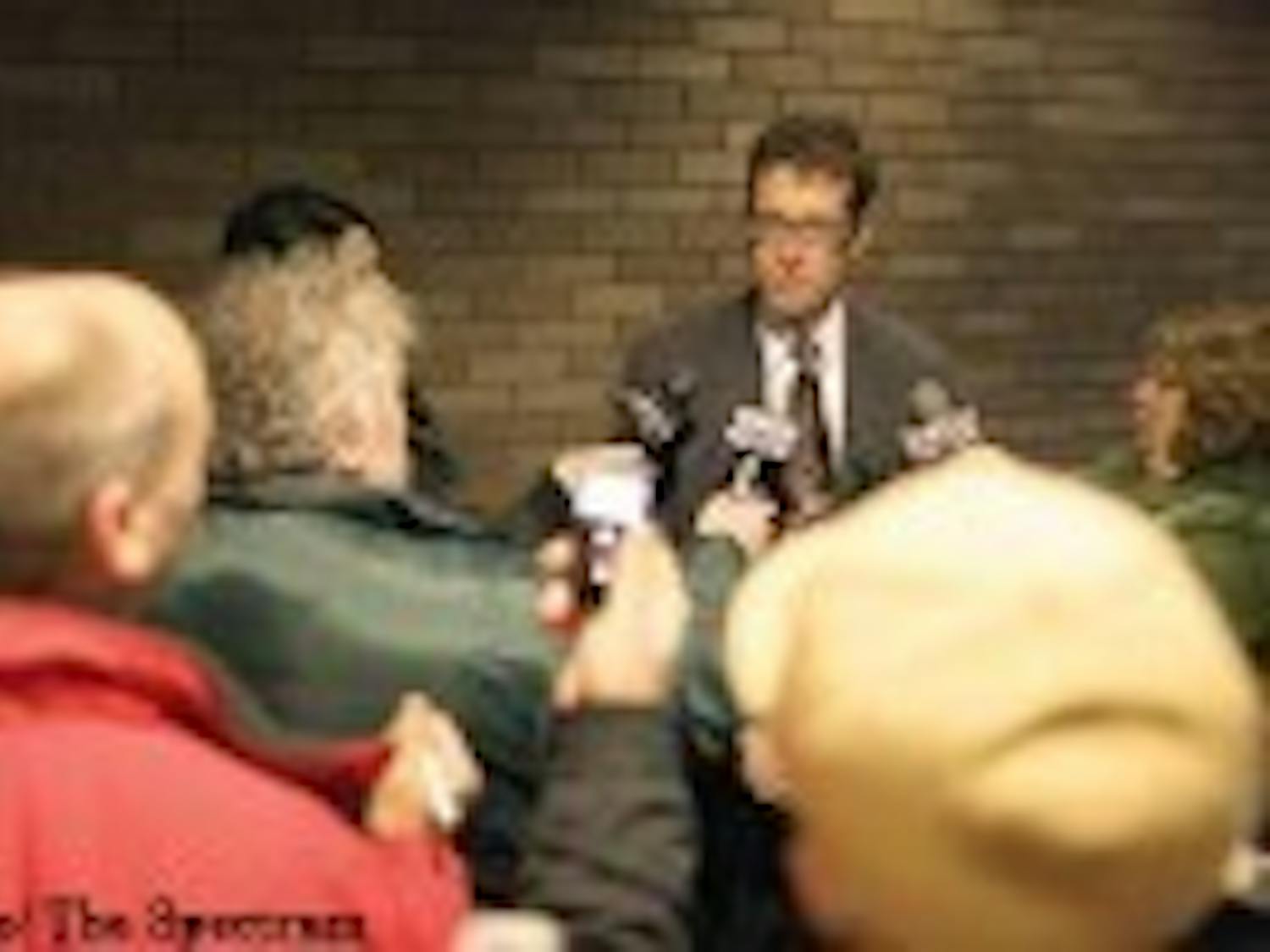
Members of the UB community can breathe a sigh of relief today after reports of a possible gunman on North Campus could not be fully verified. At 4:05 p.m., officers from the University Police Department received a call from a student at Lockwood Library, where there was a possible sighting of a man with either a rifle or a shotgun under a navy pea coat. According to Gerald W. Schoenle Jr., chief of police, the call resulted in officers' arrival at the site and the use of security footage from the building, which showed the possible suspect with something under his jacket, although what it was remained unclear. 'We went to a video and we immediately saw someone walking into the library that was right at the location where the suspect said there was a person that had a weapon,' Schoenle said. 'We were able to zoom in on those cameras and see a person in a very grainy video, that you certainly could not identify, who was carrying something that sort of fit the description, so that elevated our concerns a little bit.' The library was evacuated at 4:40 p.m. and a campus-wide alert was sent to students in the form of a text message at that time, asking them to stay away from the building. While the initial evacuation was in process, confused and interested students gathered around the library while police began to enter the building. Many were concerned that they were too close to a building where a possible gunman was on the loose. 'We would have acted totally differently [with an active shooter] than we acted in this case,' Schoenle said. Rumors about the incident were appearing on social networking Web sites such as Facebook and Twitter, mentioning hostages, missing police officers and a vague description of the suspect. Molly Wright, a senior business administration major, was sitting in her market research class in Alfiero Center when she received the text message. 'I showed the people sitting next to me and initially thought nothing of it,' Wright said. 'I just assumed it was a gas leak or something. I figured if something was seriously wrong, they would evacuate the campus.' The evacuation of the building did not cause a panic for students that were forced to leave, according to John Curaba, a senior business major. Curaba was on the third floor of the Student Union when he received notification of the evacuation. After looking out toward Lockwood Library, he was surprised by what he saw. 'It was kind of calm,' Curaba said. 'No one really knew what to think.' Alice Park, a senior nursing major who was in Lockwood Library at the time of the evacuation, said that the process was very quick. 'I was studying in the third-floor study room and the police came in and asked us to evacuate, saying there was some sort of an emergency,' Park said. 'I asked what was happening and they wouldn't disclose any information.' By 5 p.m., officers from the Amherst Police Department joined the UPD in its efforts to search the premises and fully evacuate the building. In addition, police created a perimeter around the area, which also resulted in the closure of Putnam Way between the library and the Alfiero Center. Police officers geared with assault rifles and bulletproof vests then entered the building through its main entrance to conduct a thorough sweep in search of the alleged gunman. A video of multiple police officers searching the Cybrary was leaked on Twitter and Facebook by an unknown source. 'I looked up in a window later when I was walking outside and I watched a cop kick open a door and go inside with his rifle,' Curaba said. 'I asked another cop and they said he couldn't find [a gunman] at all.' With a search still ongoing at 5:40 p.m., members of UB's senior administration felt that it was in the best interest of students to cancel all classes on North Campus for the remainder of the evening. '[We] decided … to cancel classes because there was a lot of concern on campus,' Schoenle said. A press conference was held at 6 p.m. by Joe Brennan, vice president for University Communications, which outlined what was known about the events during the late afternoon. 'The police have established a perimeter around Lockwood Library and are advising people to stay out of it so they can conduct their search,' Brennan said. But the main search didn't last long. By 6:30 p.m., officers from the Amherst Police Department left the scene because they felt that the threat was 'under control,' according to a UPD officer who spoke on condition of anonymity. As the final search by UPD officers began, there were still a sense of confusion throughout the UB community. Reports from students said that both Capen Library on North Campus and the Health Sciences Library on South Campus were closed during the early evening, but there was no immediate threat at either location. In order to coordinate a thorough search, Schoenle contacted off-duty officers to immediately come in, in addition to pulling officers from South Campus onto North Campus. 'Our emergency recall plan worked perfectly,' Schoenle said. 'Officers we hadn't even called yet got the text. We had 20 [off-duty] officers to assist us in searching the library.' To replace the lack of a university police presence there, Schoenle contacted the Buffalo Police Department, which supplied patrols to the area. At 8:15 p.m., Brennan addressed the media again, notifying them that the search for a gunman was completed and that no one was found in the building. 'Police have determined that there is no threat to campus and that it will be safe to resume activities, so classes will resume,' Brennan said. 'Safety and security of our students, faculty, staff and visitors is a top priority. We're glad that … it ended up being no harm to anybody.' Schoenle said that while no gunman was found, investigators will still be reviewing video from Lockwood Library and that police presence will be increased on North Campus until further notice. Stay with The Spectrum for complete coverage on the incident at Lockwood Library. E-mail: news@ubspectrum.com


NEWS

Watching two worlds collide

Someone passing by the Student Union Theater on Feb. 6 might have assumed from the sounds of scattered, sporadic applause that a small, unenthusiastic group was gathered inside. However, this could not be further from the truth. ASL comedian Keith Wann took the stage last Friday to Deaf applause, which entails waving both hands silently in the air. From beginning to end, he had both hearing and deaf viewers in stitches. Francisco Olivera, a Peruvian ASL comedian and Taylor Lautner lookalike, opened the show, with Wann providing a translation. 'I know what you're thinking,' he began. 'How did UB afford Jacob Black from the new Twilight movie?' Olivera signed about his experiences becoming an interpreter and the difficulties he had in making his sign language look authentic. Olivera has been performing with Wann for one and a half years. 'I love it; I wish I could do it full time,' he said. When he's not performing, Olivera works as a video relay interpreter – someone who translates telephone conversations between deaf and hearing people. 'I'm also a writer. I'm working on my epic poem – ‘Ode to Cookie Monster,' Olivera said. Wann took the stage next, to both Deaf and audible applause. With Olivera acting as his interpreter, Wann signed about the differences between hearing and Deaf families, peppering the show with hilarious anecdotes about how his mischief-making got him in trouble over the years. One of his best tales was about the incident that got him banned from Deaf church. He explained that Children of Deaf Adults are called upon to interpret so much that they tend to shorten most messages. When his father asked him to translate a lengthy explanation of how sinners will be condemned to hell, Wann's response to the hearing student was, 'My father says, ‘Go to hell.' Wann also incorporated music into his show by illustrating the difficulties involved in translating songs such as 'Baby Got Back' and 'Ice, Ice Baby.' To prove this point, he asked for two student volunteers to come up and be taught how to sign 'That's the Way I Like It.' Deirdre Carter, a sophomore accounting major and one of the volunteers, found the experience to be enjoyable rather than embarrassing. 'It was a welcoming atmosphere … Keith did a great job of setting the crowd's mood and I felt comfortable being engaged with the performance,' Carter said. 'I felt a little nervous about my signing, but I looked out into the audience and saw that the Deaf community was jut glad to see that we were having fun on stage. After a few seconds, I was having a whole lot of fun.' Wann has been performing his comedy show for 10 years and can't imagine doing anything else. 'It's what I do for a living,' he said. 'I've done lots of shows; I love hearing the laughter, I love hearing people relate. I do it for other CODAs, but there are things everyone can relate to.' Both Wann and Olivera agree that Buffalo is a wonderful city to visit and that the Anchor Bar chicken wings are the best part. Olivera, who lives in Florida, also enjoyed seeing snow for the first time. The audience, both hearing and deaf, was extremely enthusiastic throughout the whole show. 'They're super. [I loved] everything – they made me laugh [through] the whole show,' said member of the Deaf community Debbie Salruto, 47, of Williamsville. Ryan Julius, a 14-year-old CODA from Buffalo, let it be known before the show that it was his birthday and was publicly congratulated by Wann. Julius enjoyed the show and felt that it was very relatable. 'I loved the deaf driver part – it was very true,' he said, referring to Wann's bit about deaf drivers using their knees to steer so their hands would be free to talk. 'I would go back [to one of Wann's shows].' Julius's friend Elizabeth Laubenthal, 13, enjoyed the show as well, despite having no ties to the Deaf community other than Julius. 'It was good; I liked the songs,' she said. Despite not being able to relate personally to the jokes, Laubenthal felt that the show was 'funny; I would go see it again.' Emily Glenn-Smith, a professor of ASL who helped the ASL Club organize the show, was very pleased with the way the event turned out. 'CODAs, students – everyone loved it. It was about half and half [deaf and hearing]. One man said, ‘We need to have this kind of thing more often; we need to educate people in a fun way,' Glenn-Smith said. E-mail: features@ubspectrum.com


The Spectrum
NEWS

Ex-UB researcher faces jail time after falsifying testimonies

William Fals-Stewart, a former researcher for the UB Research Institute on Addictions, faces criminal charges for allegedly hiring actors to act as witnesses on his behalf at a misconduct hearing. Fals-Stewart was arrested on Tuesday and charged with attempted grand larceny, three counts of perjury, three counts of identity theft, two counts of offering a false instrument and three counts of falsifying a business record, class C, D and E felonies, respectively. The maximum permissible sentence is 15 years in prison. According to representatives from Attorney General Andrew M. Cuomo's office, Fals-Stewart 'was exonerated of the misconduct because of the false testimonies, then attempted to seek $4 million from the state by suing UB for monetary damages.' Fals-Stewart sued UB for damages to his reputation. In response, Cuomo's office began investigating this claim. It was during this time that officials discovered the alleged fraud, which initiated a criminal investigation and forced Fals-Stewart to withdraw his lawsuit. Allegedly, Fals-Stewart hired professional actors to play real people who were familiar with his research practices. The actors were told by Fals-Stewart that they were partaking in a mock trial. The actors had no idea they were at a real hearing or even that they were impersonating real people. Fals-Stewart paid them and provided them with scripts, which were full of inaccuracies in regard to his research. In September 2004, Fals-Stewart, 48, of Eden, was accused of scientific misconduct while working at UB. Fals-Stewart allegedly fabricated data in federally funded research projects. There were discrepancies between the number of volunteers he reported to the National Institute for Drug Addiction for grants and the actual number of volunteers. Fals-Stewart was also the reason that SUNY found itself under investigation for the misuse of federal research funds. Last September, the university found itself under federal scrutiny after Fals-Stewart complained that the institution was mishandling research money. He filed these complaints after he had been removed from his job at UB and after his misconduct trial. 'The charges in this case allege a pattern of lies and deceit that a public employee used to attempt to defraud New York's taxpayers of millions of dollars,' Cuomo said. 'The brazen crimes allegedly committed by this individual outline a series of frauds that could have damaged our outstanding SUNY system.' Cuomo also thanked SUNY Chancellor Nancy L. Zimpher and her staff for assisting in the investigation. Russell T. Ippolito, Jr., assistant state attorney general of the Buffalo office, is prosecuting the case. E-mail: news@ubspectrum.com


The Spectrum
NEWS

How safe are you?

At 4:40 p.m., the phones in The Spectrum office began ringing off the hook. 'Have you heard? Lockwood Library has been evacuated!' said the callers. A million different scenarios ran through our heads. Bomb threat? Fire? Another college campus shooting? Was UB destined to be the next Virginia Tech? We didn't know. Rumors spread like wildfire around campus. Assumptions and rumors exploded from social networking sites as a result of silence from police and UB. Even Generation Magazine's Twitter account was reporting unsubstantiated information. There were talks of a gunman, a student with a knife, student hostages, missing faculty and staff, and even potential evacuation of the entire campus. We didn't know what to think. The University Police Department, which was clearly occupied, wouldn't confirm anything and the chaos surrounding the scene in front of Lockwood didn't leave much substantial information to work with. It's frightening that we were updated sooner by social media than by the university and police, who are supposed to inform and protect us. No one knew what was going on. Some students were panicking, while others brushed the incident aside. No one seemed to know quite how seriously to take the situation because no information was being released and no questions were being answered. Simply put, police and UB personnel did not properly inform students as to what was going on. The Spectrum received countless phone calls from students asking about the situation and whether they were safe. UB did send out alerts through e-mails via various university listserv accounts, but that led to confusion. The problem was that everyone seemed to receive these alerts either at different times or not at all. One of us received the first alert e-mail at 5:16 p.m., while the other didn't get it until 5:45. Why the lapse? Even more so, why did it take almost an hour to tell students? The police were called to Lockwood at 4:05 p.m. Shouldn't students have been notified much sooner? If there's an alleged deadly weapon on this campus, we'd like immediate notice. Forty-five minutes is a lot of time for an armed person to mobilize, even if police are on the way. We'd like to have the time and the opportunity to save our lives. UB Provost Satish Tripathi said in a university-wide e-mail (that hopefully all of our readers received) that 'the safety of our students, faculty and staff is always our primary concern.' Really? We're pretty sure we saw students frolicking about campus within shooting range of Lockwood long after police allegedly secured the building. Our Editor-In-Chief was inches away from walking into the building. Students were being told to leave Lockwood, but that's it. Clemens Hall wasn't evacuated, nor was Baldy Hall – and they both directly link to Lockwood with sky-bridges. Why? We'd like to know. If the building was under lockdown, why were students still walking right through Lockwood without any knowledge that they were within feet of potential danger? Put plain and simply, this alert system has huge flaws. E-mail and Web site updates are not enough. Not every student has Internet access every second of every day, and not every student is signed up for text alerts. When racing from Alumni to NSC for their next class, how are students supposed to stay updated on campus emergencies? Public address systems were invented long before the Internet; sometimes it's okay to rest on your laurels. If the university can make an announcement canceling class, why can't it announce an important safety concern? We get that police and UB officials don't want to spark rumors, riots and chaos, but some form of universal notification is imperative to everyone's safety. There's a difference between keeping students safe and keeping the university's image safe. There's a way for information to be released safely and efficiently. UB is a school with endless resources. It can afford to figure something out. Luckily, this situation turned out to be non-life threatening, but honestly, from what we saw today, it was a criminal's field day. Despite several press briefings throughout the evening, many questions remain unanswered. UB is on the spot. It's do or die time – literally. With more and more students coming in every semester, UB needs to seriously reevaluate its security system and protocol. Many of UB's buildings were built 40 to 50 years ago and were designed specifically to quell riots, but it's not 1970 anymore. We need a new system. We need an upgrade. Students deserve to feel safe and, more importantly, be safe. E-mail: news@ubspectrum.com


NEWS

Bulls slammed by Chippewas

It's difficult to face a team that is in the top ten in the nation, especially when you're missing your best wrestler. After honoring the team's seniors in conjunction with UB Senior Day, Buffalo (8-7-1, 1-3 Mid-American Conference) faced off against No. 6 Central Michigan (15-2, 3-0 MAC). The day began much like it ended and the Bulls fell 35-3 at home Sunday afternoon. The dual match started with senior Dan Bishop's final match at Alumni Arena. The opener was a close match with many takedowns and illegal maneuvers throughout, but in the end, Bishop lost 6-3 to Matt Steintrager despite his late surge in the third period. Unfortunately, the day did not get any better for the Bulls. Central Michigan went on to win seven more consecutive matches, including two technical falls. 'Well, anytime we lose we feel horrible,' said head coach Jim Beichner. 'If you train hard and you get beat hard, it's hard to lose no matter what the score is.' The Bulls sole win came in the eighth match after losing in a 16-0 technical fall. In the 184-pound bout, redshirt freshman Josh Peters sealed a 4-1 victory against Central Michigan's Dillon Kern with a takedown in the third period. Junior Jimmy Hamel came close to following this up at the 194-pound bout, however, an escape by Central Michigan's Eric Simaz in the final minutes resulted in a 5-4 Bulls lost. By taking eight out of the 10 matches, Central Michigan demonstrated why they are nationally ranked. 'Year after year they are a top five, six or seven team in the country,' Beichner said. 'And if their full lineup is in as it was today, they are [definitely] one of the top five in the country, and they looked like it.' Beichner believes that the highlight of the match was the team's hardnosed wrestling. One such display came from senior Andrew Stella's battle against Central Michigan's Steve Brown, who is ranked 14th in the nation. Stella scored the first two points with a takedown, however, two takedowns and two escapes later gave Brown a 6-3 win. Stella's aggressiveness did show that the Bulls were not out of the contest yet. 'I thought our guys wrestled very disciplined,' Beichner said. 'In some weight classes we were just a little outmanned and in other weight classes we battled extremely hard and fought hard. There were a lot of good efforts there, just not enough to beat that team.' Unfortunately, there were also some questionable maneuvers in some of the matches. This was particularly apparent in Bishop's opening match. '[Bishop] I thought was getting cheap shotted,' Beichner said. '[Steintrager] was doing some things that I thought were potentially illegal or dangerous. [Bishop] didn't take it and he fought back. We lost a hard fought close match.' Biechner stated that sophomore Kevin Smith and Hamel both displayed effort in their matches despite not winning. He also felt that Stella had a legitimate shot at beating his opponent had he really given 100 percent throughout the match. The coach explained that his team would make adjustments in order to face an opponent such as Central Michigan in the MAC Championships. Beichner also believes that the return of currently injured sophomore Desi Green will help them a lot. '[Green] wasn't in the lineup,' Beichner said. 'He'll be in the MAC Championships. When he gets back, we'll be even better in the [149-pound] weight class.' Until then, the wrestling team has to contend with the bitter taste of defeat handed to them by one of the top teams in the nation. 'The team feels lousy right now,' Beichner said. 'You can't feel good when you lose. I don't care who you are or what the situation is [but] if you feel good when you lose, there's something wrong.' The wrestling team travels west to face MAC-rival Northern Illinois next weekend at 2 p.m. E-mail: sports@ubspectrum.com


The Spectrum
NEWS

Bring Division I hockey to UB

Buffalo is a hockey town. As a Buffalonian, it took me a long time to accept this fact. I have always been in denial because basketball is my first love, but Buffalo does not field a professional team in the NBA. If I were to be a Buffalo sports fan, I knew I would have to jump on the hockey bandwagon. Buffalo is a city swarmed by the most dedicated hockey fans. But putting fanatics aside, it is also home to some of the countries' most talented youth hockey players. Western New York has a vast network of hockey programs, from mini-mites to junior divisions, which have produced a handful of professional talents through the years. Buffalo area natives currently playing in the NHL include Olympians Patrick Kane and Brooks Orpik, as well as Nick Foligno, and Lee Stempniak. Tim Kennedy and Angola's own Patrick Kaleta were fortunate enough to land on the roster of their hometown Sabres. Buffalo can arguably boast more homegrown talent in hockey than it can in any other major professional sport. Which leads to me to ask – why does the University at Buffalo not have a Division I hockey program of its own? I acknowledge that it wouldn't be an easy task to acquire a hockey team. Building a Division I program from scratch requires a lot of investment and support. Financially, a men's hockey program could demand nearly as much money as our football program currently costs. A hockey program would also need to enroll in a different athletic conference, as the Mid-American Conference does not currently support hockey. While it would be costly, it can be done. Niagara and Canisius athletics compete in the Metro Atlantic Athletic Conference, but their hockey programs play in the College Hockey America and Atlantic Hockey conferences. Adding to the financial burden is the necessity for a Division I hockey program to make an arena of their own. With no rink on campus, the university would be required to construct an entirely new arena. Playing at the nearby Amherst Ice Rink (formerly known as the Amherst Pepsi Center) is unfortunately out of the question because it isn't on campus. Finding the space for a second arena would be difficult enough, let alone the cost of building and maintaining one. Cost aside, however, I believe the pros outweigh the cons. Some programs might have to be cut or forced to spend less, but so what? Would you rather have an array of mediocre teams or a smaller number of competitive programs that have the potential to consistently win on a regular basis? Buffalo athletics has just two total MAC Championships since joining the conference in 1998. With a recruiting gold mine in our own backyard, a hockey program would certainly be in contention for a national championship with a few years of work. In 2005, Gene Corrigan, whose worked as Athletic Director at Notre Dame University and President of the NCAA, published a report after conducting an assessment of UB's athletic program. A portion of Corrigan's report is as follows: 'UB needs to consider a reduction in the number of its intercollegiate sports, focusing on sports with the best opportunities for success. The University should also consider adding sports that have a potential for success due to location, facilities, or expertise, such as hockey or lacrosse.' While the report recognizes UB's lack of a campus hockey rink as the main financial obstacle, I propose the use of Alumni Arena. Why not convert our current athletic facility into a hockey rink? Arenas across the country – including Buffalo's own HSBC Arena – support multiple sporting events under one roof. While it would also be costly, converting Alumni is quite possible. For now, I'll stick to watching the Sabres, but the idea of a Division I hockey program at UB needs to be seriously considered. E-mail: luke.hammill@ubspectrum.com


The Spectrum
NEWS

The great divide

As I near the front counter at CVS Pharmacy, I can't help but make a face when something always involuntarily catches my eye: loud neon covers with photo-shopped actresses and obnoxious headlines such as, 'Best SEX ever,' 'How to turn him on' and 'Romp your way to a new weight!'


NEWS

On the hunt

After completing their grueling undergraduate career, many students still lack the necessary networking, conversing and planning skills needed to land the perfect career away from campus. The Black Student Union hosted the BSU Distinguished Speaker Series on Wednesday, designed to inform students entering the workforce about skills that employers are looking for in potential employees. Adia Jordan, a UB graduate and former BSU member, came to speak about professionalism and ways to land a desired job using the skills learned in college. 'There are a lot of different things you can do with your major,' Jordan said. 'You just have to ask … a question equals growth.' Jordan graduated from UB in 2004 with a bachelor's degree in communication and currently serves as the communications associate for New York State Assemblywoman Crystal D. Peoples-Stokes in Buffalo, NY. In addition to owning First Lady Enterprises, an event planning and public relations consulting firm, Jordan also serves on the Minority Women Business Enterprise, Labor, Cultural Tourism, Health, and Criminal Justice committees. The development of First Lady Enterprises stemmed from Jordan's involvement with BSU while at UB. Jordan served as the activities coordinator for the club, where she identified event planning as one of her passions. 'Learning a transferrable skill is important,' Jordan said. 'You never know [if it could become] a job opportunity.' While some believe Buffalo lacks the opportunities for work after college, Jordan argues that with proper networking skills and a degree of proficiency, there are many opportunities. 'Make your own business card,' Jordan said. 'It's important to be memorable. It takes more than reciting a resume to a future employer. Set yourself up for professionalism.' As a former BSU e-board member and Delta Sigma Theta sorority member, Jordan explains that the connections she made while in college helped her find a position in the field she was interested in. 'Never say that the people you meet in your lifetime are not able to help you,' Jordan said. 'People in BSU really helped me because we worked as a team. Just because you have a relationship with someone in college, doesn't mean that the relationship can't grow and it doesn't mean that you won't need it later in life.' Jordan recommends reading Business First and also suggests the 2010 Book of Lists. She believes it's necessary to target those companies destined for success and know about the major competitors in the area. 'You are only as good as what you research,' Jordan said. 'There are companies that are really making it happen here. There are resources.' Jordan emphasized the importance of community activism, club involvement, and internships. These experiences tend to prepare applicants for the workforce, she said. The next Distinguished Speaker event will feature Antwan Diggs on money management and will be held on Wednesday, Feb. 17. For more information, visit the BSU's office in 307 Student Union. E-mail: features@ubspectrum.com


NEWS

Students react to alleged gunman

Students surrounded Lockwood Library on Tuesday, curious about the rumors that they had heard. Once word of an alleged gunman in the library got out, students hit the social networking sites, cell phones and e-mail looking for answers. Many stories circulated, but no one knew what was truly going on in the six-story library. Joe Brennan, vice president for University Communications, stated in a press conference that police became aware of the situation and evacuated the building around 4:30 p.m. Students began spreading word about the evacuation and alleged gunman via social networking Web sites around the same time. There were few police securing the area in the early stages of the incident, as many were evacuating the building and investigating the situation. Students easily walked up the Lockwood Library stairs or through the building's courtyard, but those aware of the situation were worried. 'I walked up in there and asked a cop what was going on. He said that someone [had] a shotgun. There are cops everywhere with M5 rifles,' said Ahmed Attoh, a senior electrical engineering major. Ann Marie Awad, a senior English major, was working in Lockwood's Cybrary at the time of the event. 'One of the pubsite managers came into our office and said, ‘The cops said we got to get out,' ' Awad said. 'We looked outside and everyone was getting their stuff and leaving. They evacuated us into the hallway and then we stood in the hallway for a little bit, and they locked up the Cybrary. Then they told us we had to get out of the building.' Awad was just one of many students sitting in the Baldy walkway near Lockwood with little information about what was going on. A number of the students in the area were waiting to find out when they could get back into the library, while others seemed to be drawn to the area because of the story. The UB alert system sent out a text to students, notifying them that Lockwood was being evacuated at approximately 4:45 p.m. Jennifer Kane, a senior psychology major, was in a class in Clemens Hall when she received that text. 'My teacher didn't know what was happening. We saw the police going to Lockwood and we kind of figured it out,' Kane said. 'We told the teacher and he continued on with class until after everyone knew classes were cancelled. He let us out around 6 p.m.' Although Kane was happy with the action taken to secure the library, she was dissatisfied with how security on the rest of the campus was treated. 'It was good that the police evacuated Lockwood so fast, but it was disconcerting that they didn't come to our class to let us know what was going on,' Kane said. 'We didn't know if we should be evacuated, considering Lockwood is attached to Clemens. No one really knew if we should be let go or if we should be on lockdown, too.' After she became aware of the entire situation, Kane was worried about her safety. 'You never know with something like that,' Kane said. Charles Anzalone of University Communications believed that the regular protocol was followed to alert teachers of the incident. 'I think that the normal emergency alert system went out, so that is probably how they were notified,' Anzalone said. An e-mail was sent to UB employees from the University Communications Division of External Affairs at 4:54 p.m., giving them the same information as the text that was sent out. Students received that same e-mail at 5:16 p.m. The perimeter of Lockwood was tightly secured around 5 p.m., and students outside were told to go indoors or clear the area. Police armed with assault rifles told students they could not leave through the eastern doors of Alfiero Center, as they were holding a position. Inside Alfiero, students' emotions ranged from joking to scared as heaps of students crammed together and waited to see something take place through the second story windows of the library, directly across Putnam Way. At 5:45 p.m., students were informed through an e-mail that classes were canceled. Though the situation and the safety of the area were unknown even to the police at that point, some students thought they should have been told earlier. 'I don't really like the way it was handled. I mean, I get a text from them saying Lockwood is under police lockdown, but they don't explain why. Then I find out there is a possible gunman on campus, but still have to wait a couple more hours before they decide to be done with classes,' said Daniel Kimble, a senior business administration major. Daniel Dimillo, a senior architecture major, was in the Health Sciences Library on South Campus at 6:20 p.m. when someone came over a loudspeaker alerting students to stay away from the North Campus. That same person came back on about 10 minutes later saying that the South Campus library was closing at 7 p.m., as opposed to the regular closing time of midnight. Dimillo arrived on North Campus around 7 p.m. and saw that police were still patrolling the area. 'From what I saw, cops seemed to have it pretty secure, but I saw some people just walking around other buildings,' Dimillo said. 'They had plenty of support there, like Amherst cops and Buffalo cops, but I think I could have walked into any building if I wanted to.' Although Dimillo thought the officers' security was not as strong later in the evening,g he did think that the university successfully alerted students. 'They were pretty vague in their statements, but they did send two e-mails as soon as I started hearing about it,' Dimillo said. 'They were pretty informative.' While the UPD's search of the building determined that the area was secure, it increased patrol and kept Lockwood closed for the remainder of the evening. UB's alert system was tested and students were affected, but ultimately, the school can use this as an opportunity to see where its safety measures can be improved. E-mail: news@ubspectrum.com


The Spectrum
NEWS

Spectrum Playlist

With the Winter Olympics now underway in Vancouver, it is so easy to see why the United States of America is the best country in the world.


NEWS

Daddy's home

Bioshock is back and this time it's packing more plasmid-pumping, gene-splicing, over-the-top action than ever before – all of it served from the prototype ‘Big Daddy' himself. The in-house development crew at 2K studios worked internationally to make this game as dark, or even darker, than the first. But like all metal juggernauts, this game has a few exploitable weaknesses. For those new to the franchise, this game may not appear to be anything special. Yet, delve into the city of Rapture for a few hours and the difference between this game and other shooters will become noticeable. The biggest feature of this game is the use of the super-substance ADAM to wield plasmids. These plasmids are bio-enhancements meant to give the user superhuman powers, like telekinesis or the ability to shoot lightening. For returning players, the best news about the sequel is the ability to have both a weapon and a plasmid out at the same time. Sadly, these plasmids don't become powerful until about mid-game, which makes for much more difficult gameplay. However, players will get a chance to use Subject Delta's drill, which dishes out quite a beating. Whether it's directed at another hopped-up gene-splicer or the new Big Sisters, the drill is the bread and butter of the player's arsenal. The game developers made the use of this weapon more difficult by making it run on drill fuel, a sparse commodity in the submerged apocalyptic Mecca that is Rapture. Thankfully, every gun in the game comes with its own unique melee move, similar to a Left 4 Dead push back. The melee doesn't inflict an incredible amount of damage, but can give the player a bit of space to work with. The game's plot is enthralling from the moment the player picks up the controller until the credits; Bioshock 2 isn't lacking in story department. Focusing on retrieving Delta's little sister, the story begins by showing the game's antagonist Sofia Lamb, a psychotic psychologist with dreams of total control. Without giving away too much of the game's artfully crafted plot, Sofia Lamb wants Subject Delta dead, and she succeeds. The game begins with Subject Delta's forced suicide, as Lamb attempts to take back her daughter, Eleanor. Resurrected eight years after the events in Bioshock, Delta sees that Sophia Lamb has become the new leader of Rapture after the death of Andrew Ryan. Let's just say that Lamb has a pretty deadly sense of the word 'community' as she rallies the inhabitants of Rapture to hunt Delta. The game is polished, yet it lacks a certain dynamic to help new players get into the franchise without getting incredibly lost. The game can be overwhelming at times, as it throws the player into the action. Hordes of splicers will attempt to kill your little sister while she tries to harvest the all-important ADAM from seemingly random corpses. Multiplayer is the real standout addition in this game. Players will take on the role of a splicer endorsed by Sinclair Solutions, the famed plasmid manufacturer. Chaos ensues as the player can either play a capture-the-flag type game involving little sisters, or the standard variation of a death match. The game is great for the fans of the franchise, since they can explore more of the Bioshock universe and enjoy every facet of the incredibly deep plot. But for those new to the franchise, Bioshock 2 may not be the droid you are looking for. E-mail: arts@ubspectrum.com


The Spectrum
NEWS

Unfortunate accident

The ongoing 21st Winter Olympics had its first whiff of controversy the day of the opening ceremonies. Georgian luger Nodar Kumaritashvili died in a training accident when he lost control of his luge in the final turn of the world's fastest course and slammed into a steel support at over 90 miles an hour. It's a tragedy when any young athlete dies. Luge is a crazy sport – imagine sliding down an ice chute at 90 miles an hour, lying flat on your back, only shifting body weight to steer. To say it seems dangerous is an understatement, but in fact, the last luge accident that resulted in death, before Kumaritashvili, was in 1964. Whistler Sliding Centre's track has been nicknamed the 'beast'. In light of the accident, many have cried out over the lack of safety of the track. Let's be clear: the simple fact that the concrete pillars weren't padded is reprehensible. It points to the fact that extra padding and retaining walls should be added to all tracks. An article in the American Journal of Sports Medicine analyzed luge injuries between 1985 and 1992 at Lake Placid, NY. Its luge course is considered to be a technically tricky course to many lugers, although considerably slower than Whistler's. The study analyzed more than 57,000 runs by competitive lugers of both sexes. Participants were between the ages of 12 and 35 years old. It recorded 407 injuries. An overwhelming majority of them were muscle sprains, bruises and scrapes. Over the seven-year study, only 10 injuries were serious enough to force athletes to miss training. In fact, the study found that injuries to the athletes were more likely to occur while carrying their luges away from the track than on it. Whistler's track has been around for three years. Its crash stats are no different than other tracks around the globe, according to officials from the International Luge Federation. Out of more than 30,000 runs in three different sliding sports — bobsled, luge and skeleton — Whistler has seen 340 crashes total. Even coaches and lugers at the Olympics have never seen an athlete thrown from the course like Kumaritashvili was. 'Everything came together at the same time,' said Tony Benshoof, a U.S. luger, 'but there are places on every track where that could feasibly happen.' Lets call this what it is – a terrible freak accident. It was correct for the modifications to be made on the track. The ice on curve 16 was shaved down to make it harder for sleds to fly up the wall. In addition, a new retaining wall was put in place and a lower start point was being used. Are these modifications enough? No one will know. Dangerous sports such as luge will have freak accidents, and the athletes who choose to participate know this going in.


NEWS

Suspects identified in credit card scandal

New but limited information has been released in the ongoing investigation regarding two UB students who stole credit card information with the help of local businesses. Police have released the names of the two male suspects accused of using a skimming device to obtain credit card information and then buy various items. Donlet O. McCalla, a senior psychology major, and Theron J. Harris, an undergraduate student in the School of Management, are the two UB students facing charges. According to Tracy Gast, special agent in charge of Buffalo's Secret Service office, there really hasn't been much new information since the charges were filed, aside from the release of their names. 'Because it is still an ongoing investigation, we have to be careful what we release,' Gast said. McCalla is the former health chair of UB's chapter of NAACP, which was derecognized on Jan. 31 for breaking SA club regulations regarding proper money handling. No correlations of the two incidents have currently been made. McCalla and Harris could not be reached for statements. SA President Ernesto Alvarado was aware of the allegations against the two UB students, but was shocked to learn of McCalla's involvement due to his previous position in the NAACP. 'We're obviously deeply disappointed in his actions. We don't stand for anything like that,' Alvarado said. 'They should be prosecuted to the fullest extent.' E-mail: news@ubspectrum.com


The Spectrum
NEWS

Lack of oversight

Binghamton University was enjoying its recent basketball success with its first berth in the NCAA men's tournament last March, but the dream ended last week. SUNY Chancellor Nancy Zimpher ordered the investigation into Binghamton's athletic program. The probe's findings were published in a nearly 100-page report about how the University's administration, mainly the school's president and athletic director, allowed the basketball program to go haywire. The repercussions from the fallout could be detrimental for all SUNY schools. Some might argue that what occurs at one school has no bearing on another. They would be incorrect. More eyes will be on athletic programs, looking for misconduct. The fact remains unchanged that these student-athletes are, in fact, students first. The litany of misconduct that occurred at Binghamton is amazing. The report states that players and assistant coaches discussed cash payments and help with homework and papers. Even the head coach lobbied on behalf of players to get failing grades changed. In fact, one athletic official asked an admissions officer, 'What do you care if we have six guys who don't go to class?' The coaches seemed to care more about covering up these infractions than punishing players. Another example of this is the assistant coach who helped a player pay a fine after the player stole condoms from Wal-mart. Many of the infractions have been in the sphere of academics. Binghamton has built its academic reputation as the crown jewel of the State University of New York system. It's all been wiped away in one shot. President of Binghamton University Lois DeFleur will work hard to implement the changes the probe suggests until her retirement in July. Athletic Director Joel Thirer already has resigned as news of the scandal broke. Head men's basketball coach Kevin Broadus has been placed on administrative leave and, in all likelihood, will not be asked to return. This is a very big blow. The situation isn't easy for Zimpher to clean up. The school's president is leaving, its athletic director is gone and it will be hiring a new head coach. The probe will be turned over to the NCAA, which will decide if any penalties are warranted for the university's actions. It may be naive to think that college athletics is completely clean, but surely winning football and basketball games cannot be more important than giving young Americans an education. Athletics provides a great deal to the university setting, such as school spirit and common gatherings for students to visit and cheer on classmates. It is deeply troubling when schools tend not to care. It leaves a bad taste for anyone who loves college basketball and fans of Binghamton athletics. Maybe this incident is just another warning sign of what American society values — winning at all costs. It doesn't matter how it's achieved. In its hunt for athletic supremacy, Binghamton admitted several transfer players with academic and legal problems. One even left the country on bail. Every college in the United States should have an oversight officer to make sure that priorities on programs are to make sure student-athletes get an education and that coaches are role models who follow the rules. The ones who aren't are snake oil salesmen and hurt the integrity of their school, their sports and, most importantly, their players.


View this profile on Instagram

The Spectrum (@ubspectrum) • Instagram photos and videos


Powered by SNworks Solutions by The State News
All Content © 2026 The Spectrum