
Windows paned with horizontal red stripes of uneven lengths, made to resemble a time-elapsed photo of brake lights on a highway, help visitors comprehend the blending of architectural edifice and natural surroundings at the latest exhibit in UB's Dyett Gallery.
The gallery, located in Hayes Hall on South Campus, has welcomed the work of internationally renowned architect Gilles Saucier as part of the School of Architecture and Planning's 2004 lecture and exhibition series.
Saucier is scheduled to discuss his work Wednesday at 5:30 p.m. in 301 Crosby Hall. The exhibit, brought to Buffalo from Montreal, encompasses Saucier's collaborative projects with fellow architect Andr?(c) Perrotte over the past decade.
The two young Quebec natives have taken modern architecture to a new level, infusing their work with the flow and energy of its outside surroundings, according to Brian Carter, dean of the School of Architecture and Planning.
"The exhibit is interesting because French Canadians are using architecture to make an identity," said Carter.
Carter said he is excited to host Saucier as an example of a young and successful international architect, since international architects and their work will be a theme throughout this year's series. Many of Saucier and Perrotte's projects are located in Quebec and Ontario, while others can be found around the globe in Germany and China.
"It is important for UB to bring in top-notch, professional architects to help with the development of the faculty and students," said Michael Poczkalski, an alumni of the School of Architecture and Planning. "This will not only help expose the university to international influence, but it will help in future endeavors and opportunities for the school and students."
The exhibit itself is a collection of award-winning completed projects strategically placed throughout the gallery. Plaques located next to each project explain the work's influences and processes.
According to the architects, a central goal within their work is to have artificial and natural elements coincide to represent more than just form and structure.
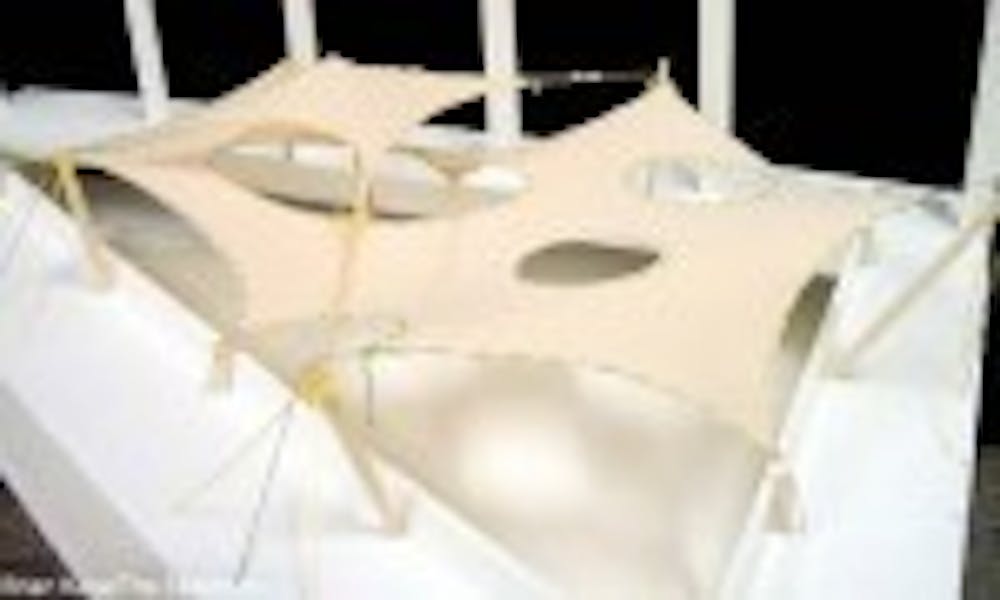
The style builds on such integration concepts developed by architect Frank Lloyd Wright, whose designs can be found throughout Buffalo. For example, The First Nations Garden Pavilion, a project completed in 2000, has an undulating, ribbon candy-style roof made to recall wisps of campfire smoke through trees.
Panoramic photography of vast fields, provided by photographer Marc Cramer, outlines the gallery. According to Ruth Bryant, the assistant dean for development in the School of Architecture and Planning, the photography is meant to make the exhibit more intimate and is something rarely seen in architecture exhibits.
"It encompasses you almost like an envelope," Bryant said. "The students are going to be exposed to a very intensive, compact exhibit."
The exhibit also caters to students on the urban planning end of UB's program. Saucier and Perrotte's exhibition offers explanations on how they infuse the local population into their designs.
Other lectures coming to the School of Architecture and Planning include Lebbeus Woods, a visiting professor at the Cooper Union; Jane Wernick from London; Monica Ponce de Leon, an associate professor at the Harvard Design School; and Swiss architect Peter Zumthor.
The Saucier-Perrotte exhibit runs until Feb. 20 and is open from 9 a.m. to 5 p.m. Monday through Friday.



