
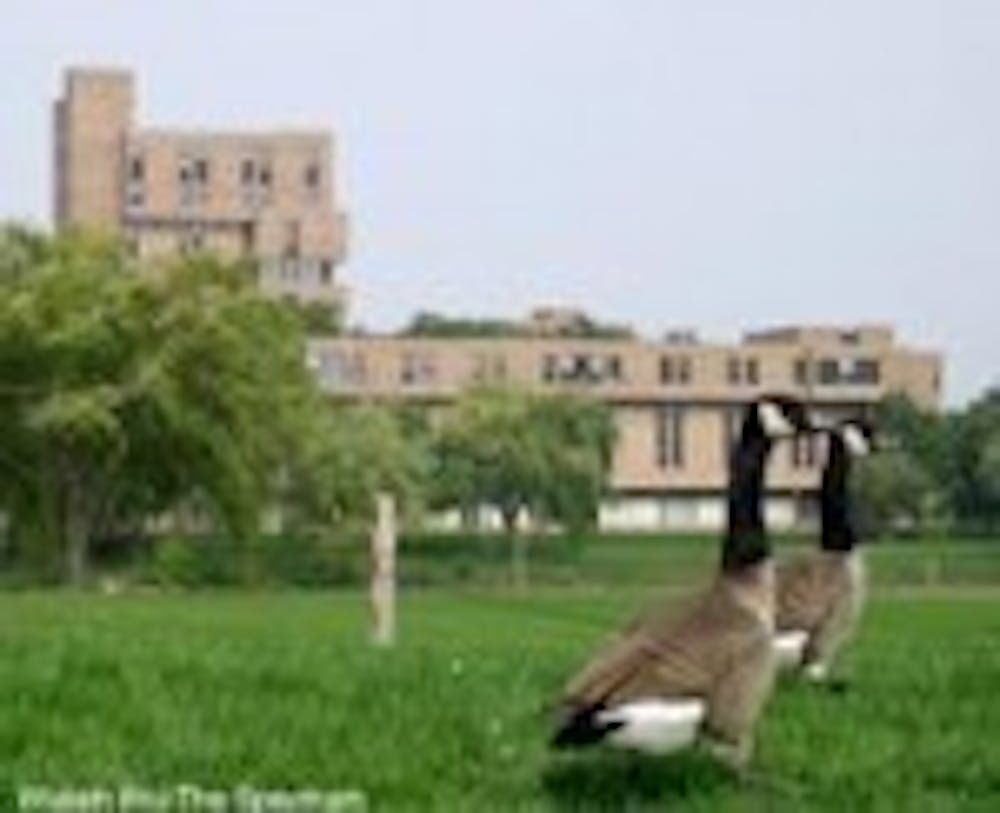
To many people, geese are harmless and nothing more than a nuisance at most, but for a number of students, the growing number of geese at UB has become a problem that interrupts daily life.
Lou Schmitt, director of facilities operations, said he doesn't feel the geese are a danger, but it is a problem that they walk in clusters and inhibit the flow of traffic.
Plus, there is the possibility that the geese droppings could create a health threat. Schmitt said the issue has grown over the years because the same geese return every year to nest, and the goslings return to create their own nests, perpetuating the cycle.
Each year more and more come back until there are just too many, he said.
Campus policy dictates that no lethal method may be used to get rid of animals, so the university is considering three possible options to decrease the number of geese on campus.
"In the next few months you will see something being done," Schmitt said. "The good news is we can do something to help the problem slightly."
One option is to use a repellent, which would use a scent the geese don't like to keep them away, Schmitt said. The repellent is expensive, however, and if it rains, it washes away.
Another idea is to plant vegetation around the lake. Geese like to be in wide open areas so their predators can not sneak up on them, and the theory is that by enclosing the lake with vegetation, they will no longer want to inhabit the lake.
The third option is to bring in dogs. These dogs are trained to chase but not hurt the geese, Schmitt said, and UB is looking into each option to choose the best one.
In the meantime, some students say they are simply fed up with the flocks that take up walking and driving space, and scatter "gifts" across campus.
"When I am walking to the NSC building, the geese poop is everywhere," said Rebecca Adler, a freshman communication major. "I feel like I am walking through a maze."
Molly Dubansky, a junior theater major, agreed the fearless fowl have become a problem.
"You're walking across the path and they stand there, staring at you. My older sister's been bitten by a goose before, so I'm terrified," Dubansky said. "If it's not the geese, it's their poop. I just started a yoga class, so it's hard trying to find places to do yoga when there is goose poop everywhere."
Though the geese will be gone soon enough when they migrate south, and many students agree they are more than manageable, some would like to walk on a nice field of grass on campus, while there is still grass to walk on.
"Its nice and pretty, but once you're there it is gross," said Gabriela Becerra, a freshman architecture major. "They poop everywhere."
Schmitt said there are several ways to help stem the problem.
"Do not feed the geese," he said. "This will help prevent them from lingering around any longer then necessary. When people feed the geese it prevents their wings from growing, and they become more dependent on humans. That would make it very difficult to survive in the wild and having more geese living on campus longer. Soon our new neighbors should be gone for the season, and hopefully we won't see too many next year."



