
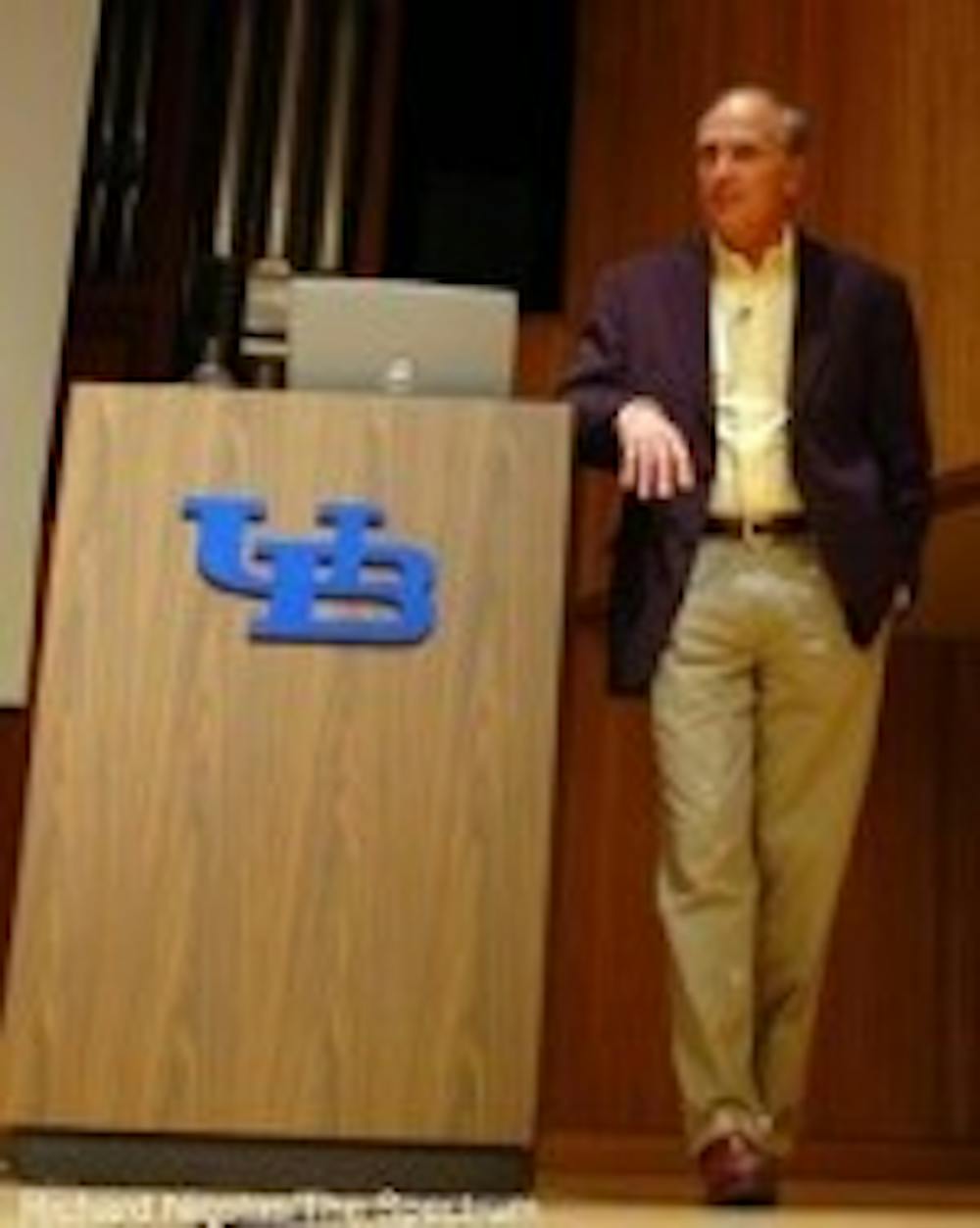
David Orr doesn't think anyone should graduate from college without being ecologically literate.
In other words, if you can't talk knowledgeably about the environment and ecology, and how connected it is to other issues, then you better get your money back for that degree.
Orr, a distinguished professor of environmental studies and politics at Oberlin College, came to UB on Wednesday night to talk about just that. He is a renowned author, teacher and speaker on environmental issues that has won several awards for his work.
A few days before he gave his talk, Orr decided to exercise what he referred to as "speaker's prerogative," changing the title and subject matter of his presentation from "Earth in Mind: Patriotism, Politics and the Environment in an Age of Terror" to "Learning from Katrina."
"Katrina is a microcosm of several issues that needed to be addressed," Orr said. "It was an act of God magnified by human behavior."
One of these issues was the world's -- specifically America's -- obsession with the combustion of fossil fuels, which leads to global warming. The temperature of ocean water is higher than it has ever been, and as a result, hurricanes heading inland hit this warmer water and greatly intensify.
Global warming, Orr explained, is actually climate destabilization. Small changes in temperatures have massive implications worldwide. They cause extreme conditions such as lowest low temperatures, highest highs, storms, droughts, rising sea levels, new diseases, changes in ecosystems and the death of coral reefs.
Also, this destabilization causes 150,000 climate-related deaths each year. This past century was the hottest one in the past millennium. To put it in perspective, the average temperature of the Earth rose five degrees Celsius in the 5000 years previous to the year 1900. Since then, the average temperature has risen another five degrees Celsius.
Orr also discussed the effects that carbon dioxide, a heat-trapping greenhouse gas that's most commonly produced by automobiles, has in aiding global warming.
We should also have a larger vision of the effects our actions have on the land, according to Orr.
For example, the Appalachian Mountains in West Virginia are being destroyed at an alarming rate. The federal government is allowing private companies to go in and cut the tops off of these mountains to get at the coal veins more easily, Orr said. The tops of the mountains are dumped into the valleys between them, flattening the terrain. This practice, while serving immediate consumer interests, is destroying the ecosystem, the people inhabiting the area and the culture of the area.
So why isn't anyone trying to stop this? Orr said that in 1973, Senator Henry Jackson proposed a land use policy for the United States that simply called on the country to have a plan on how they should use the land. It was proposed to stop the sort of destruction that is taking place now. The plan was dismissed as a communist plot to take over the country. Nothing has been proposed since.
Elizabeth Henry, a senior industrial engineering major, found out about the event on the UB Green Web site, and said she thinks that there should be more on-campus promotion for events like the David Orr lecture.
"It's pretty interesting," Henry said. "I think more students should get involved. There's not enough activism, like really active activism."
Orr said we should not think of this nation as bitterly divided left to right or liberal to conservative, but that all sides should work together for a sustainable future for this country. He said he wants there to be good, usable land for our children and grandchildren.
He then asked when patriotism stopped meaning "defense of the land." If Al-Qaeda, for example, revealed a plot to destroy 1 million acres of American land, we would have been outraged and ready to fight. Instead, the United States will destroy that land over the next few years with projects such as mountaintop removal in West Virginia.
He ended with saying that design needs to become a healing art. As we develop buildings, automobiles, roads and everything else, we need to be conscious of its impact on our world.
Jillian Cavanaugh, a senior communication major, said she came to the lecture with her whole graphic communication class and left with a different outlook than when she came in.
"It was really inspiring," Cavanaugh said. "I was really unaware of all the environmental problems and their severity."
Orr said that disasters like the Iraq war and Hurricane Katrina have ripped the veil off of the United States.
"We are not the country we tell ourselves we are," Orr said. "We spend more money on cosmetic surgery and cat food than on foreign aid. Check it out."
Dove Altabef, a sophomore psychology major, said the lecture got him interested in environmentalism.
"David Orr convinced me that environmental issues are the most pressing issues facing us as a society today," he said. "Furthermore, he's gotten me on board and committed to the cause of environmentalism and informing people everywhere about it."
Orr said that his biggest message to students is for them to get involved as soon as possible. He says students should run for political office and start changing things now.
"We need to learn how to make connections between disparate things like Katrina, the lack of an energy policy and the war in Iraq," Orr said. "Don't wait, don't linger, don't be passive. Ask questions, make connections."



