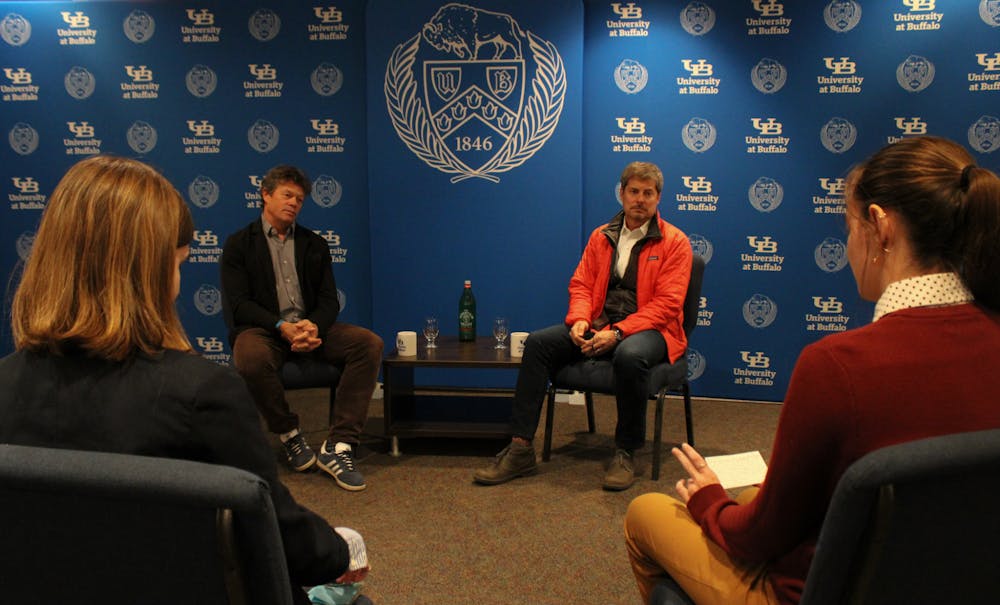
The interview has been edited for length and clarity.
The Spectrum: Who are some of your biggest influences or inspirations for film and photography, or in the field of nature preservation?
Pete McBride: I have many. They started as far back as Ansel Adams. Many [that] people have heard of but there are many that I worked with in National Geographic, and they’ve become great friends. And a guy named Joel Satori, he’s done a lot of stuff in endangered species, and he was one of these people that I looked up to, and now I call him a peer. A great lesson from this is, don’t be afraid to reach out to people you admire or look up to — you might be surprised how much you might have in common and how you might become friends. My parents, too, were great influences, and as you get older, parents can become friends too.
Kevin Fedarko: I’m a writer, and so there are people who I consider kind of models or mentors whose work influenced my thinking about language and writing about landscape. Some of those people are kind of problematic now because some of their ideas have not aged well. A concrete example would be a writer that you may or may not have heard of, Edward Abbey. [He] is someone who’s written some of the most beautiful writing that we have on the American Southwest. He harbored ideas and attitudes towards women, Native Americans, Hispanics, that were probably pretty offensive at the time, he wrote them in the 1960s and 70s, and have not aged well. One of the complex challenges that I had is how to balance that against the fact that the beauty of some of the writing is nevertheless as timeless and strong as it always has been. So I am confronted with the challenge when I consider somebody like Edward Abbey of figuring out what I want to take from it and what I want to set aside.
TS: In your documentary “Into the Grand Canyon,” you say that the canyon is changing, and touch on issues such as the depletion of natural resources, construction projects and uranium mining. Because this documentary was released a few years ago, which are the most troubling issues for the canyon and the Indigenous people who live on the land as of now?
PM: There are the exact same issues, maybe even more so. So the issues of our native voices being heard — are they being brought to the table to have a voice on the issues that are important to them? Fresh water, where the drought that I talked about in the film, is even worse today. The hand of climate change is definitely making it hotter and drier in that part of the world, so that is critical. The National Park has less funding today than it did when we did this project in the film, so that is an ongoing threat. The ability for people to come look at this landscape and try to make money out of it — whether it’s through tourism, loving a place to death, or resource extraction, through mining or damming, there’s been dam proposals — those are all very similar to what the film highlighted, I would say they’re even more pronounced today.
KF: I could add to that and say that all of what Pete just said falls under the heading of a larger issue that felt urgent at the time and feels every bit as relevant today as it was then, which is the fact that the Grand Canyon National Park is part of this larger mosaic of public lands that we have in this country, not just national parks, but national forests. We like to think of those landscapes as being protected, because the protection is enshrined in law, and yet all of these landscapes are continuously beset by challenges and threats. This is mostly coming from the groups of people who are trying to find a way to monetize them, often for very understandable and legitimate reasons. Those landscapes, in order to be passed along intact to the next generation of Americans, need each successive generation to decide whether it's willing to stand up and fight on behalf of those landscapes. Those landscapes all pose a challenge to us as citizens. Are they important enough for us to sacrifice and fight on their behalf, sacrifice our time and our energy to fight on their behalf? Or do we have other things that are more important, other priorities that will take those resources?
PM: I’ll add one more thing. You may have heard in the news, but the North Rim of Marin County National Park experienced one of the biggest wildfires since we did this hike, the infrastructure of that particular park has already changed since we did this. So your park, because it’s your park too, and it will be your generations’ to take care of, is already facing more challenges, so we’ll need your voice as much as the next.
TS: Of all your adventures, long hikes, filming, flying, journalism, which has ultimately been the most rewarding work and what work have you done that you believe will leave the most impact?
KF: Here’s a weird thing. When I was your age, I started working as a journalist, I started at daily newspapers. I worked at a newspaper in Pittsburgh, which is where I grew up, and I experienced a sense of frustration because I felt like what I was covering was changing every single day. Every day I was sent out to do a different story on a different topic involving a totally different aspect of the city of Pittsburgh, and I didn’t know what I was talking about, and I felt like I wanted to move to a place that allowed me to devote more time understanding issues and stories better. So I moved from a daily to a weekly magazine, and after several years, I had the same frustration and complaint, and so I moved from a weekly to a monthly magazine, and eventually realized that even that wasn’t enough, and that’s where I got into writing books. And what I ended up doing, instead of moving from one subject to the next with each successive book, I fell in love with a place, the Grand Canyon National Park, so deeply and so incorrigibly and so obsessively that all my work since then has focused on this one place. The longer that I’ve spent writing about it — moving through it and spending time inside of it — the more I’ve begun to understand that one of the most marvelous aspects of nature is that the more time you spend in them, the more deeply you begin to understand how little you understand about them, how much there is to learn, how complicated they are. You never arrive at a point where you truly feel that you have mastered it. And so I don’t know if my work is going to have impact or meaning. I do know, however, that I have devoted everything I have to this one place, and that has given me meaning in a way that moving from one subject to the next like hopscotching across a chessboard wouldn’t have. So the choice I made has given me meaning, and it’s not for me to decide whether the work that I’ve done as a result of that has meaning for others to judge.
PM: I think building a repertoire of an archive of stories of things I'm passionate about, which is particularly land and water, where I live as well, and sharing it with the next generation; speaking to students, becoming friends with students [and] watching them evolve and helping them. We're going to talk tonight about a Native American mother and daughter that we met on our journey, and they are, as we speak right now, in Los Angeles at a film festival representing a film I made about them. And that is a friendship that I never expected would have evolved. It took years of trust, and I think it's symbolic of how stories can open doors. It can be a passport, journalism. Whether it's with a camera, whether it's with social media, whether it's with a pen, keyboard, whatever, it's a passport to build relationships as well.
TS: We currently attend a university that is trying to place itself at the forefront of Artificial Intelligence (AI) research and development with the creation of the Department of AI and Society, but it is also projected by the US Department of Energy that by 2028, AI data centers could require up to 33 billion gallons of fresh water and are set to double their CO2 emissions by 2030. As lifelong environmental advocates, what advice would you give to the next generation of journalists and students that are trying to raise awareness of these flaws in a technology that is so rapidly spreading?
PM: AI is tricky, it’s going to have a lot of benefits, and I think we’re seeing some of them. I think it can find efficiencies for us, it might find efficiencies in climate change. I learned that AI can figure out what elevations jets should fly so they create less contrails — contrails [are] those white streams that come up in jets — and contrails are a huge impact in climate change, they can help find efficiencies there. Obviously we need to find a lot more, because we’re falling off on the climate change realm. AI data centers are using not just water, but energy. So we have to figure out where that energy comes from, and how we can recycle this water. If we’re going to need this water, how can we recycle it and use a closed loop water system so we’re not constantly pulling new fresh water? We have such a limited supply of fresh water, so that’s important. Then there’s a whole other element of AI that I think is very important to be aware of. AI may make it really easy to write things really quickly and do snapshots, but AI is daunting on creativity and original work. AI is never going to go write a “Hamlet,” Shakespeare wrote “Hamlet.” AI is not going to write the new “Hamlet.” AI is just repurposing everything we’ve already done. If you work in the world of creativity, we have to be aware that AI is not going to be making original, authentic work; it’s just pulling from everything that’s in the past. I think we need to be cautiously optimistic about how AI is introduced into our world on many fronts.
KF: I don’t think there’s much I can add to it, except maybe just to pick up on one aspect of what Peter said. It’s not that I disagree with it, it’s just that I wish I could endorse it, but I’m not confident enough to. I don’t know if AI at some point will be capable of writing “Hamlet.” Maybe it will evolve to the point where it is capable of matching and even transcending the best level of creative writing that human beings are capable of. Even if it does that, the thing I’m concerned about is the loss of an element that I consider to be essential. I think that writing is an incredibly important skill, not just for the transmission of information, but for the way it trains one’s own mind. The person doing the writing is transformed by the writing in a way that improves that person’s ability to process cognitive information, to communicate important ideas, to analyze critical and cognitive skills. [Which] I think will only become more important, not less important, as people your age and younger than you try to figure out how to navigate their way through a world that is increasingly being defined by AI. There’s a long winded way of saying that, like even if AI can produce excellence that surpasses what we can [do], learning how to write is really important.
Nadia Brach is the senior features editor and can be reached at nadia.brach@ubspectrum.com
Ciah Courtney is an assistant sports editor and can be reached at ciah.courtney@ubspectrum.com

 Photo: Wikimedia Commons | Courtesy of Quintin Soloviev