
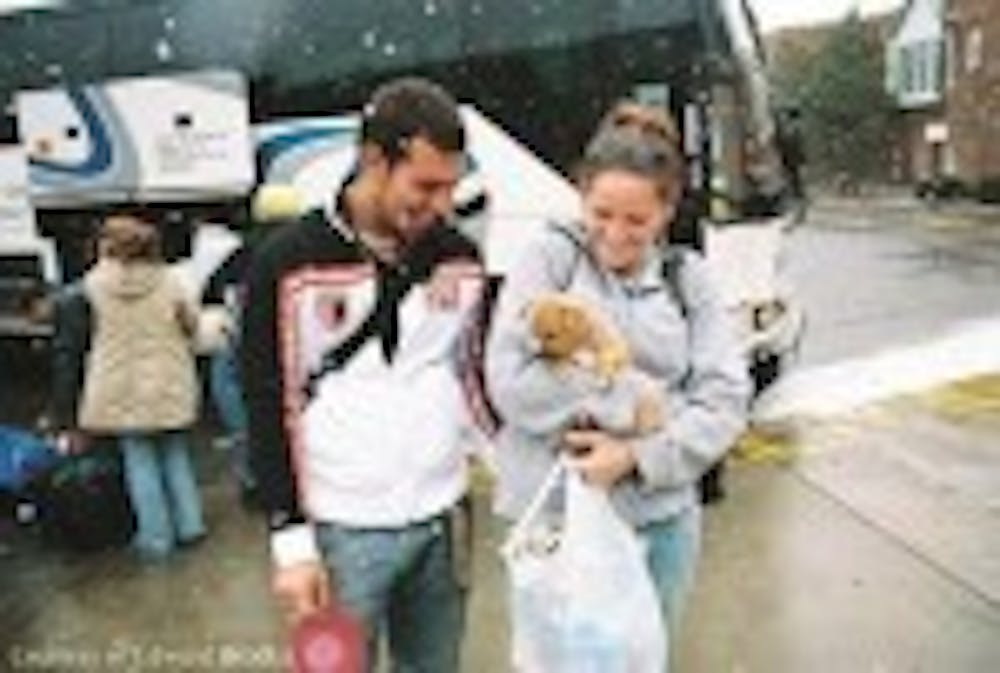
When 57 UB students went to New Orleans, they weren't there to save lives -- they were there to help the city rebuild. But amid the wreckage, the spring break volunteers wound up rescuing two lost souls: a pair of puppies found in one of the houses they were helping to clean up.
"We found two puppies living under some rubble in a dilapidated house in the lower Ninth Ward near the levy in the hardest-hit part of Louisiana," said senior Eileen Marutiak. "We called the (Society for the Prevention of Cruelty to Animals), but no one would take them so we brought them back to the Common Ground Center.
"We named her Nola," Marutiak added, "for New Orleans, Louisiana."
While saving the puppy - and helping hundreds of other New Orleans families - the students also found a little irony.
"I'm going to give her to my sister, Katrina," Marutiak said.
The UB students who signed up for the popular trip endured a 22-hour bus ride and $100 fee to go down to New Orleans, joining roughly 10,000 other college students from across the United States who dedicated their spring break to cleaning up the lingering destruction of Hurricane Katrina.
In the aftermath of Hurricane Katrina, 300,000 homes were destroyed, 160,000 houses were left beyond repair, and approximately 300,000 abandoned cars still dwell in New Orleans. The estimated cost of cleanup is about $1.5 billion.
Mary Clare Fahey, community service learning coordinator for Student Life, was one of the people who coordinated the Alternative Spring Break.
"It began as a search for a summer trip to New Orleans," Fahey said. "But after some research we found this spring break trip being offered through Habitat for Humanity, and I knew that our students would want to know about it."
After the first interest meeting, a few students stepped up and took on the responsibility of organizing the group.
"I set up a listserv and my goal was to get 30 people to go. I wrote a lot of letters to Buffalo companies and did a lot of fundraising," said Clark Dever, a senior business management major. "Things were going well, and then Habitat decreased occupancy of their camp, so we no longer had a place to stay, and plane tickets went up, like, overnight so we lost transportation."
Habitat had allowed space for 2,000 volunteers for their spring break project, but their program filled up before UB students could sign up.
"After hearing about Habitat filling up a few of the students went out, did some research and found this group called Common Ground," Fahey said.
"The entire university got behind us and really supported the trip," Dever said. "RHA, Student Life, GSA, and Delaware North Companies were some of our major contributors."
Each person paid $100 out-of-pocket in addition to the $15,000 fundraised to help cover the cost of this trip.
"Common Ground started as an immediate response to Hurricane Katrina," said Rachel Berstein, a senior sociology and psychology major. "It was founded by a former member of the Black Panthers. The organization's goal is to work in solidarity to get people the basic necessities. 'Solidarity, not charity' is their motto."
Once the students arrived in New Orleans, their primary responsibility was gutting houses in the area.
"We were taking out personal belongings before gutting the houses. Taking out clothes and children's clothing and pictures, and it was all so damaged from the flood and mold that everything had to come down," said Creighton Randall, a senior mechanical engineering major. "We went through the worst-hit part of the city. There was six square blocks right next to where the levy broke down, and there just was nothing there. It was like a tornado went through and there was just nothing we could do."
According to Common Ground's Web site, a team comprised of five volunteers can gut one house in seven days and save a New Orleans resident $10,000.
"There's nothing but work, seven days out of seven days everywhere you look," said Matt Moynihan, a first-year chemical engineering graduate student. "Every house had to be gutted."
The UB crew gutted 14 houses with five crews of 10 over the course of the week, but a total of roughly 200 homes had been impacted in that week by the thousands of volunteers.
"Every house is someone's life, everything they've ever worked for and it's completely destroyed and it was tough to deal with," Dever said.
Safety was an important issue for those students who attended the Alternative Spring Break.
"It was a very unsafe environment with all the mold and toxic chemicals, broken glass and nails," Moynihan said.
The conditions were so intense that each volunteer was given a respirator mask, gloves, goggles and a head-to-toe hooded suit.
"We had to clean everything with bleach every morning and night because you had to decontaminate it. You had to clean all the tools, gloves and goggles, but the suits were one-time use only," Moynihan said.
Although the UB group brought their own supplies, Common Ground supplied a lot of the necessary materials, such as tools and safety gear.
Beside the long hours and physical work, the students found the condition of New Orleans to be very shocking.
"When you first get there it's very shocking. It looks like the city has been bombed, it looks like a war zone," Dever said.
"The media here doesn't do it justice," said Marutiak, a communication and Spanish major. "What you see on TV is only half of it. Six months later and nothing has been changed and there are no plans. It's unbelievable how much work there is to do down there, it's pure neglect."
Moynihan agreed: "There's just nothing down there. It's a huge void, no school, no working police department, no hospital and nothing for health care. It's amazing how people can self-organize."
Despite the treacherous conditions and devastation, students came in flocks looking to do a small bit to help the relief effort.
"Our camp had 200 in it but I met people from all over, like California, Nebraska, Minnesota, Georgia. It was like living in a tribe of all college students from all over; like a hippy commune," Moynihan said.
Though the atmosphere of numerous college students camping out may sound a bit exciting, living conditions were kept to the bare necessities.
"We lived in a rundown warehouse in the middle of nothing, sleeping in tents in the parking lot. Some people had air mattresses and some didn't," Bernstein said. "We were sharing one bathroom and two showers amongst 200 people. You really had to take responsibility for yourself."
"Everyone volunteered to help make dinner or do 24-hour security. UB students were up at 4 a.m. walking around with flashlights doing rounds and then would go work all day on houses," Moynihan said.
For many who got involved with the Alternative Spring Break, the trip was a learning experience.
"This trip has changed them and they will never be the same, make them more concerned about natural disaster or poverty or diversity," Fahey said.
"People worked very hard and I was very proud of the group," Bernstein said. "They went down there with the mentality to make a change. It was beautiful to see people want to help people that they didn't even know."
"On a whole the thing that impressed me the most was how grateful everyone was for what we were doing down there," Randall said. "People would wave to us or give us thumbs up. Didn't seem like we were doing all that much but in the great scheme of things we really did a lot."



