
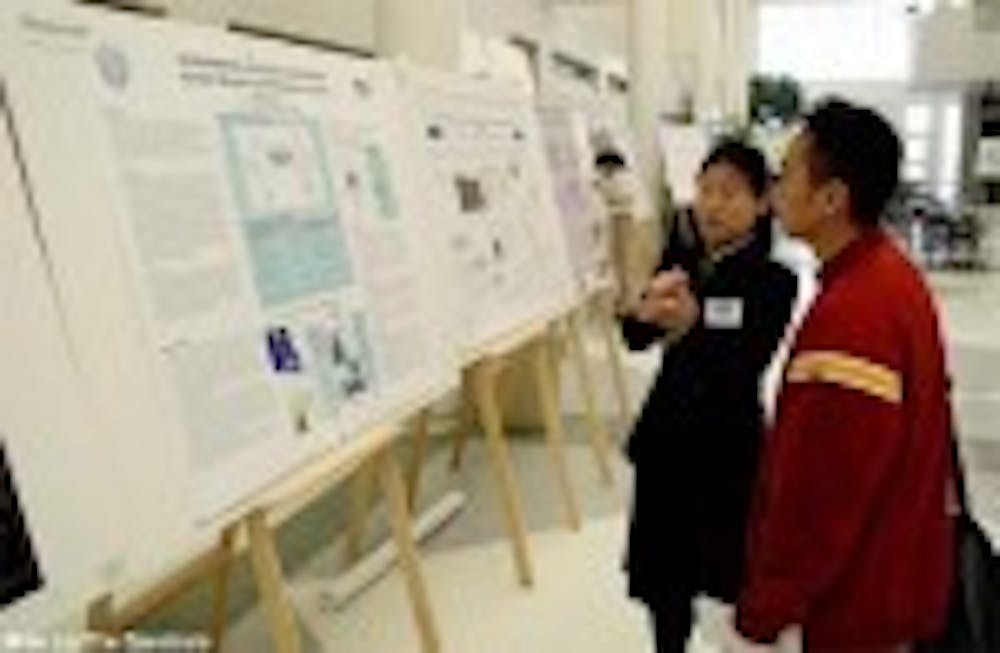
To mark Earth Day 2004 Friday, a group of over 100 students and faculty flooded the Center for the Arts atrium for a poster competition and series of lectures on water usage.
Organized by the Environmental and Society Institute, the lectures and poster competition identified environmental issues within the Western New York region, addressing subjects such as harnessing water and improving the hydroelectric power plant at Niagara Falls.
"The posters are research-based. Various departments are represented by 40 posters," said Shouvik Chakraborty, a first-year graduate student in architecture. "Contributors include work from the physics, biology, geography and architecture departments. This gives students insight on scholarly research within interdisciplinary studies. Usually there would be no interaction."
Sinu George, a first-year graduate student in architecture, said the posters were too complex for any non-technical major.
"The target audience is definitely technical. People on the street would not be able to make sense out of them. It would help if the posters were arranged by department," said George.
Dale Meredith, a lecturer at the event, introduced water resources as the topic. His presentation described the techniques used in efficiently harnessing water, backed by historical examples.
"The objective when developing a water system is first to enhance human welfare and the environment," said Meredith. "Our second objective is to develop simple, natural solutions. Third, to minimize time and cost, and last, to realize the solution will be around a long time."
Meredith explained the long history regarding water usage and control.
"Conflicts over water are centuries in age because water is necessary for life," said Meredith. "The Owen Valley War in Southern California was over water. In 1928 the St. Francis dam collapsed and killed 500 people. The depression is what ended this war, due to a lack of funding for the project."
Meredith also discussed the current issues of pollution in U.S. waterways and how pollution could affect water as a commodity.
"The value placed upon water could perhaps lead to water trading. Water is necessary for life and we don't always live near it," said Meredith. "I often joke with a relative in Texas about a future where Western New York will be trading gallons of water for gallons of oil."
Lynda Schneekloth, an architecture professor, and Barry Boyer, a law professor, spoke about "Hydropower and Empowerment" in relation to Niagara Falls.
"Niagara Falls is a miraculous and sublime experience," said Schneekloth. "Niagara Falls was the utopian fantasy for a time, a community with clean power. The Free Niagara movement of 1875 led to the first state park that removed development."
The plant was licensed in 1957 with a 50-year lease, according to Schneekloth, and will be re-licensed in 2007. The plant will go through an alternative re-licensing process with an agency trial in Washington.
According to Boyer, local interest groups such as environmental organizations and host communities are initiating action now in regards to improving the hydropower plant.
Boyer said innovation and renovation is necessary in order to improve the system.
"The power of a public conversation and steering conversations is important. This process could lead to a re-imagination of the region, possibly with a lake-to-lake greenway," said Boyer.
"Eco-tourism is the next major economy in this region. We need to prepare for a new economic structure," said Schneekloth. "The next question becomes, what is this water worth?"



