
It's almost like a running theme for Buffalo: never-ending construction.
On Main Street they've been tearing up and paving roads for two years, and now at UB, the construction at O'Brian Hall is reaching a 15-month anniversary with few signs of quick completion.
The building, which is home to the law school, was stripped of its uniquely slanted brick wall in October 2004 for safety reasons. According to officials, the project's completion date is still unclear, and the renovation will continue to keep O'Brian looking like a danger zone until April or May.
The repair project will remove the brick exterior and replace it with a paneled system with new waterproofing, according to Kevin Thompson, director of Facilities Planning and Design. This project alone will cost the school $750,000, much greater than the initial estimated cost of $350,000 to $400,000.
In addition to the exterior renovation, the fifth floor of O'Brian Hall is undergoing construction to add a conference center for the law school. The conference center will cost about $1 million with furniture and design fees, Thompson said. When completed late this summer, the new center will serve as a multi-purpose room with space for seminars and assemblies.
"The law school has such a variety of functions, and they need a place conducive for bringing in those functions," Thompson said.
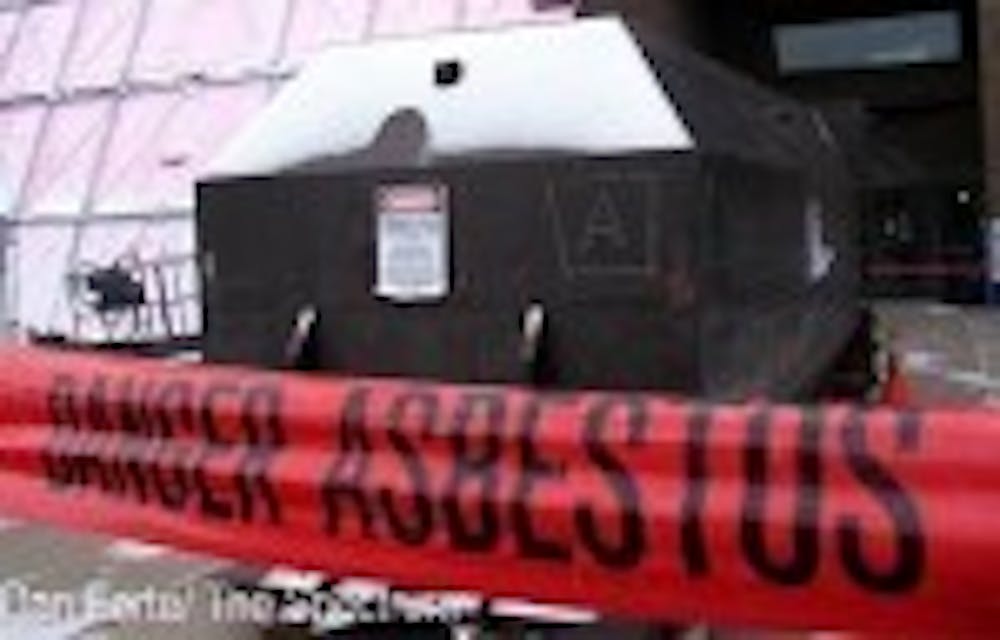
And last but not least, as if O'Brian Hall didn't have enough happening to it already, an abatement program is in progress to remove asbestos from the area as part of the fifth-floor renovation.
As a result, part of the fifth floor has been cordoned off this semester while workers clear out the harmful product, which the Environmental Protection Agency declared unsafe in 1970 after studies showed that occupational exposure can lead to lung cancer and mesothelioma, a specific type of lung disease associated with asbestos.
Paul Kosyniak, director of UB's Toxicology Research Center, said the biggest incidence of asbestos is in insulation and fireproofing.
"There's a very low occurrence of asbestos exposure in the general population," Kosyniak said. "Exposures have been minimized significantly as people became more aware of the problem."
"There's strict regulation and continuous monitoring," he added. "State inspectors go around to ensure safety in the handling of asbestos material."
Asbestos can be found in older ceiling and flooring tiles as well, but use of these building materials has decreased. Materials with asbestos were commonly used before 1970 because it is a durable product that absorbs noise and resists heat.
O'Brian Hall was completed in 1973.
UB officials said the asbestos hazard is carefully contained and poses no danger to the public.
"Asbestos is really not dangerous unless it's airborne," Thompson said.
Asbestos fibers become airborne when materials containing asbestos are damaged or improperly removed. Though asbestos materials are being phased out through new construction, there is no requirement to remove asbestos building materials from older facilities unless it's in poor condition.
O'Brian Hall was completed over 30 years ago at the cost of over $7 million. Along with housing the law school, it is the site of all the law classrooms, faculty offices, and the Charles B. Sears Law Library, which itself had to be renovated last March for smoke damage after a fire.
Although the cause of that fire, which started in the second floor food court, was never determined, officials say the cleanup for it was successful.
"Classes were shut down for two days, and the classes on the second floor had to be moved for the rest of the semester," said John Hayes, facilities operations manager from University Facilities, in an October article in The Spectrum. "There was a lot of smoke damage in them."
According to Mike Dupre, associate director of University Facilities, the cost for all that particular cleanup and refurbishing came to approximately $1.7 million.



