
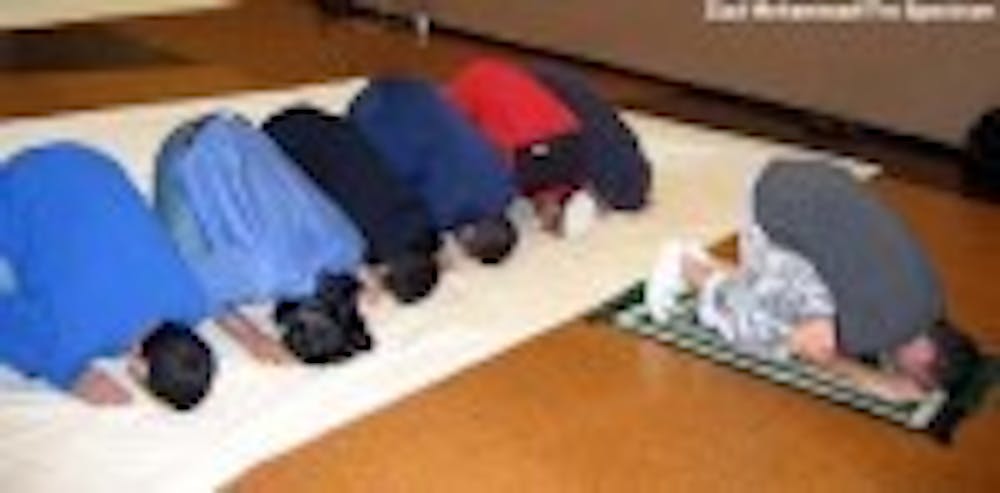
Muslim students, faculty and community members celebrated the start of Ramadan Friday, beginning a month of inner reflection and devotion to God with a prayer service in the Student Union.
Othman Shibly, an assistant professor in the School of Dental Medicine, led Friday's prayer service and spoke about the importance of Ramadan.
According to Muslim tradition, Ramadan is the time during which believers must purify themselves in order to create a just system on earth, Shibly said. To do this, participants fast from sunrise to sunset every day for about a month.
According to Shibly, there are three levels of fasting, the first being the easiest level where one abstains from food in order to understand the pain and deprivation that hungry people endure daily when there is no social justice. In the second level, one cleanses their soul, which promotes morality and respect for others.
Abstinence, the third level of fasting, is considered the most difficult. A man and woman are not to have sexual contact in order to keep focus on the spiritual and intellectual self.
Shibly stressed that Muslims should not view Ramadan as a sacrifice but as a teaching tool for the self.
"I hope you all understand that fasting is not a punishment but a spiritual discipline," Shibly said.
Those who would be risking their health by fasting, such as elders and women who are nursing, are not required to do so during Ramadan. And if a Muslim chooses to break the fast for a day, that individual is urged to help another fellow human in need of aid, Shibly said.
"If you do not fulfill your duties it is recommended that you feed a poor person in compensation for every day you break the fast," Shibly said.
Amil Sarfraz, Muslim SA president, said Ramadan pushes an individual to learn about self-control, piety and patience.
"If done sincerely, fasting during Ramadan helps you become a better person," Sarfraz said. "In a sense, it charges your religious battery for the whole year."
Asma Ahmed, who participated in Friday's ceremony, echoed Sarfaz' feelings.
"Ramadan really has to do with having control of myself," she said. " Above everything, it helps me understand who I am as a person."
For many Muslims, Ramadan is synonymous with Iftaar dinners, which mark the breaking of the fast for every day during the course of the month.
"Iftaar" is an Arabic word used to describe the breaking of the fast, which includes eating dates and drinking water like the Prophet Mohammed, Shibly said.
According to Muslim SA member Hyder Hussain, Muslim SA will provide Iftaar dinners in 145B Student Union every weekday from Monday to Friday until the end of Ramadan on Mon., Nov. 15.
"I expect a great turnout for these Iftaar dinners," Hussain said. "Just last year alone we had between 120 to 150 students come together every night."
This year, Ramadan almost came a day late for Muslims in the United States, where many communities depend on the Islamic Society of North America to say when the first new moon is officially sighted and Ramadan begins.
According to Sarfraz, there was confusion earlier last week over whether the new moon would appear on Friday or Saturday. That problem cleared up, however, when the news broke that the full moon was sighted in early morning hours in Texas. Ramadan ends with the next full moon, known as the celebration of Eid-ul-Fitr.



