
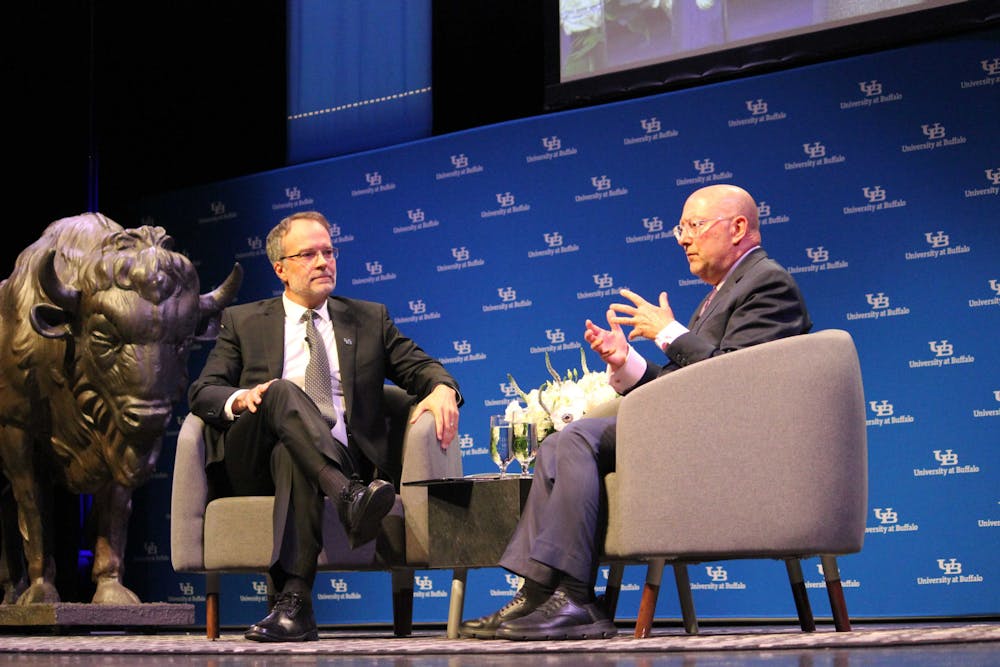
James Stavridis spoke at the Center for the Arts on Tuesday, Oct. 21 about international adversaries, alliances and other geopolitical risks.
An author of 15 books on international strategies and leadership experiences, Stavridis spent 37 years in the navy, eventually ranking as a four-star admiral. Today, he serves as senior military analyst for CNN and has been a public speaker on major networks and universities regarding his experience and the future of international relations.
Stavridis began his lecture by discussing the conflict between Israel and Gaza, though his relationship with this issue has been controversial. Prior to his speech, a small group of students representing Youth Democratic Socialists of America protested Stavridis’s invitation to the University, referring to him as a war criminal and denouncing the role he played in various wars throughout his career.
Stravridis discussed the current devastation in Gaza, but also encouraged the audience to “step out from Gaza for a minute and look strategically at the Middle East.” He outlined positive prospects for the Middle East, predicting a peacekeeping force and humanitarian aid in Gaza, as well as a disarmament of Hamas.
He highlighted that the diminished power of Iran, tyrants and other terrorist organizations, along with Saudi Arabia’s recognition of Israel will allow for “Israel [to] be this kind of flywheel economically that will access Arab capital.” Stravridis believes these opportunities could be achieved as a result of Steve Wikoff and Jared Kushner’s influence in the Middle East.
Stravridis also discussed the war in Ukraine as a potential avenue for opportunity. He predicted that a negotiation between President Zelensky and President Putin will occur to end the conflict. Additionally, he stated that a negotiation will be necessary for Putin “because of his manpower losses” and for Zelensky “because of waning support from the West.” He foresees an outcome that will be comparable to the result of the Korean war, including “a division, a demilitarized zone [and] maybe international forces.”
He is also optimistic about the opportunity for Ukraine to be reconstructed into a democratic state and a part of the European Union, stating that "the reconstruction of Ukraine is going to be very big business.”
Stavridis shifted gears from Ukraine and the Middle East to discuss the geopolitical climate of China. Starting with their Belt and Road Initiative Plan (BRI), he raised concerns for its growth in naval presence, specifically regarding the Spratly Islands, a group of artificial islands scattered in the South China Sea.
“China claims everything inside those red dotted lines is theirs — territorial seas — and they want it because it's full of oil, gas fisheries and 40% of the world’s shipping passes through there.”
Stavridis highlighted their political advantages to the vulnerability of the biggest manufacturer of the “most high-end microchip,” Taiwan, saying “they’ve got to up their game, because China has options. China can invade.”
Admitting that a Chinese invasion of Taiwan is a “hard proposition.” Stavridis emphasized opportunities for cooperation between the US and China as strategic. He mentioned several “pressure points,” such as artificial intelligence and economic battles, that inhibit their relationship, but reiterates that “if the U.S. and China can work together on climate, pandemics, humanitarian operations, counter-narcotics and cyber arms control, there’s huge potential there.”
He ended his speech with the importance of balancing the use of hard and soft power with foreign relations.
“There are times when you need hard power. We’re not going to negotiate a solution with the Islamic State or with Hamas…But in so many cases, it’s less the hard power and more the ability to apply soft power, the schools, the wells, the clinics…they are big opportunities, and I see that.”
In his final remarks with Professor Jacob Kathman, Chair of the Department of Political Science, Stavridis considered the U.S. relationship and future potential of NATO alliances.
Recognizing the political tensions that exist, he says President Trump is “quite happy to see the Europeans increase defense spending and decide to become principal supporters of Ukraine,” and believes that “Europeans are stepping up in ways that are going to allow NATO to actually strengthen.”
The features desk can be reached at features@ubspectrum.com
Emma Mendola is a student at Amherst Central High School and a high school intern at The Spectrum.
 Photo: Courtesy of Wikimedia Commons

 Photo: Courtesy of Nicc Williams; photographed by UB Athletics
