
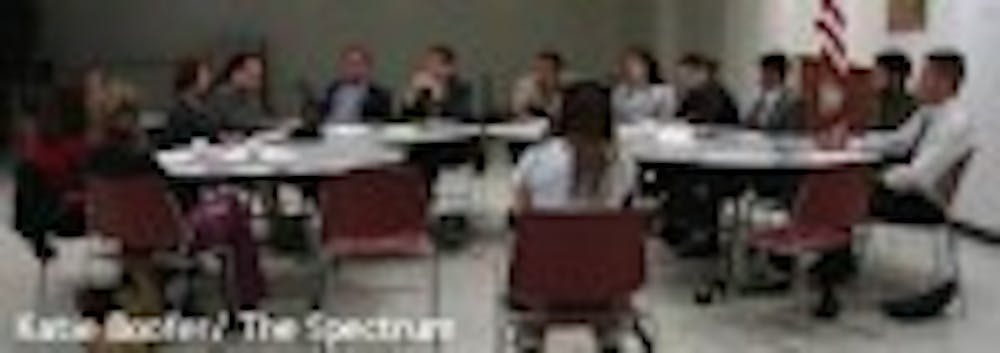
Tuesday, Student Association club representatives met with local politicians for a round-table discussion regarding the gap between UB and the Buffalo community.
While club leaders considered ways to improve UB and integrate it into a more active role in the Buffalo community, local political leaders shared ideas about how their influence could aid the cause.
"Buffalonians feel that UB students don't care about Buffalo, when many of them actually do," said Jovan Ramirez of UB NAACP. "In turn, many students don't know what goes on here in Buffalo. Politicians are the link between the students and the community."
Both sides agreed that UB could do more to give back to the community through education.
"Most urban colleges and universities in Buffalo have done a far better job at interacting with its host community than UB has," said New York State Assemblyman Sam Hoyt (D-Buffalo).
This is partly due to the lack of funding and advertisement for community service, according to group members.
The undergraduate SA proposed creating a youth outreach center for the University Heights community. Run by UB students, it would provide after-school tutoring, sports programs and higher education application assistance.
A lack of sufficient transportation was blamed for hindering UB students as well as the community, and a possible extension of the NFTA metro rail to North Campus was discussed.
Transportation between downtown and UB - including the possible impact of a Niagara Frontier Transportation Authority metro rail route to North Campus - was also discussed.
"Transportation is the biggest obstacle in bridging the gap between UB and the Buffalo community," said Maria Whyte, Erie County Legislature majority leader.
Extending the metro rail would present a more united UB, as opposed to two separate campuses in separate areas, students at the meeting said. It would also open Western Buffalo to areas that are difficult to access without a car.
"Forty percent of people from low-income families have to turn down jobs or even interviews for jobs because of lack of transportation." Whyte said. "Low-income people get stereotyped as not wanting to work, but they cannot get the opportunity because of minor issues such as transportation."
While higher education in Buffalo may be thriving, public education is not, according to SA President Viqar Hussain.
"Forty percent of Buffalo students never complete or even reach high school," Hussain said. "Having so many higher education facilities in Buffalo, it's an embarrassment to have one out of two Buffalo students not graduate high school."
To combat this problem, Hussain proposed a special feature of the outreach program - youngsters would be tutored by students from the Equal Opportunity Program (EOP) and Center for Academic Development Services (CADS).
Other proposals included switching UB Stampede busses from gasoline to biodegradable oil, moving architectural, medical and law schools to downtown Buffalo, as well as holding voting education and cultural sensitivity training classes in public schools.
"I am elated to see young people trying so hard to make a change," said New York State Assemblywoman Crystal Peoples (D-Buffalo). "Every activist movement has had students at its backbone."
In addition to the association executives, SA organizations involved included Urban Renewal, Engineers for a Sustainable World, the Muslim Student Association, NAACP, the Women's Center, UB Students Against Sweatshops, PODER: Latinos Unidos and the College Democrats.



