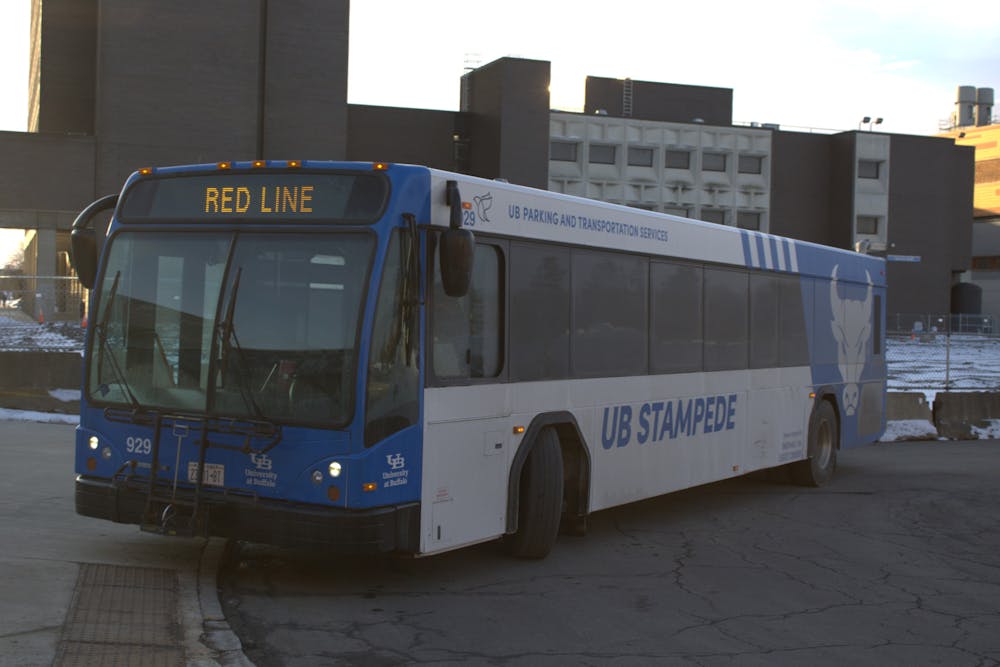
As UB’s transportation system, UB Stampede aims to connect students with every part of campus. Students disagree, believing that it continuously falls short in delivering fast and efficient transportation.
Dorm buildings Goodyear and Clement Hall on South Campus, and Creekside, Flickinger and South Lake Village Apartments are cut-off because of the on-going problems with the Stampede. Issues with routes, schedules and wait times make it difficult for students in these buildings to get to class, access campus and beyond.
Goodyear and Clement Hall are separated by a seven minute walk. In the morning, students can skip the walk and take the Yellow Line or All-Stops bus to Main Circle — the main stop on South Campus — but on the way home students must walk. Though it may seem insignificant, seven-minutes in the Buffalo winter after a long day of classes is the last thing students want.
“When I was a freshman and lived on South Campus, I would definitely stay on North [Campus] later rather than coming to Abbott [Library],” Jillian Schneck, a pharmacy student graduating in 2029, says, “because that meant I would have to walk home rather than just taking the bus right back from the North Campus libraries.”
The Yellow Line and All-Stops buses run in a loop between North and South Campus. This loop does not provide a route from Main Circle back to the dorm buildings, forcing students to walk home from their classes in all types of weather, in any condition, at any time of day. Knowing this, residents are discouraged from traveling around South Campus and taking advantage of its amenities, as Schneck points out.
More than this, inconsistency in bus times and longer wait times can discourage students from traveling between the two campuses.
“What should be a 20 minute commute [becomes] a 40 minute commute, it wasn’t worth it and it definitely made me not come to South Campus,” junior computer science major Alexandra Gelinas explains.
On North Campus, the apartments, located in spots further back from the main campus, face similar challenges. Their substantial distance from academic buildings makes the buses a necessity for traveling around campus, especially to and from class.
The North Campus Shuttle is the only bus that services Creekside, Flickinger and South Lake, and is tasked with connecting them all with the rest of campus. Riley Sobey, a sophomore psychology major, says that they fail at that task.
“I have to wake up extra early and give myself a lot of extra time in the morning because either waiting for the bus or walking takes a while,” she explains. “I have to leave about 40 minutes before my class to give myself a good chance of being on time.”
Sobey explains that, despite it being their only link to the rest of campus, the North Campus Shuttle is usually unreliable, forcing her and other students to walk to or from campus.
According to the UB Parking and Transportation’s Spring 2026 North Campus Shuttle Weekday Schedule, the bus is scheduled to leave from the Creekside Village Community Building every ten to 20 minutes from 6:30 a.m. to 5:30 p.m. But after 5:30 p.m., the bus is scheduled to depart from Creekside once every hour until 12:52 a.m.
Even in the morning, when buses are meant to be running frequently, times are inconsistent and tracking buses on platforms such as UBMobile is unreliable.
“Usually [UBMobile times] are not accurate. Especially as it gets later, I do not rely on the Creekside Apartment shuttle to get me back,” Sobey said. “Even if I did, I can’t wait an hour for the bus back to my house, so I usually take the Stampede and walk, which is brutal in the dead of winter. It is also why I’m reluctant to be on campus late, and makes having later classes difficult and unappealing.”
Sobey explains that she walks every day. It takes her 30 to 45 minutes to travel through piles of snow, rain storms and freezing temperatures from her apartment in Creekside to campus.
“I walked when it was in the negatives, when there were warnings from UB about hypothermia, about even a half hour of exposure putting you at risk,” she said.
When asked if she’s ever taken an Uber home from campus, she said
“Many nights I’ve contemplated it, especially when I am somewhere further on campus, like Alumni [Arena]. I’m honestly too stubborn to pay for a ride back to my house when it should be free with the tuition I’m paying to be here.”
According to UB’s Financial Aid Office, UB students pay an annual $3,078 transportation fee. Students, especially those who live in dorm buildings far from campus, pay for and rely on transportation to get to classes, and UB Stampede is falling short.
“It definitely dissuades me from leaving my house unless I really need to,” Sobey explains. “I’m even reluctant to go to my later classes because I know how brutal it will be trying to get back home.”
UB Stampede is meant to be a reliable transportation option that allows and encourages students to travel around and between campuses. Instead, the buses actively discourage students from going to classes and using campus amenities by cutting off dorm buildings from reliable transportation.
The features desk can be reached at features@ubspectrum.com

 Photo: Wikimedia Commons | Courtesy of Quintin Soloviev