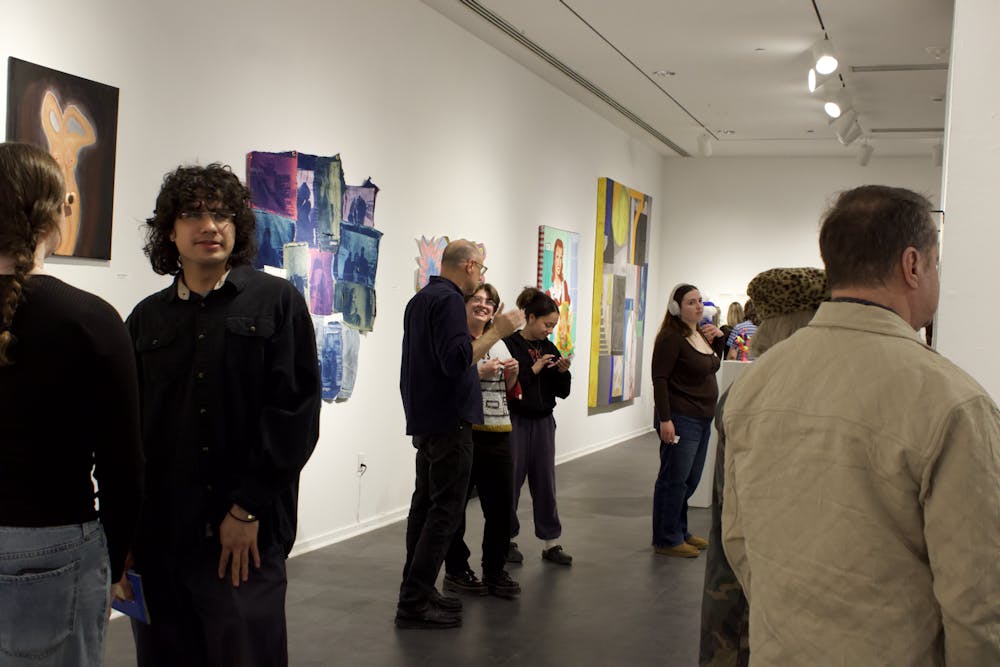
The UB Center for the Arts (CFA) was full of noise last night as the reception for the Bachelor of Fine Arts (BFA) Senior Thesis group exhibition, “Memoria,” took place in the Department of Art Lower Gallery.
The exhibit was lively, to say the least — not just because of the constant stream of talking, congratulating and picture-taking — but because of the wide variety of paintings and sculptures spread through every inch. With a variety of mediums, from bacterial cultivation to worms on strings, there is something for everyone that decides to pay a visit.
It’s hard to walk through and not notice the extensive collection of Thomas M. Walsh, primarily made up of cyanotypes with some digital prints. His subjects are simple, featuring ordinary people and scenery, typically at fairs.
“I grew up around the fair,” Walsh said, “And I want others to see the beauty of it too.” Walsh, a children’s musician, takes photos along the road as he travels around the country. “I want to make these sights accessible by bringing them here,” he states.
With pieces such as “my trusty stead,” “Heaven” and “side of the road,” the viewer is invited on a simple yet deeply fulfilling journey with Walsh, to see the beauty in sights that are often overlooked.
Walsh wasn’t the only artist focusing on the overlooked; Gardner Astalos, with his captivating display features windows and architecture, aims to show charm through a veil — through obscurity. His pieces, “West Galvanized” and “The penultimate act of summer” are installed with the latter in front of the other, adding another layer of depth to this work. “West Galvanized” features a lithograph and chine-collé print of a house from the West Side of Buffalo, with the center window illuminated in hot pink.
“I think there’s a sort of magic to be seen here,” Astalos states.
“The penultimate act of summer,” a cyanotype on muslin, serves as a curtain or a veil for the piece behind it. Astalos remarks on his love for obscurity with intent, which is shown wonderfully in his work. The act of moving the curtain, seeing one house on top of the other allows the viewer to change the piece at will, allowing them to truly understand Astalos’ idea.
Faced directly in front of the main entrance is Max Flanigan’s “7,” a piece featuring as many scenes and shapes as the amount of mediums used on a panel.
“My research is mostly about the empty spaces behind walls or floors, where wires and stuff like that are,” Flanigan states, “no one really thinks about them, but sometimes they’re even more important than the actual building.”
Flanigan commented on the idea of dissonance, the way these spaces are spaces yet they aren’t, and this is shown quite accurately in his piece. For me, this is through the way the viewer is able to recognize some scenes and objects yet not really.
His work isn’t based on just real life spaces, but virtual ones as well. Flanigan finds enjoyment in empty and dead servers on “Garry’s Mod,” a physics sandbox game with no objective but to explore maps and play around with various add-ons. “I like to sketch some of the spaces I find on there and add that to my artwork,” Flanigan explains.
The BFA Senior Thesis Exhibit will remain on view until May 5, featuring many artworks by our highly talented and graduating students, and I urge anyone to go and spend a few minutes, maybe an hour or two, admiring their work.
The arts desk can be reached at arts@ubspectrum.com

 Photo: Wikimedia Commons | Courtesy of Quintin Soloviev