
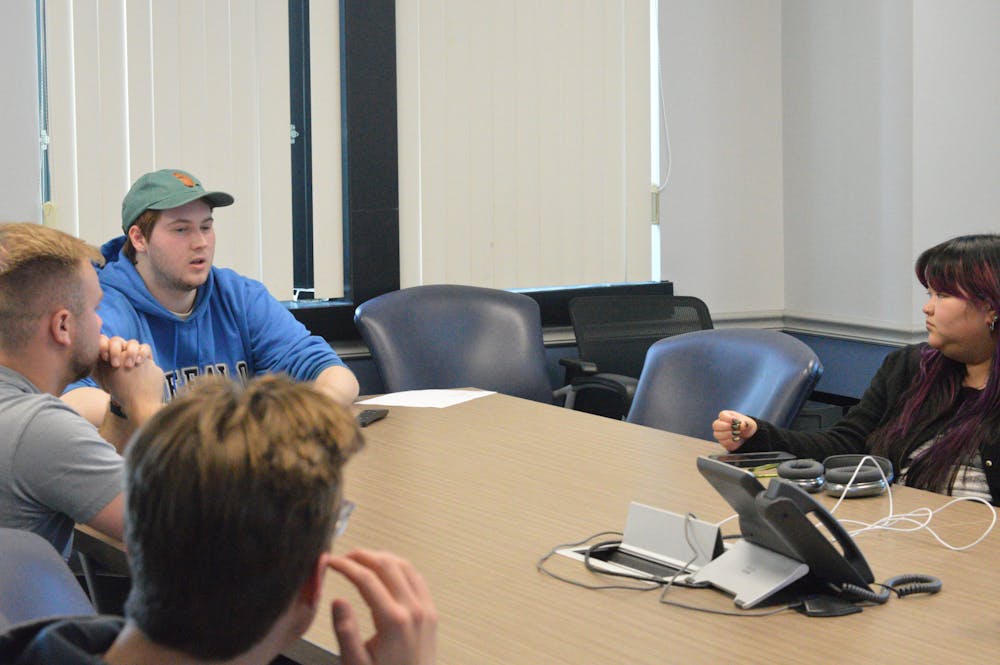
The Advocacy Committee — the undergraduate Student Association Senate’s first and only advocacy initiative this year — was meant to “make reports and recommendations” to the Senate about student issues. Almost all of the senators voted to form the committee and approximately half volunteered to be a part of it last fall.
Any reports and recommendations proposed needed to make it to the Senate’s agenda quickly, as unlike other Senate committees, the Advocacy Committee is temporary and only authorized through the end of this semester.
SA senators are set to vote on whether or not to extend the committee at its last Senate meeting later today.
When the Advocacy Committee finishes its first — and maybe only — semester, its legacy will be defined by three irregularly-spaced meetings and multiple initiatives discussed without any implemented solutions.
Clash over chairperson position delays formation and halts student issues agenda
Issues surrounding UB’s dining services and transportation would go on the Advocacy Committee’s initial agenda last fall, but the clash over the committee’s chairperson role sidelined plans for an exact course of action.
SA Senate Chairperson Gavin Krauciunas and SA Student Affairs Director Tyler Herman submitted nearly identical resolutions at the Dec. 4 Senate meeting to form the committee but each appointed himself as its chairperson.
The power struggle forced senators to kill both resolutions in a tight vote of 11 ayes and 9 nays.
An internal election would settle the disagreement, but the SA Senate did not form the committee until its last meeting of the fall semester on Dec. 11.
The election dominated the Advocacy Committee’s first meeting on Feb. 4, where Krauciunas and SA Senators Joseph Pawelcyzk and Aidan Sumrall ran for the position. Herman withdrew his candidacy, citing other commitments.
Sumrall secured the position with votes from five of the eight senators present, running on a platform to increase student participation and engagement in SA.
The vote would be the only one conducted for this semester.
Senators spent the rest of the Feb. 4 meeting discussing campus dining issues, an event for National Transit Employee Appreciation Day and on-campus student safety — all introduced by an email Sumrall read off from SA Senator Kayla Yan who was absent at the time.
Resolutions would not be the committee’s course of action, regardless of the kind of initiative.
“There were a lot of times where resolutions came up where just them passing wouldn’t do anything. It looked good that we were doing them but they didn’t actually do anything,” Sumrall said at the meeting. “What else can we do outside, use the resources we have, talk to these people, to actually make a change than just saying we want to make a change?”
No meetings for nearly two months; committee’s role reframed to assisting SA Student Affairs department
The committee abided by its planned biweekly meetings in February, but the schedule began to derail in early March when Sumrall canceled the third meeting on March 5 the night before.
“Multiple members have let me know ahead of time that they will not be able to attend and because of this we sadly will not be able to meet quorum, and I would rather cancel it than make everyone show up when I know quorum cannot be met,” Sumrall wrote in a note on the SA calendar.
The inactivity persisted, with no meetings held in March and early April. A planned meeting on April 3 had to be called off when only four out of the eleven senators needed were present.
SA Senators Benjamin Lau and Jack Koscinski resigned from the Senate late March after they were elected to SA’s new 2025-26 e-board, dropping the committee’s required quorum from eight out of thirteen to six out of eleven.
By mid-April, out of the three meetings — two with full quorum, one cancelled — SA Senator Nithiya Santhapriya and SA Treasurer Louis Poon were absent for all three; Herman and SA Senators TJ Ledwith, Sherry Smith and Yan were absent for two.
Smith was present at the Feb. 19 meeting for one minute.
Santhapyriya, Smith, Poon and Ledwith did not respond to The Spectrum’s request for comment.
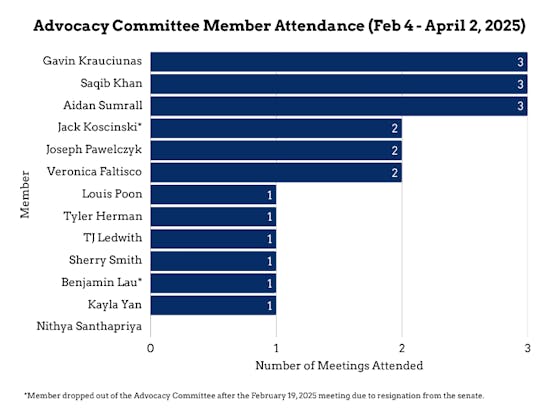
Graphic of Advocacy Committee Member Meeting Attendance.
Yan did not respond to The Spectrum’s request for comment, telling fellow senators at a committee meeting on April 30 that she is unlikely to respond.
“I’m just really burnt out at this point,” Yan told members. “They [The Spectrum] asked me why I wasn’t in attendance and I was like, ‘Oh I had graduation stuff.’ I don’t want to have to justify myself.”
Sumrall told The Spectrum in an email on April 22 that senators are still passionate about the committee and advocacy, but are “busy people” and many of them overlap between the Senate and the committee so sometimes “members aren’t able to attend both.”
The biweekly meetings are held on weeks opposite of the SA Senate meetings around the same time. Sumrall had moved the advocacy committee meetings — originally scheduled for Tuesday evenings — to Wednesday evenings, citing at the Feb. 4 meeting that senators are likely to have their Wednesday evenings free.
SA Senate meetings carried a full quorum for all meetings this year, with at least 12 senators present.
But the committee isn’t structured like the Senate, according to Sumrall. Rather, senators mainly work alongside the SA Student Affairs department on specific topics or concerns.
“The purpose of this committee is fairly different than the Senate, so even if an official meeting ended/never happened due to lack of quorum, we still meet and discuss matters,” Sumrall wrote in the email, “Not reaching quorum prevents the committee from officially meeting or voting on resolutions, which unlike the Senate, doesn’t need to happen to fill our purpose.”
Krauciunas, Herman and Sumrall reiterated to The Spectrum in a joint email on April 29 that the April 3 meeting’s lack of quorum “does not strike us as a significant concern.”
“The Advocacy Committee serves primarily as a venue for Senators to voice the concerns brought to them by their constituents, the undergraduate students,” the email read. “Their ideas are discussed within the committee and brought to the Student Affairs Department, which is responsible for actually carrying out the advocacy priorities of SA.”
Final committee meeting of the semester lasts for two minutes; “99%” of advocacy done outside the conference room
Two months past the Advocacy Committee’s last official meeting, six of 11 senators showed up for a two-minute meeting on April 30 to approve the meeting minutes for the Feb. 19 and April 3 meetings.
Sumrall told The Spectrum then that the meetings are mainly there to approve the meeting minutes and to talk, with “99%” of the work done outside meetings.
Sumrall says senators brought up a range of concerns, including the quality of snow plowing on-campus, alternate places for student tabling after the Student Union’s renovation, and the condition and quality of UB’s Student Health Services. One member is researching possible environmental effects of UB’s planned AI and Society building, while others went on a guided tour of Campus and Dining locations to learn sanitary conditions and safety measures.
The only executed initiative was a transportation appreciation day, where messages were displayed on TVs around campus and students wrote thank-you notes to UB Stampede and shuttle drivers, in collaboration with UB’s Parking and Transportation department.
“We listen and then we go to Student Affairs or we point students like ‘Oh this is your concern, they can help you more, but we’re here to listen and tell you how to get help,’” Sumrall said to senators at the meeting.
Mylien Lai is the senior news editor and can be reached at Mylien.lai@ubspectrum.com.
The news desk can be reached at news@ubspectrum.com.

Mylien Lai is the editor-in-chief at The Spectrum. Outside of getting lost in Buffalo, she enjoys practicing the piano and being a bean plant mom. She can be found at @mylien.lai on Instagram.
 Photo: Credit: Kishaun Proctor


