
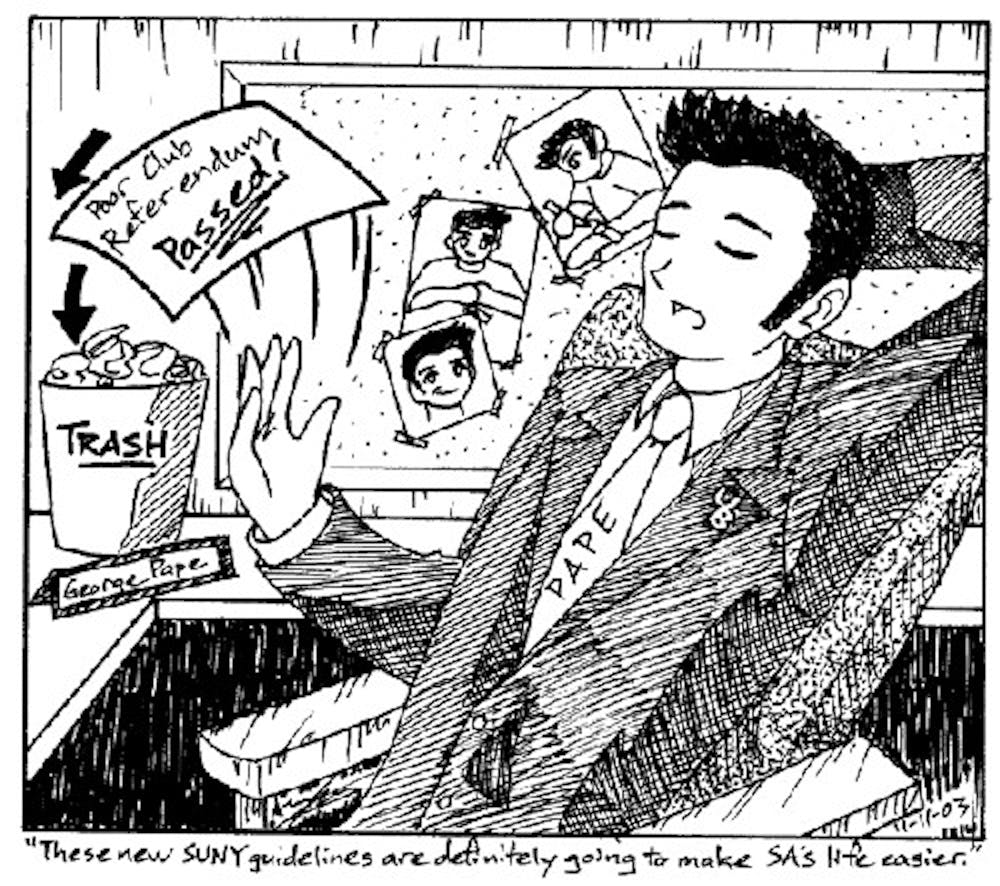
Under new SUNY guidelines, the Student Association now has oversight of the Student Subscription Fee to The Spectrum, and is using their power to review the financial situation of the only independent undergraduate student newspaper. The strong-arm tactics are nothing more than an effort to push The Spectrum into a situation that will be ethically compromising to the newspaper, the student governments and ultimately to the students.
There are several issues revolving around control of the newspaper, involving financing, ethics, coverage, time and the law. Legally, SA is no longer required to adhere to student referendums involving money. Despite a student vote that sets a subscription fee for The Spectrum, the governing body can choose to spend that money any way they want. Those powers also extend to the ability to raise student activity fees without any oversight or student awareness.
The SA Senate Allocation Review Committee claims that while the undergraduate students pay a subscription, students in other graduate and professional programs can pick up the paper for free. This is true. Faculty and even off-campus community members may also pick up the paper. The fact remains that the paper is written, photographed and designed entirely by undergraduates, and the coverage itself deals almost entirely with undergraduate matters.
SA has suggested The Spectrum look to other student governments for monetary funding, but that would be a failure. The $30,000 that comes from SA is only about 1.3 percent of their budget. An equivalent amount from any other government's budget would not be enough to even fund a single issue of the newspaper. Also, The Spectrum would have to cover other events, when it is committed to being an undergraduate newspaper.
The process The Spectrum must go through is not completely inefficient. If SA honestly believes that money can be saved in a certain area, their suggestions will be welcomed. Over the last year, The Spectrum has gone through many different cuts and is always looking for ways to be run more efficiently. However, the search for alternate funding has already been conducted and is ethically compromising in that other governments consistently ask for certain coverage requirements in exchange for funding.
The weekly meetings with the Senate Allocation Review Committee are designed to force The Spectrum into a corner, and make concessions where none should be made. While there was a referendum last semester to increase the subscription fee, The Spectrum has made no other attempts to acquire funding from that avenue. Since that point, The Spectrum has cut corners and worked things out, making another review entirely unnecessary.
This situation is a waste of resources for every party. The Spectrum is committed to putting out a newspaper three times weekly and should not have to worry about fending off power-hungry committees. SA would be better served to stop complaining about their coverage, and realize that it is their own ill-formed ideas that cause the bad coverage, not a bias to smear their efforts.
The undergraduate students have voted in favor of a small subscription fee in order to help fund The Spectrum. The students are the ultimate loser in this affair, as their voices no longer mean anything to their elected government, chosen to represent their interests. If SA actually cares how their time and money is spent, they are doing a poor job of showing their concerns. Their inquiry has no basis and should be abandoned.



