
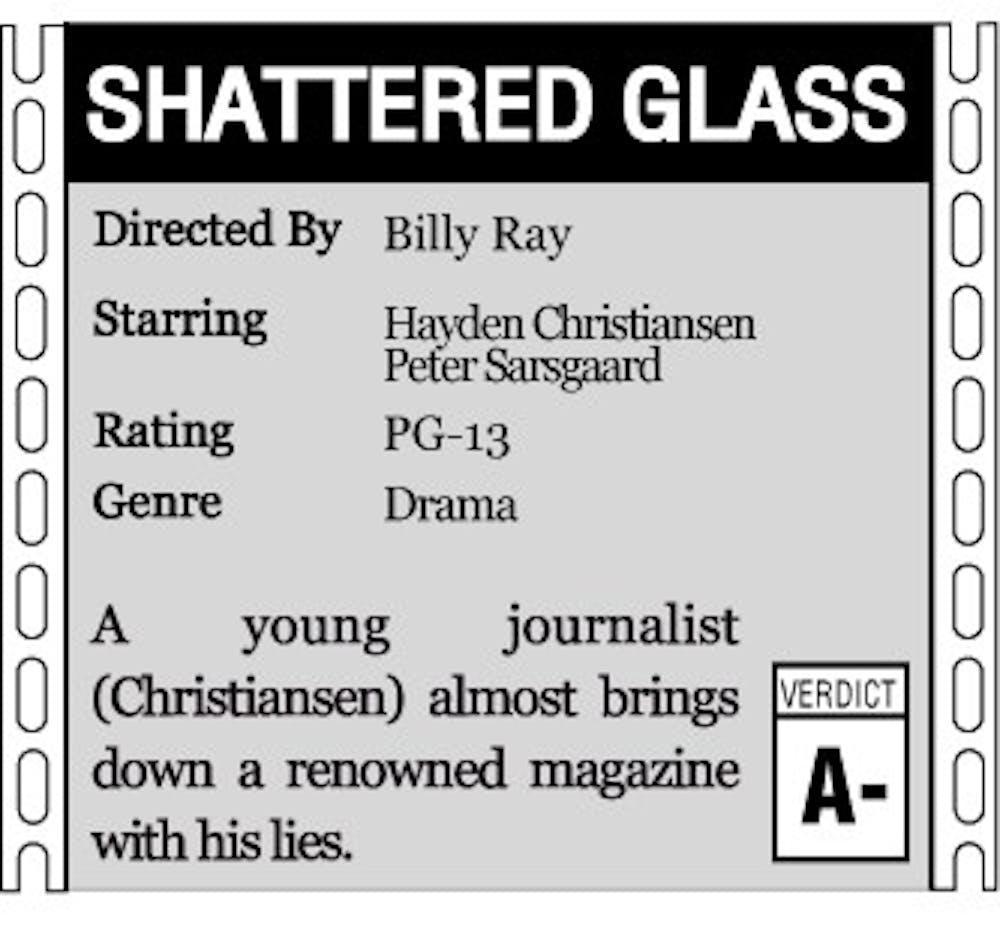
Upon hearing the premise of director Billy Ray's "Shattered Glass" - a promising, young journalist climbs the ranks at a distinguished publication, then falls into an endless pool of lies and plagiarism - common sense would immediately bring to mind Jayson Blair.
Blair, the former New York Times writer, was exposed earlier this year for fabricating many articles, bringing to the attention of the nation's most discriminating readers the systemic loopholes lying beneath the surface of legit journalism.
But Ray's intriguing retelling of the film's true-to-life story is, while equally troubling and fascinatingly disturbing, not about Blair at all.
Hayden Christiansen, star of the "Star Wars" prequel trilogy, is Stephen Glass, the young Penn State graduate who became an associate editor at The New Republic magazine in the late 1990s. Out of mid-air, it seemed, he found himself in the middle of a giant mess.
Or as Glass calls it, "a big mistake."
From the start Glass lies somewhere between victim and villain, and is a strong character amidst the magazine's otherwise Joe Schmo staff. Glass is too oblivious to realize that he has no shot of climbing any professional ladder by being overly impressive at office meetings; at least not at the cost of being fake.
He lies about article subjects; he lies about their phone numbers; he even creates a Web site for a company that doesn't even exist. He essentially creates a wave of pain for co-workers, senior staff and, ultimately, his own psyche.
No one needs to be told how this story ends.
The trouble with Glass isn't that his lesson is sorely learned. Anyone, in any job, would be held accountable for his or her dishonest actions. Thankfully, the film never sinks so low as to ask the audience to question Glass' actions. Just his motives are on the line.
The purpose of "Shattered Glass" isn't just to expose the common plight of the workplace, either; that was "Ally McBeal's" job.
Thanks to some highly creative shots in the film's concluding moments, Ray pinpoints the real story behind the headlines: one little white lie, while seemingly unintentional, can create ripples of pain. It's a basic rule of thumb, really; children are taught this the age at which they learn to speak. Glass appears to have missed that memo, and that's what's so puzzling about him.
Few of Ray's storytelling decisions are poor, though they do exist. The first act jumps into action abruptly, as if to suggest that Glass' problems started at the New Republic. What the hour-and-a-half never even touches upon is why a writer so promising could look past conventional commonsense.
Like the lead of a proper news article, the essential information of a story - the "who," the "what," the "where" - must be properly introduced before the "why" can even be dealt with. Ray's composition, as it stands, might be confusing for anyone previously unfamiliar with the story.
This isn't to say that the weak leading minutes make the film a bad one. Ray immediately employs a unique filmmaking language. Even the stylistic trailer is eye-catching.
Christiansen digs a deep characterization that the story's progression benefits from. If he were any less convincing, or the slightest bit the "bad guy," it would be no more effective a moral tale than a 1950's instructional film reel depicting "little Johnny" lying to his parents about getting an "F" on a test.
The difference is that in Johnny's film, all an "F" gets is a slap on the wrist.



