
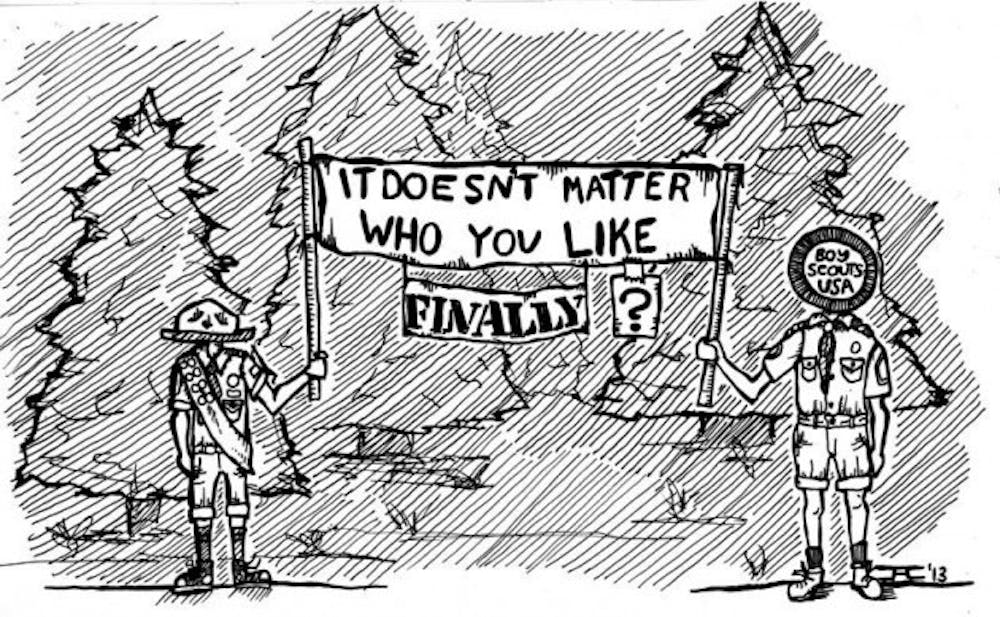
In a statement last Monday, the Boy Scouts of America (BSA) indicated its policy of "not granting membership to open or avowed homosexuals" might soon come to an end.
The end of the organization's backward and intolerant policy is long overdue, and anything less than full reversal is unacceptable.
The recent release is a complete 180 from the organization's news back in July, when it clarified its ban on gays and lesbians following a two-year evaluation. Seven months ago, the Scouts said it would take no further action to change its policy.
You can only be so strong when your former members are attacking your morals, though. Hundreds of former Eagle Scouts renounced their rank and returned their medals in response to the decision, spurring protest through social media and the blogosphere. It seems the Scouts couldn't handle the pressure.
Since the BSA's founding back in 1910, it has worked toward building the strong and capable leaders of tomorrow. But 1910's version of "tomorrow" is different from today's, and the organization needs to change to reflect that by eliminating the biases and hatred cleverly penned as part of its membership code.
To be clear, if the policy is to change, it will not be a national reversal. The organization of 2.7 million members is considering eliminating its national policy, but decisions on gay membership will most likely differ from charter to charter. Each local troop would be able to determine its own policy "consistent with each organization's mission, principles or religious beliefs."
A fair step in the right direction, but it's not enough, as history has proven. In 2000, the U.S. Supreme Court reversed a decision made by N.J.'s highest court that required the BSA to re-admit assistant Scoutmaster James Dale after he made his homosexuality public and, as a result, was expelled. Boy Scouts of America v. Dale determined BSA and all private organizations are protected under freedom of association and the First Amendment to set membership standards.
BSA stands alone on this one, as other organizations, such as the Girl Scouts of the USA, the Boys & Girls Clubs of America and most recently the U.S. Armed Forces, have disassociated themselves with prejudice. Unlike the Scouts, these organizations no longer need to hide behind an excuse.
Like BSA's ban on atheist and agnostic members, the organization's forbidding of homosexuals stems from its connections to religious groups. The Catholic Church and the Church of Jesus Christ of Latter-day Saints are among the Scouts' biggest backers, and approximately 70 percent of Scout troops are affiliated with a religious group of some sort.
The Scouts' policies are bound to change given time, and if they don't, they risk becoming socially irrelevant.This specific case mirrors the organization's former policy on racial segregation, which was also left to the local level. It wasn't until 1974 when one of the last racially segregated troops broke its policy.
When are we going to teach children your sexuality doesn't determine how much of a man you are? And since when is the BSA the determining factor of manliness and morality anyway, especially as it faces an extensive sexual abuse investigation at the moment? When will we teach them "moral values" include decency and respect and acceptance? We create a list of excuses for why and why not when we should be teaching them it doesn't matter.
If BSA is so sure the skills it teaches are vital for boys growing up, then it makes no sense to separate them from learning. Character, leadership, loyalty, bravery - these are all fantastic traits we should be teaching our children and traits BSA claims it is teaching them. But the Scouts should also be teaching tolerance and acceptance, especially at such an important, malleable age.
Email: editorial@ubspectrum.com
 Photo: The Spectrum Archives


