
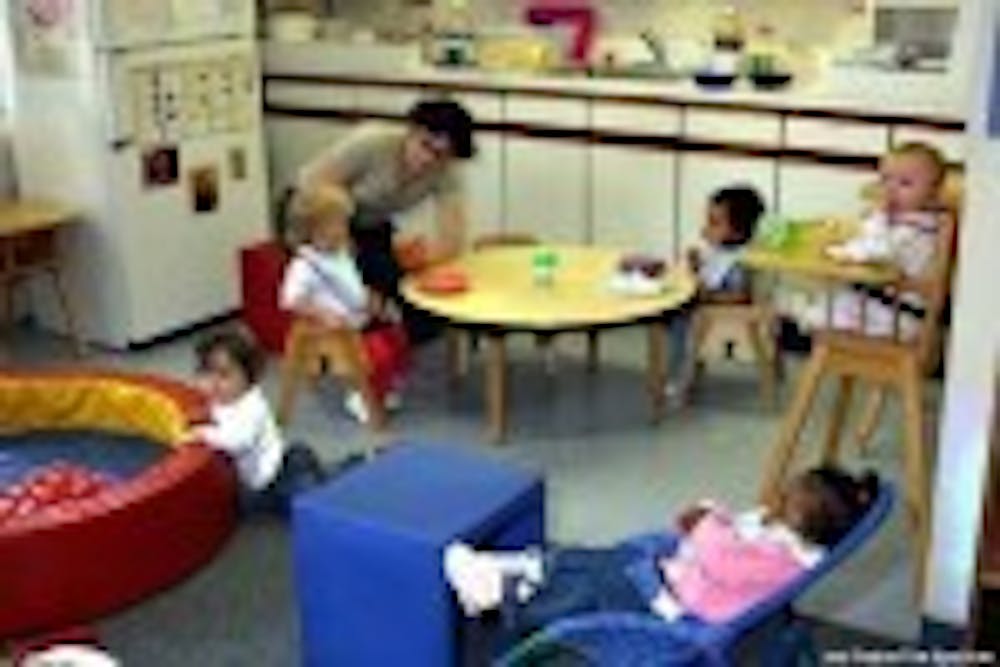
The smallest members of the UB community are living large. They have two personal gyms, custom bathroom fixtures, walls with original artwork, fresh greenery in the centerpieces of their custom dining room tables and a two-hour midday siesta.
It's a small wonder that there are 150 parents of toddlers on the waiting list. Life can be good for those under five years old and attending a UB Child Care Center.
The UB centers, one on each campus, provide daylong care and education for 145 children of students, faculty and staff.
"We believe there's education going on no matter what they are doing," said Director Dr. Tamara Jacobson, who has a Ph.D. in Early Childhood Education. "We're a very prominent child care center. We also are a training site. UB, Buffalo State College and Erie Community College use our site to train their early childhood interns."
In 2003, the National Coalition of Campus Children's Centers awarded Jacobson their Director of the Year award, and her apparent dedication to children and their care is visible throughout UB's facility.
The outer appearance of the larger of the two centers is unassuming at best. Established in 1985, it is housed in Butler Annex on South Campus and about three times the size of the North Campus site on St. Rita's Lane near South Lake Village. The two buildings of Butler Annex can be seen from Bailey Avenue. They are long, low, gray utilitarian metal buildings, which were meant to be temporary structures. Inside, however, the staff has created a pleasant, homelike atmosphere.
The "custom" dining room tables are kid-sized, as are the sinks and other fixtures in the lavatories, proportioned to make it easy for toddlers and pre-schoolers to use. The "centerpieces" are small round vases with a fresh, living plant floating in each of them.
The "original artwork" is the children's own, ranging from paintings of flowers to a drawing of a kid-sized human body with various body parts and organs labeled. When some of these girls and boys get to anatomy class in about 16 years, they will already know what "phalanges" are, as well as be able to spell the word.
The toddlers, 18 months to three-years-old, have a gym in one building; preschoolers, three to five-years-old, have one in the other. The preschool gym has one plastic basketball hoop at an appropriate height. The children on North Campus use the Alumni Arena gym.
Jacobson said that while the children benefit from education and care, so do the parents.
"For the faculty and staff, they become more productive when they know that their children are receiving quality care and education and are safe," she said. "For the (university students) it's even more powerful because they can go back to school, and some of them really need that."
About 60 percent of the kids are children of UB students, Kathi James, assistant director of the center, noted; the rest are children of faculty and staff. The on-campus locations give parents easy access to their children. Under the open-door policy adopted by the centers, parents can come see them at any time during the day.
"We have some parents who come and have lunch every day with their children," Jacobson said.
Mothers who are breast-feeding infants will come up to three times a day to nurse, she added. The centers accept babies as young as six-weeks-old.
The students' day starts early. Children arrive as early as 7:15 a.m. and have breakfast and quiet play until 9 a.m.
"They'll do all kinds of things - work with clay, woodworking, play with building blocks ... they might do something with what they're studying, (or) whatever the theme is that they're learning," Jacobson said.
Other activities include "circle time" - which involves group games, songs or stories. Then it's outside for an hour of playground time or walks. The weather doesn't often curtail the daily schedule, although if the temperature falls below 20 degrees or it rains hard, they usually stay inside.
According to James, the kids enjoy winter anyway.
"They love to play in the snow," she said.
After a hot lunch provided by UB's Faculty Student Association, it's two hours of naptime in their group rooms. Individually decorated by the teachers, each room might contain between 12 to 15 children. With the lights lowered, soft music playing, and curtains and artwork softening the look, the rooms become almost like bedrooms.
After awakening at about 2:30 p.m., the children have more play and learning time. The after-nap period is a bit less structured, and is kept open to enable the children time to pursue more individual activities and interests. Activities include working on puzzles, writing, reading, playground time, or using the computers available to them.
"They do some computer work, mainly games and learning programs," said James.
After that, it's time to go home. Pickup time for parents is between 5:30 p.m. and 5:45 p.m.
While the infants up to 18 months don't have formal organized activities, the ratio of staff to infants is 1-2, enabling them to provide close, hands-on attention.
"Singing to and playing with them, helping them with crawling and standing - you are developing children all the time," said Jacobson. "Talking and reading to children is the way you help them read, write and talk."
Eighty percent of the budget comes from tuition and 20 percent from grant funding, according to Jacobson. While the University doesn't give them a check, it does provide the site, electricity, custodial service and grounds maintenance.
"So it's like they give us dollars," Jacobson said. "They're very generous in what they do."
The tuition itself is on a sliding scale, depending on a child's age and family income. It can be as low as $98 a week or as high as $192 for full-time attendees. Part-time enrollment is allowed but no less than two full or five half days a week. The centers are not for "drop in" care while a student or faculty member has a class or two. It is also a year-long program, running through the summer and holiday breaks.
"In terms of what's out there," Jacobson said, "we feel (the tuition is) quite reasonable."
Many of the parents with children at the center are graduate students, who are studying in a wide variety of majors.
"It really is a good mix," she observed. "It's well spread across the board, at least this year. It can vary from year to year."
Jacobson and James said they'd love to be able to expand the program. They were able to open the North Campus center in 1998, and it filled rapidly, leading to the current waiting list. Right now, they say, any thought of expansion is in the early stages where the hope is to make the administration aware of the need for it.
In the meantime, Jacobson has a recommendation for anyone hoping to send his or her child to the center - apply early. Especially since, she said, university departments have been known to use the centers to attract faculty.
"Sometimes departments recruit faculty saying, 'You know, we have child care,'" she said. "If you are a parent with an infant you probably have a year wait, so it's good to get on the list while you're



