
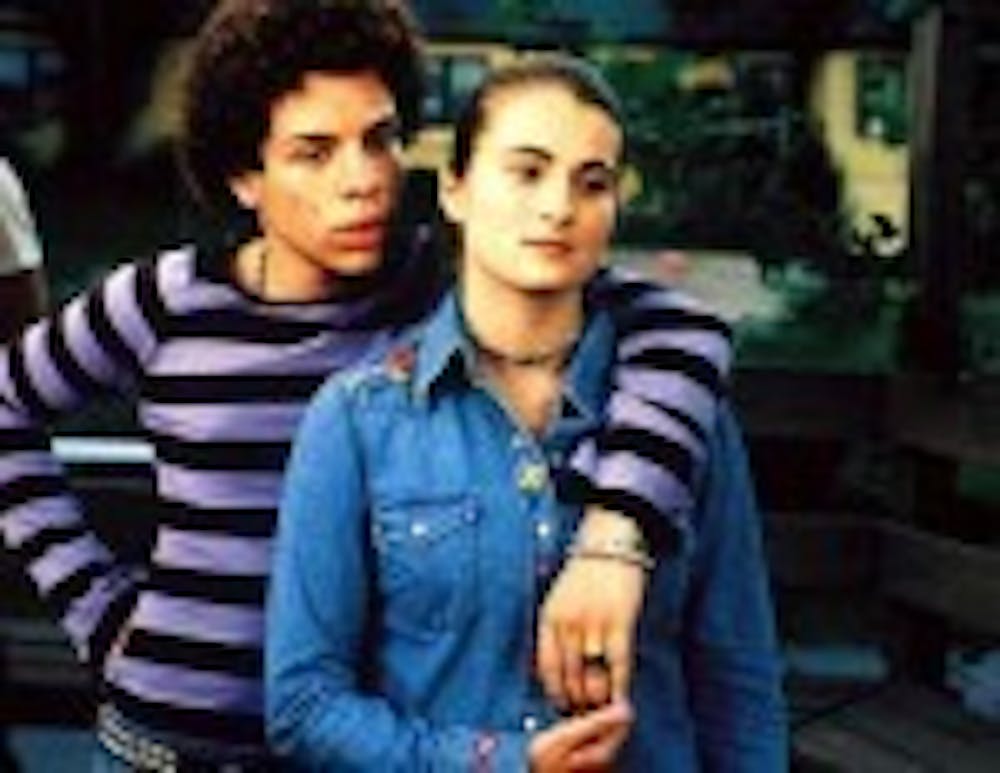
Advertisements and promotions for Todd Graff's new film, "Camp," call it "a comedy about drama." While not the most accurate sentiment to describe the film, which takes its name from the term used to describe exaggerated and self-parodying behavior, it's the most appropriate one with which to advertise.
The film, which opened last weekend at the Dipson Theater on Main Street in Amherst, is smart at times but silly at others. It never quite lifts off the ground the way a good movie should, but that shouldn't be held against it. It's got an awfully generous amount of heart, a few very hilarious scenes, and some good lessons that everyone could benefit from.
There is a summer camp for just about every kind of kid, with every emotional or social "situation," disease or otherwise abnormal characteristic. The guiding essence behind these getaways is to harbor a feeling of community, safety, and, ultimately, acceptance.
This camp, called "Camp Ovation," and loosely crafted after the real-life "Stagedoor Manor" in upstate New York, is for kids who love musical theater. Drawing the most popular of high school blondes, the most rejected of sexually confused pre-pubescent boys, and just about everyone in between, those who attend the camp are there for the love of song and dance.
They're certainly not there for the sports, as director Graff's own script wisely points out.
Vlad (Daniel Letterle), a camp rookie and the only "is-he-or-isn't-he-gay?" male, sweeps into camp as if on a horse and chariot. The girls, primarily Ellen (Joanna Chilcoat) and Jill (Alana Allen), swoon over him, while the certifiably homosexual boys blush in his presence. The brief doubt over Vlad's sexuality is a natural plot point to explore, but is quickly and thankfully dismissed.
Michael (Robin DeJesus) is certain about his sexual orientation, and that's what gets him into trouble back home. The opening scenes of the film are of Michael attending his high school prom alone, and in drag. With quick edits juxtaposed against a camp production number, the gospel-heavy "How Shall I See You Through My Tears," the film quickly and frankly makes the point that differences do not set people apart-they bring them together.
It's an appropriate and honest introduction to this "Fame" meets "The Wonder Years" atmosphere, although the next moment of true sentimentality-not the soap opera gush that carries most of the second act-doesn't come until the movie is almost over.
If "Camp" bills itself as a comedy about drama, logic dictates it be funny most of the time, not just occasionally. However, the only real hilarious moments come when Fritzi (Anna Kendrick), Jill's subservient and not-as-pretty roommate, poisons buxom Jill's Snapple with hair dye, leaving Jill unable to finish her onstage solo number, "The Ladies Who Lunch." Jill vomits onstage-and on cue-, leaving Fritzi to take over. Both carry the scene hilariously, and with quite accomplished vocal work.
In another brief sequence, two African-American brothers, one approximately 17-years-old and one around the age of eight, complain about the camp's all-white shows. They request more culturally diverse roles, and are promised color-blind casting for the upcoming production of "Dreamgirls."
That scene was funny enough, but Graff, in a moment of inspired brilliance, brings it to another level. A scene from the musical, which is about a Supremes-like girl group of the 1960s, has the younger African-American brother, who wears too-thick glasses, as the business manager to the mature and developed lead singer. On top of that, the traditionally black girl group is headed by a whiter-than-white suburbanite.
Opposites might attract, but an eight-year-old and a 17-year-old in a passionate romance doesn't make sense. It's a great scene, but one of only a couple that takes this camp to higher plateaus of comedy.
As implied, it's not a bad movie. "Camp" just suffers from a few misplaced scenes and dialogue that can't make up its own mind on how dramatic or comedic it wants to be. Usually stuck between moments of high camp-like the break-out-in-song musical theater setting the film thrives on-and after-school special silliness, it's only slightly above a mediocre attempt at an otherwise fine concept.
A more rewarding effort might have been in television form. NBC's short-run "Freaks and Geeks" which ran during the 1999-2000 was the last "high school reject" show to find critical success. In an ideal TV landscape, otherwise sparse with gay-centric themes, "Camp" could take the concept and run with it.
As long as the kids don't have to play any sports.



