
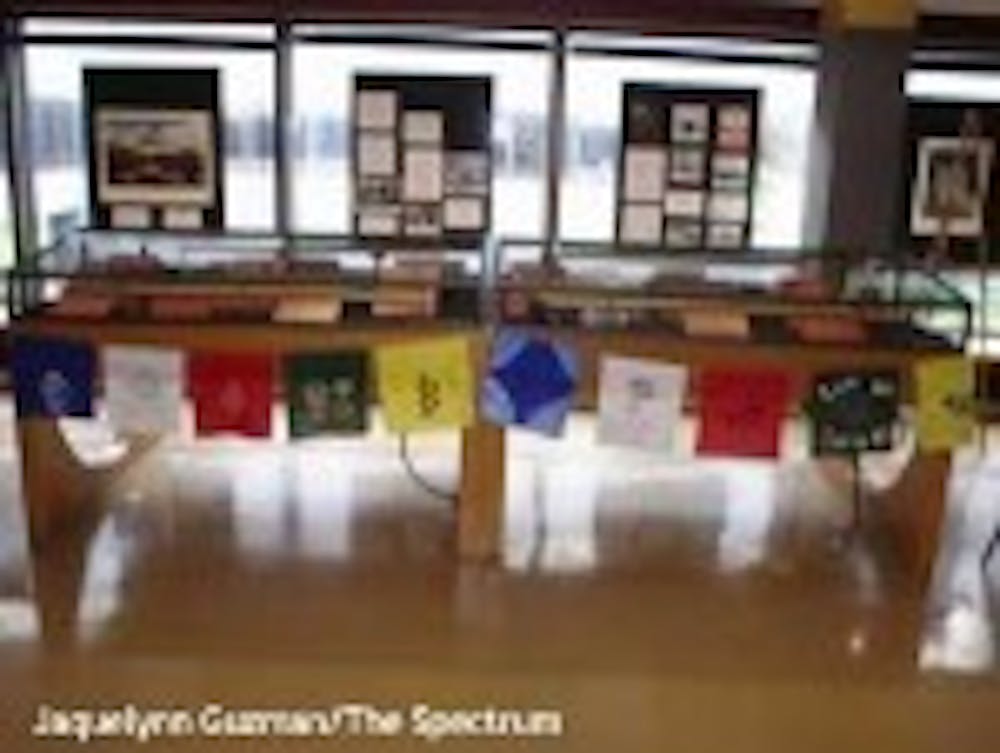
Throughout the month of September, libraries across both North and South Campus will be busy hosting exhibits in honor of His Holiness the 14th Dalai Lama's visit to UB.
The exhibits, which opened on the first of the month, display not only a visual timeline of the Dalai Lama's life and works, but also several installments dedicated to the culture, religion, science, medicine and law of His Holiness' homeland of Tibet.
"These exhibits are important because many UB students are not aware of the challenges and cultural traditions of Tibet, and the outlook and perspectives of Tibetans which are uniquely their own," said Jill Hackenberg, curator of the Undergraduate/Science and Engineering Library exhibit.
The Lockwood Memorial Library exhibit, called "The Dalai Lama, His Life and Thought," displays detailed photography of the Dalai Lama's life, from his childhood in China to his receipt of the Nobel Peace Prize in 1989. It also explains how he was selected as the 14th Dalai Lama, and tells of his exile to Tibet.
The exhibit also displays His Holiness' complete collected works including "The Art of Happiness: the Handbook for Living and Ethics for the New Millennium," which delves into his message of peace and spirituality.
Accompanying this visual biography is a multimedia work area, where patrons can listen to selections from a lecture on the Dalai Lama given by his primary English-language translator and interpreter Dr. Thupten Jinpa.
Also on display are Tibetan Buddhist artifacts, which include mantra scrolls and prayer wheels. The curator of this exhibit, Charles D'Aniello, expects it will be a great success. In fact, several curators noted that students have even stopped to inspect the photos while the exhibit was being set up.
"Visitors tell me they are attracted to the brilliantly colored objects and the informational descriptions of life for an average Tibetan," said Hackenberg.
The staple of the Undergraduate/Science and Engineering Library exhibit, "Tibet: a Cultural & Natural History," are the displays of richly colorful and authentic Tibetan clothing. The exhibit was designed to show how Tibet has developed a unique culture when compared to other Asian societies, mostly due to the fact that it has been fairly isolated throughout time.
Many other members of the UB and Buffalo community have donated to the exhibits. Dr. Richard Lee, a professor at the UB School of Medicine and Biomedical Sciences has donated rare maps, books and photos to the exhibit in the Special Collections Research Room, called "Discovering Tibet: The Development of Western Notions of Central Asia and Tibet."
The artifacts, which date from 500 years ago up to the present, explore travel, experience and beliefs of Tibet and Central Asia.
"There are many myths and misconceptions about little known areas of the Earth that can persist, for centuries," said Dr. Lee, "and lead to misunderstandings and conflict without a good understanding of history."
Tibetan legal manuscripts donated to the Charles B. Sears Law Library in 2004 by Rebecca R. French, a UB Law School professor, will be apart of the Law Library Exhibit entitled "Tibetan Legal Manuscripts". These manuscripts will supplement a scholarly conference "Law, Buddhism and Social Change: A Conversation with His Holiness, the Dalai Lama," which will take place during His Holiness' visit in mid-September.
The Health Sciences Library Exhibit, "'gSoba Rig-pa'" Tibetan Medicine: a Healing Science," explores the history and training in Tibetan medicine, spiritual healing and herbal medicine. Special points of interest are how the five elements-earth, water, fire, wind and space-and the three humors, wind, bile and phlegm, are used to explain the body and how it works. Medical artifacts have been donated to the exhibit Rochester's Amitabha Foundation.
There is also an online exhibit dedicated to Tibetan music and explores Sacred/Monastic, Traditional, Folk and Contemporary music genres as well as Sacred/Monastic and Traditional/Folk musical instruments. This exhibit also provides sound recordings of musical instruments and a host of secondary resources on Tibetan music.



