
During the pandemic, many students were exposed to a “new” kind of coursework that has existed at colleges for years: classes where all instruction is conducted virtually, rather than in a physical classroom. One form of virtual learning that is widely offered at UB is the “asynchronous” option. These courses have no scheduled meeting time, not in-person nor over a live video feed, such as Zoom, but there is still an expectation that work will be handed in according to set deadlines.
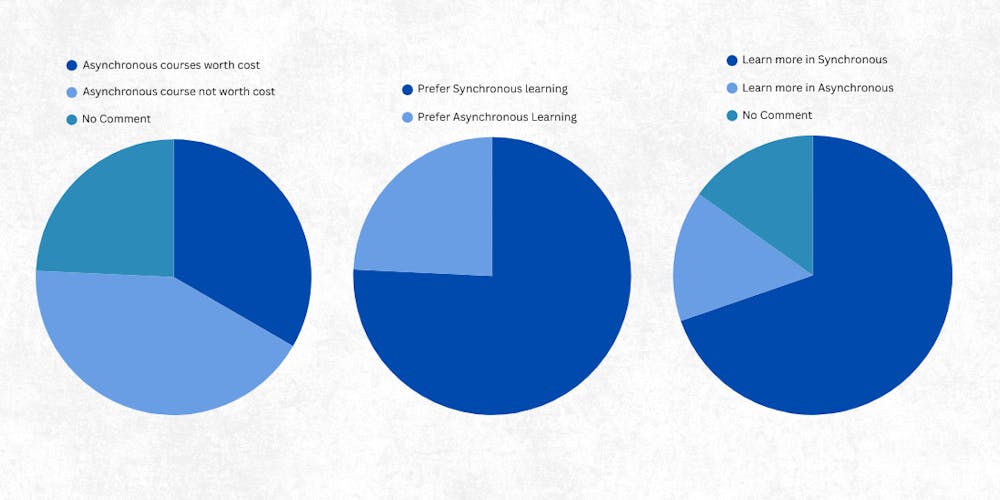
In a survey with students from the UB community in a variety of majors, The Spectrum has uncovered differing student opinions about this form of learning.
Many classes at UB are only offered asynchronously, and there are often pre-recorded lectures, or sometimes, no form of lecture whatsoever. Often, the only communication students will have with their instructor in these courses is through email or virtual office hours, and the only interaction with other students occurs through written discussion boards.
Maya Reynolds, a sophomore English major, enjoyed being able to communicate with fellow students in discussions in past courses, and didn’t get the opportunity to do this in an asynchronous course. Speaking on asynchronous classes, Reynolds gave a succinct answer: “it sucked.”
It may come as no surprise that many students reported difficulty keeping up with coursework when taking asynchronous courses. Many students offered that this was the reason that they preferred synchronous classes over asynchronous courses.
Jacob Cole, a senior in environmental engineering, said that “it makes time management harder not having a scheduled routine.”
Another negative aspect of asynchronous courses is the lack of an ability to speak with other students, form a working relationship with the instructor or have networking opportunities.
Andrea Calderon, a senior biomedical sciences major prefers asynchronous courses, because of the ability to “see a recording” of the lecture.
“Captioning is nice since sometimes people are talking during the lecture and it’s tough to hear [the Professor].” Despite this advantage, Calderon still said that she learns better in person, due to a better student-professor relationship.
A college education is famously an expensive endeavor. Considering that students have to do most of the legwork in an asynchronous course, often without a lecture, students were asked whether they believed that asynchronous courses offered a good value for the overall cost of their education. More students agreed that this was not the case, and that asynchronous classes felt like self study.
Karla Barraza, a sophomore majoring in nursing, expressed a sentiment similar to several other interviewees: “[I’m] not here to teach myself.”
For students who enjoyed asynchronous classes, these courses were worth the cost of their education.
Students expressed that they had more free time when taking asynchronous classes. Without a set meeting time, there is less time spent in class and more time to be spent on other activities. Some students offered that for students who travel to campus, this is a great upside.
Carlie Spall, a senior majoring in biomedical sciences, said of asynchronous courses “they’re easy to access from any location and time, and you don’t need to commute.”
Other students enjoy the ability to set the pace with their learning.
Alex Just, a junior in accounting, said that with asynchronous classes, he could “finish learning when I’m done learning the material, not when the professor thinks that I’m done learning the material.”
Additionally, some students who like free time for work or hobbies prefer asynchronous courses for the ability to have free time.
Nick Pancari, a sophomore in civil engineering, enjoyed the free time afforded by asynchronous classes, which allowed him more time to sleep and focus on his hobbies. He said that having this free time “helped him emotionally.”
It’s clear that many factors play into a student’s ability to enjoy and succeed with asynchronous learning. If these courses will continue to be offered in colleges, student feedback will continue to be necessary for the success of every student.
The features desk can be reached at features@ubspectrum.com
 Photo: Credit: Kishaun Proctor


