
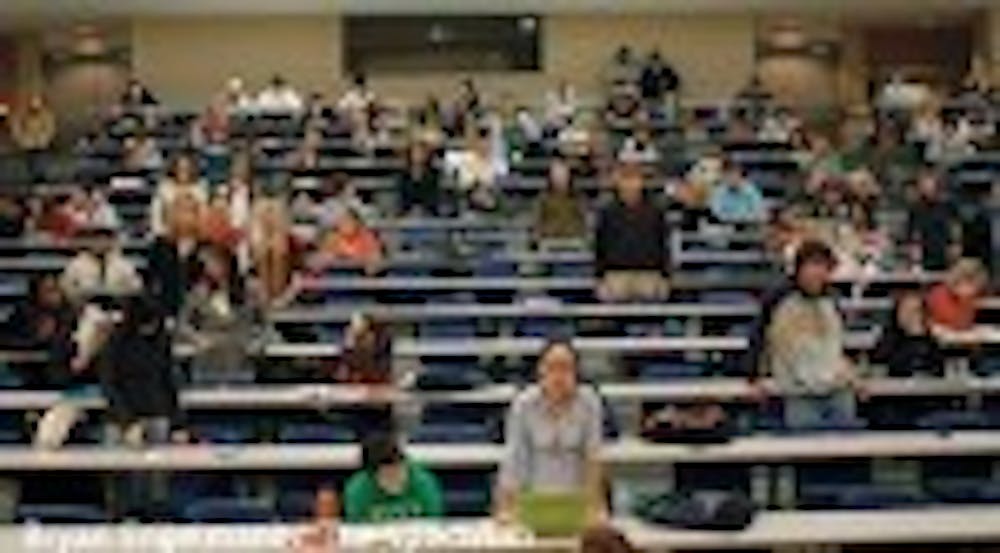
Last Monday night, red dots appeared across UB's North Campus without warning or explanation. By the end of the week, there were about 500 of them in lecture halls, walkways and staircases.
Many students, including Mike Thom, a freshman exercise science major, and Kristin Thompson, a junior business administration major, thought the red dots were a part of an AIDS awareness campaign.
Some students speculated that the red dots were product advertisements.
"I thought it had something to do with Connect Four. They confused me. I had no idea what they were," said Jacob Weiner, a junior chemical engineering major.
Other students developed ideas along the lines of other health campaigns.
"I thought it was to promote the Human papillomavirus (HPV) shots," said Alyssa Placito, a freshman undecided major.
Students' theories proved the underlying idea of the One in Five project, according to the campaign creator Jacquelyn De Jesu, a senior advertising and art direction major.
"The interesting thing was not one person said genital herpes, which just goes to show how little people think about it," De Jesu said.
One in five people have genital herpes. The sexually transmitted disease (STD) is not discussed despite its high prevalence among the general public, according to De Jesu. The placement of the red dots was significant in its representation of the statistic, she said.
"The dots represented the statistic in itself. Showing that on a stairway...you're comparing each step to a person. In the lecture halls, that comparison was more obvious because they are on seats people actually sit in," she said.
About 60 seats were marked with a red dot in each of the three largest lecture halls to make the statistic more visual and easier to grasp, De Jesu said.
"When you look around and see that there are red dots all around you...it means more than if you just heard the numbers," she said.
De Jesu explained the importance of getting people to talk about genital herpes. Usually people automatically shut off when exposed to statistics or information about STDs, she said.
"I just wanted people to internalize the statistic without reaction people usually have when talking about STDs," De Jesu said. "More people were able to absorb and internalize what I was trying to say before just brushing it off."
Hundreds of red circular flyers announcing the project's name were distributed this past Monday, a week after the unexplained emergence of red dots. The buzz and curiosity of the UB community worked purposefully for the project, she said.
"When you intrigue people and they are curious that is one of the best ways to get people's attention and have them retain something. When somebody has a question, they want to know the answer," De Jesu said.
The project was completed as an independent study. The sticker campaign had to be authorized by Vice President of Student Affairs Dennis Black, according to De Jesu. A public art installation proposal was needed for the project's main display of red dots on the Center of the Arts.
"Nothing is as big as that. That definitely is the main focus. I'm really lucky that I had that because it pulled everything together and people realized it was actually a project," De Jesu said.
Some students did not see the red dots despite the wide distribution, according to De Jesu. This illustrates a significant point, she said.
"I will walk up to some people when handing out the flyers and they haven't seen the dots," De Jesu said. "It shows how people go about their day to day lives not paying attention to things like this."
Benjamin Van Dyke, associate professor in the Visual Studies Department, oversaw the project. According to Van Dyke, the public art project was effective in serving two purposes.
"First, it changes the architecture of the university in some ways, which is really effective and interesting. When that happens...it makes people pay attention, and when you have a message behind it, it can be really powerful," Van Dyke said.
The red dots must be taken down by Saturday, Dec. 8, according to De Jesu. A video will also be put together in conjunction with the project.
"We walked around with a video camera and first we taped people's reactions just when they were walking by the CFA. Then we asked a couple of people what they thought they were - there were some very interesting responses," De Jesu said.



