
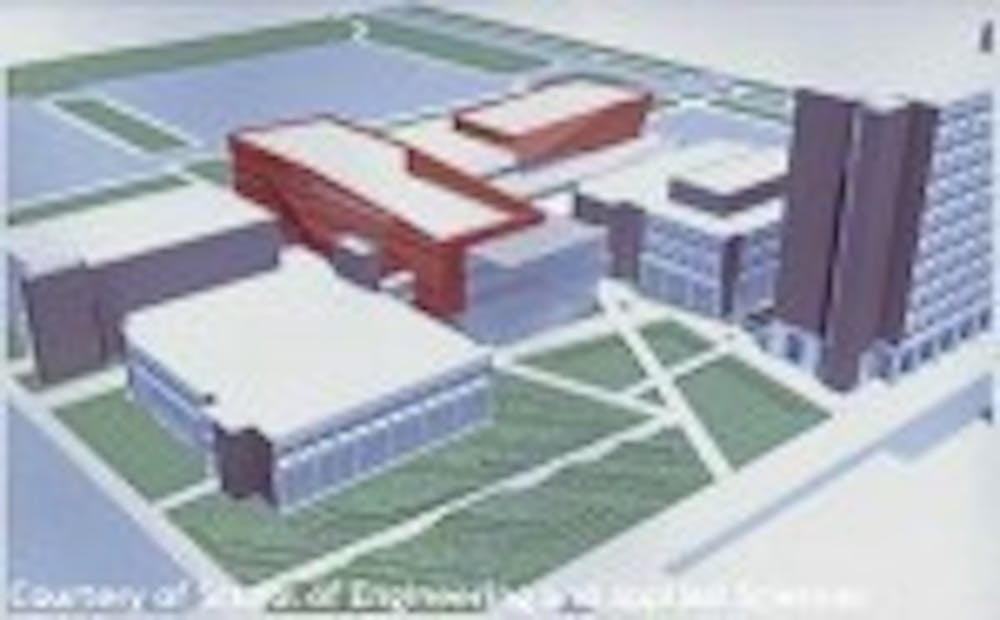
Engineering students can wave goodbye to the trailers between Ketter and Jarvis Halls. Come spring, the structures intended as a temporary solution to overcrowding in the late 1980s will be removed to make way for a new engineering building.
Designs for the new building are now being finalized. Construction is set to begin in Fall 2009 and scheduled to be finished in the summer of 2011. The new building will look like neighboring Furnas and Bell Halls.
"It will blend in, but it won't mimic them," said Harvey Stenger, dean of the School of Engineering and Applied Sciences.
The three-story building will comprise 130,000 gross square feet and provide the department with new classrooms, laboratories, and offices. Architectural highlights include a lobby area for relaxation between classes, and special rooms that will utilize the latest in computer science and engineering technology.
The "smart room" will use special technology that allows the room to change its features based on the needs of the person inside of it - similar to the rooms said to occupy Bill Gates' home.
"It's going to be a state-of-the-art facility," said Tim Siderakis, senior director of development in the School of Engineering.
There will also be a clean room, which filters out dust and pollutants from the air to allow for advanced research in electrical engineering and computer science. A cybertorium will help students engage in video conferencing and long distance learning.
"[The building] is vital to the future growth and development of the school," Siderakis said. "It will help us surpass many of the peer institutions that we are compared to."
The new structure is one of many future enhancements for the School of Engineering based on its planned advancements under UB 2020. The school is planning on growing in both prominence and size, according to Siderakis, resulting in the removal of the trailers.
"We're already busting at the seams," he said. "Ten trailers that graduate students are doing research out of - that's unacceptable."
Part of the designing and planning of the new building came straight from the people who will benefit from it the most - the students. Engineers for a Sustainable World (ESW) is a club on campus that has provided insight into ways to make the building the most useful for students.
"[We] know the building design and schematics pretty much as well as anyone here at UB," said Chris Llop, the ESW president.
More than 60 percent of the estimated $73 million cost of the building is covered by New York State. The rest depends on contributions from prominent alumni and corporations.
Recently, an anonymous corporation made a $1 million donation to the school for the project.
"We're not there yet," Stenger said. "We definitely have a lot of work to do to meet our goal. That one million is a nice step towards the money we need to raise."
UB, in the fundraising phase of the project, is currently talking with close friends and area businesses that may have an interest in investing. One local business gave a contribution to the school's new building efforts because they have hired several UB engineering graduates and wanted to show support for education.
"Philanthropy can lead to that margin of excellence," said Siderakis. "Private support can bring it over the top."


