
Two cultures bonding through art have resulted in the UB Art Gallery's hosting of the "Chinese Maximalism" exhibit, in which 16 contemporary Chinese artists, all with very unique perspectives on art, are showcased. The exhibit, the first of its kind in Western New York, is on display at the Center for the Arts through Jan. 1, 2004.
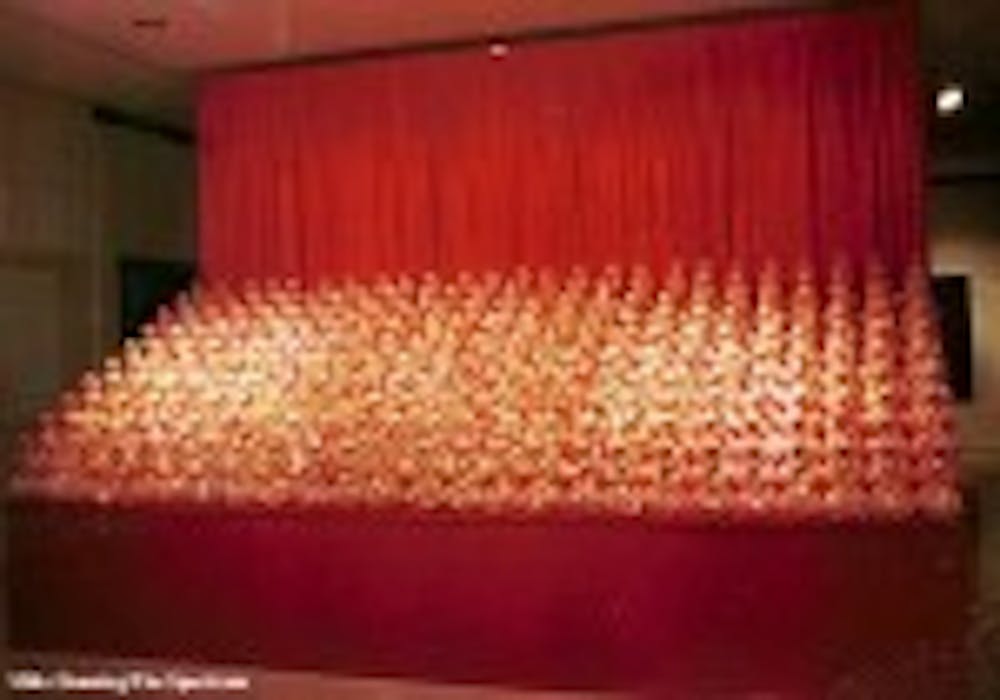
Two hundred fifty shiny, red-dressed dolls greet visitors who enter the gallery. Each doll is a blonde-haired, blue-eyed creation of China. The dolls sing the irritating pop song "Barbie Girl" by Aqua, moving their arms, some with blinking red lights for earrings. Set up to perform until they run out of batteries, the dolls' singing is warped, and some do not sing at all. Presented by Gu Dexin, the piece contrasts female sexuality with childhood, a duo that is often meshed in today's society and pop culture.
Five large paintings of oil on canvas by Zhu Xiaohe appear similar to the "magic-eye" images that gained popularity in the mid-1990s. The piece was formed with the bright use of color and well-placed dash marks. It takes a step back to see what Xiaohe's work has to offer.
"It Looks Very Beautiful - The Second Performance" is a series of seven paintings by Wu Yiming. At first glance, each painting appears identical to the next. After further attention is given, slight differences appear in the black and white figures of the same faceless woman. It is like trying to spot the differences between two cartoons in the comics section of the newspaper.
An especially aesthetically pleasing work by Qin Yufen is suspended from the ceiling; it incorporates the sounds of Chinese lute music in a roomful of white paper surgical masks. Peaceful and one-of-a-kind, the work stuns the viewer with an exquisite combination of elements and natural light.
Xing Danwen displays photographs of computer parts that have been clumped together in different forms. A critical take on the consumer waster, the subject matter is unexpected, but interesting to view from the artist's angle.
Hong Hao's manner of creating artwork is photographing everyday objects, scanning them and then strategically organizing them together. The three displayed works by this artist include objects such as food, buttons, torn pictures, office supplies, cell phones, tools and nuts. One entire work is devoted to hair. These pieces are outrageously colorful. Trying to pick out one specific object is like searching for Waldo.
There are three videos included in the exhibit. The first, entitled "Summer of '69," by Cao Kai, reveals a video of youth singing the lyrics to the title song by Bryan Adams, images of young Red Guards en route to Tiananmen Square and footage of the March on Washington in 1963.
A second video is shown in conjunction with Song Tao's 57 sheets of blue print graph paper, each with a sequential design of blackened boxes.
The third is a humorous piece. Yang Zhenzhong shows footage of a hen and cock pecking away at rice, while a man and woman count each piece in Chinese.
The upstairs of the exhibit contains a more generalized theme of design and replication than the downstairs, which is more diverse. Lei Hong's works are done in charcoal on paper, with a red matte-border. Xu Hongmin uses simple black and white shapes to make a bold contrast.
The most vibrant and colorful works are by Ding Yi, whose focus is on using a simple cross shape many times in each piece. Some pieces appear almost like Oriental rugs, with repeating colors and patterns, elongated, and done on corrugated paper.
Lastly, standing as a temple in the center of the gallery, Zhu Jinshi's "No Beginning No End" is an overwhelming work consisting of wood and ivory rice paper. Appearing soft, yet crinkly, the structure extends from floor to ceiling. It is an homage to Chinese culture.
There is no lack of creativity within the Chinese Maximalism showing. It is, without a doubt, an exhibit unlike any other. It is a cultural display that should not be missed. "Chinese Maximalism" is free for all.



