
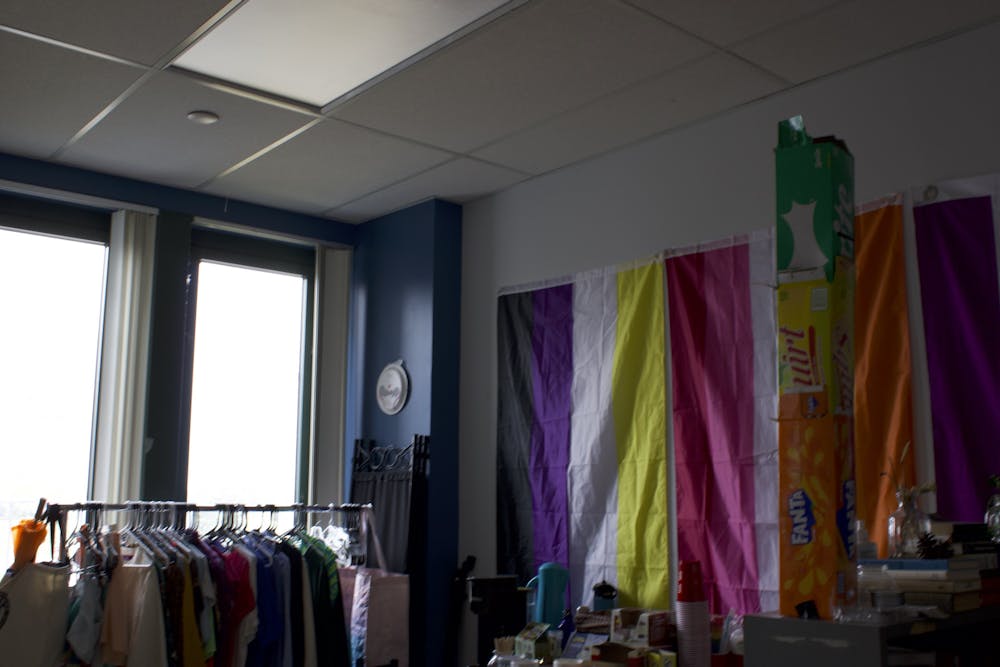
Rouge Rodriguez didn’t have any friends when they started attending UB as a freshman at the height of the COVID pandemic.
Per the quintessential student experience of quarantines, most classes were online and club meetings were rare. And being a commuter student only compounded the isolation.
That was until Rodriguez visited Student Union 373: the home of a queer space run by UB’s LGBTA student club. It soon went from two to three visits weekly to anytime they had a gap in their schedule.
“It offered a way to have that social support which I think is especially needed,” Rodriguez said. “I really do miss it. I wish I had time to go back.”
Rodriguez is now a second-year graduate student in public health; even though they’re still at UB, they miss that room.
That space is set to be shut down at the end of this month.
Over the past several years, the university has been slowly discontinuing its practice of allowing student clubs to exclusively use rooms on-campus. All organizations, except for the LGBTA club, have moved out of rooms they were once assigned in SU and must now book rooms through UBLinked.
But the LGBTA club’s e-board is fighting to keep the space with a petition that reached about 560 signatures. They argue that SU 373 still needs to be the exception, because the queer space is for everyone — not just club members.
LGBTA club, university clash on new policy
Ending the practice of assigning clubs individual rooms is part of “ongoing efforts to ensure equitable access to SU spaces,” according to a university email that was sent on Oct. 2 notifying the club’s e-board that they needed to vacate the space.
“This change ensures that Student Union continues to provide flexible, inclusive spaces that meet the needs of our entire student population,” SU Director Sue Kurowski wrote in the email.
Kurowski said that the club can, as with all student clubs, reserve meeting and event spaces on-campus upon request, in an email to The Spectrum.
“Student Union staff will continue to work with the club to ensure there is a smooth transition, and that it maintains a strong presence on campus,” Kurowski wrote.
A new commuter lounge would take over SU 373. Nearby rooms will be renovated as well: 303 would host a conference room, 307 a board game room and 370 a multipurpose study area.
But SU 373 isn’t a club-exclusive space according to Kay Heubusch, the club’s president. She claimed that a written agreement was drafted between the LGBTA club and university officials upon the room’s establishment in Nov. 2021 that deemed the room a “community space” and the club would be in charge of running it.
The club doesn’t possess a copy of the agreement.
In a Nov. 2021 email exchange The Spectrum obtained regarding the creation of the queer space in SU 373 between the ‘21-22 LGBTA club’s e-board and Maria Wallace — SU’s director at the time — SU 373 was repeatedly referred to as a “community space.”
Wallace advised the ‘21-22 club e-board to not market the room’s opening event as “Grand Opening by LGBTA” in the email exchange.
“This may be seen as ownership of space and we need to move to ‘Community Space’ philosophy,” Wallace wrote.
Wallace also said that SU will send an email to “all affinity groups regarding the Community Space.”
“Our hopes are as other groups show interest in the space, the master calendar of sorts will expand the hours of the Community Space,” Wallace wrote.
Heubusch says that the university is pushing the idea that SU 373 is a club space.
“The room was established by an agreement between members of the LGBTA and the Student Union but it was not expressly about the LGBTA,” Heubusch said. “It was just the only club that was willing to operate a space for free.”
Kurowski corroborated Wallace's statements, telling The Spectrum the space in SU 373 was established as a community space and not a room to be exclusively used by one club.
Kurowski also said that there is no written agreement on file providing exclusive access to SU 373 to the LGTBA club or its leadership in perpetuity. While the club did have access to an office space prior to the establishment of SU 373, agreements were only for one year at a time, she said.
An agreement provided by Kurowski to The Spectrum — which assigned the LGBTA club an office space during the 2019-20 academic year — stated that it was “valid until the end of the Academic Year for which it was signed.”
‘People want both things to exist’
UB’s LGBTQ+ center will now serve the role as a community space for our students, Kurowski said in an email to The Spectrum.
“UB recognizes the importance of providing safe, welcoming spaces on campus for our students, which is why the university established and opened a new LGBTQ+ Center on the second floor of the Student Union at the start of the fall semester,” Kurowski wrote. “The new center is staffed weekdays during business hours and includes meeting, study and lounge space where students can connect, build community and access support.”
Gi Swords, assistant director of UB’s LGBTQ+ center, told The Spectrum in an email that they are meeting with a variety of students to solicit feedback about ideas for uses and services of the Center, to provide a welcoming and inclusive space for all students.
The club’s e-board disagrees. They claim the center wouldn’t feel like a student-run or even a safe queer space, where there’s less ability to confide in others in a place run primarily by university staff.
Heubusch says that conversations often include things that are “explicit but vital to the queer experience” including words that are known as “reclaimed slurs” — words such as f****t, which have derogatory connotations but may be used by members of the queer community.
“We say these things because they are part of our identities and part of our communities,” Heubusch said. “We worry that in a space that is monitored by staff and has to conform to university standards, that we’re going to lose all those conversations and in doing so we’ll lose part of the collective queer consciousness and community we’ve developed.”
Aaron Field, the club’s secretary, isn’t comfortable coming to the center.
“I don’t know where I would go or what I would do,” Field said. “I would probably just go sit at some random place and not talk to anyone.”
The e-board reached out to multiple university administrators and the undergraduate Student Association’s advocacy department but kept arriving at the same reply: concerns will be taken into account but the club can use the spaces in UB’s LGBTQ+ center.
There is no issue with the center itself, says Heubusch.
“I think it’s a great resource but I think that queer spaces also need to come from the hearts and minds of queer students,” Heubusch said. “People want both things to exist.”
SA Vice President for Advocacy Mason Bayer, who was in contact with the club, did not respond to The Spectrum’s repeated requests for comment by the time of publication.
Members are heartbroken, Heubusch said.
“People are outraged,” Heubusch said. “For a lot of people, it’s felt like a massive betrayal that UB has decided to do this to a queer community space.”
A protest over the closure of SU 373, led by the LGBTA club, will be held at 12:00 p.m. Monday at the corner of Lee Road and Founder’s Promenade.
Emma Anders contributed to the reporting of this article.
Mylien Lai is the senior news editor and can be reached at mylien.lai@ubspectrum.com.

Mylien Lai is the editor-in-chief at The Spectrum. Outside of getting lost in Buffalo, she enjoys practicing the piano and being a bean plant mom. She can be found at @mylien.lai on Instagram.
 Photo: Credit: Kishaun Proctor


