
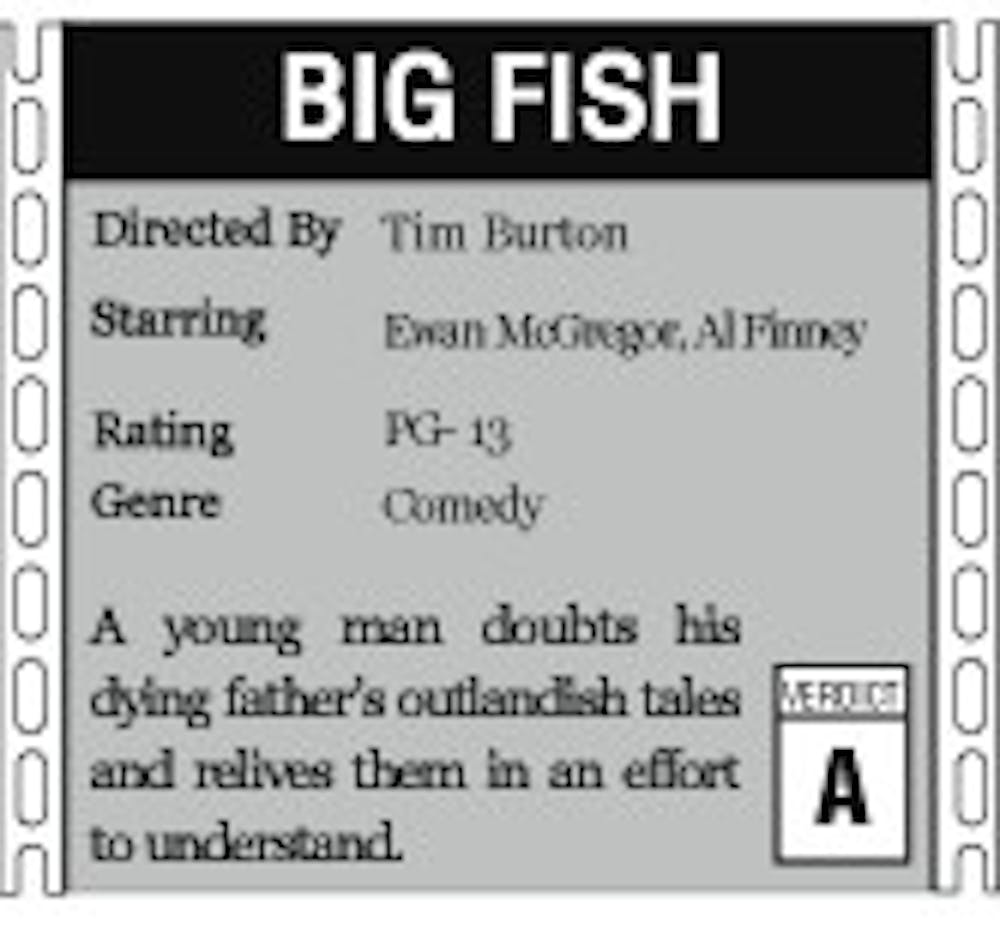
"Big Fish" marks a new approach for director Tim Burton. Known for crafting films such as "Pee-wee's Big Adventure" and "Edward Scissorhands," he is renowned for the imaginative storytelling and dark, brooding atmospheres. With "Big Fish," Burton created an uncharacteristically bright and uplifting film, which thankfully retains the quirky creativity that made his previous movies a joy to watch.
The story of "Big Fish" is relatively simple. William Bloom (Billy Crudup) has grown up listening to the fantastically outrageous stories of his father, Edward (Al Finney). After more than two decades of hearing these tales, Will and his father have a falling out over the credibility of the stories and lose contact for years.
When Will discovers his father is dying, he begins to relive the impossible stories his father had told him throughout his childhood, trying to separate fact from fiction in order to better understand the life Edward lived.
Watching "Big Fish" is almost like watching two movies by two totally different directors, edited together into one. In portraying the young Ed Bloom and the senior Ed Bloom, Burton managed to give each respective life its own emotional and visual style in order to effectively separate fantasy from reality.
The magic of Burton truly shines in the fantasy tales of Ed Bloom's past. These stories are told in a way that only the twisted mind of Burton can tell, and those in dire need of an imaginative kick will be in heaven. Bloom's stories are filled with magic and monsters that encompass the fantasies of any man or woman. There is a witch who can see how a person will die through her crystal eyeball, a singing pair of voluptuous conjoined twins and a ten-foot tall giant in the employ of a surprisingly hairy and mercifully under-acting Danny DeVito ("Death to Smoochy").
Steve Buscemi ("Fargo") also contributes his talents as a mentally unstable poet laureate who has some of the most hilarious scenes in the film, including one in which he tries to rob a bank that was already pilfered by the United States government.
However, one cannot forget to laud the job of Ewan McGregor ("Moulin Rouge!") as the young Ed Bloom. His upbeat performance, along with Burton's colorful and cheery visuals, capture the pure and innocent lifestyle of a man hungry for adventure in the first half of the 20th century. McGregor more than successfully portrays the young Ed and his desire to become something bigger in life, perfectly complementing Finney's performance as the older Bloom.
The focus of reality in "Big Fish" revolves around Will's inability to understand his father's reasons in telling his amazing stories. The despair shown in Will is used by Burton to create a dark and uncomfortable real world. Similar to the atmosphere in previous Burton's films "Batman" and "Sleepy Hollow," the disturbing air increases the nigh-hopelessness that Burton so lovingly presses on the audience's shoulders.
Logic would say that Burton's polar opposite directing styles used in "Big Fish" would conflict with one another, yet strangely, they are quite complementary. The extremes used in separating fantasy from reality work extremely well and, quite frankly, parallel the way people think.
Everyone adds a bit of spice to stories they tell because nothing is ever as exciting in real life, which is visualized perfectly by Burton when Will finally begins to discover the truth about his father.
"Big Fish" is no doubt Tim Burton's best effort to date. The film is as playful as it is serious and as funny as it is heart-wrenchingly sorrowful, a trademark that has sadly been missing in his more recent pictures. With "Big Fish," Burton proves once again he - like Edward Bloom - is not afraid to bend the boundaries of reality in order to bring out the child within us.



