
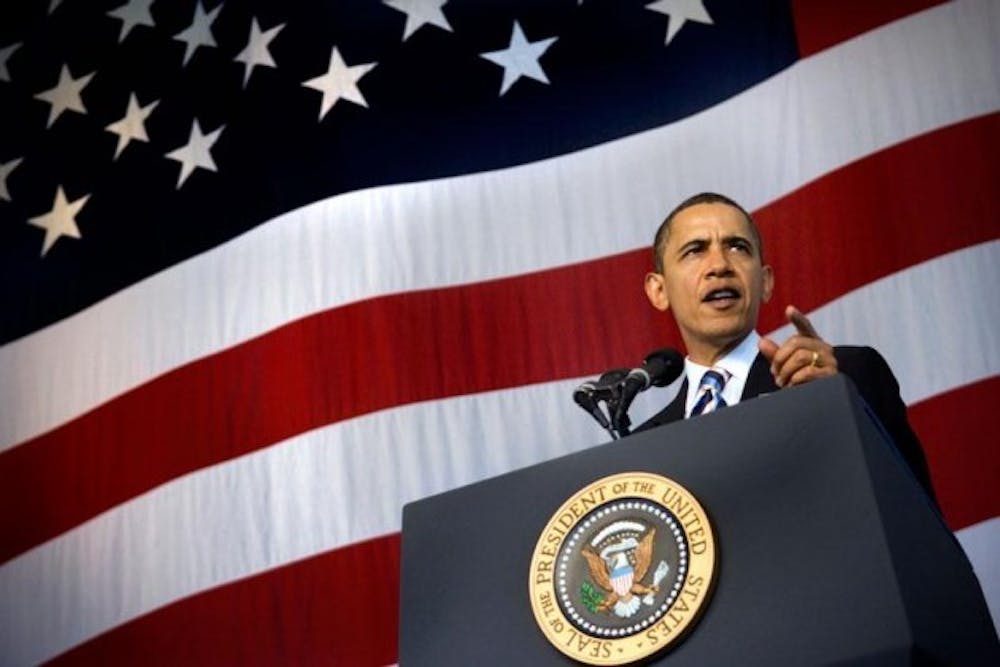
Before the State of the Union on Tuesday, many Americans wondered how President Barack Obama would address a divided Congress about his plans to improve the economy.
In an hour-long speech in which the president addressed immigration reform, gun control and reducing carbon emissions to prevent global warming, he defined the nation's primary goal of achieving prosperity for the middle class. Obama established the most tangible of his list of economic initiatives: raising the minimum wage.
"A growing economy that creates good middle-class jobs - that must be our North Star that guides us," Obama said.
In a move pundits identified as having political appeal to younger Americans - particularly college students - the president proposed an increase in the federal minimum wage from $7.25 an hour to $9.
Michael Calliste, communication director for the College Democrats, thought the speech was superlative and outlined a bold vision for the future.
"I thought his focusing on education, on getting voting rights out there, on lowering gun violence, I thought that was all fantastic," Calliste said. "I think he outlines a more liberal second-term agenda."
James Campbell, a distinguished political science professor, said the speech summarized a fairly partisan agenda and did not defy any expectations he had from the president - outlining a more proactive position of the government to help build the economy.
"I didn't hear any surprises," Campbell said. "His perspective on what it takes to get the economy moving again is in line with what he's been saying over the last four years."
Over breaks, Calliste works for minimum wage in Brooklyn, N.Y., at a local movie theater. He was happy when President Obama made his announcement on Tuesday. However, he also expressed concern over the efficacy of such an economic policy move on a macro-level.
"The idea appeals to me because I work for minimum wage when I'm back home," Calliste said. "I don't necessarily think it's the best idea, but I like where he's thinking."
While Calliste questions the possible effects of raising the minimum wage, he feels it is a good step toward reducing income inequality in the United States. Most Americans can't live off such a low income, he said.
Campbell said such a move would be harmful to what needs to be Obama's highest priority: getting the economy moving and creating jobs.
"It seems to me that increasing the minimum wage has a cost and the cost is jobs," Campbell said. "When the unemployment rate is pretty close to 8 percent and has been there for pretty much his entire time in office, this may not be a good idea in terms of increasing job growth throughout the country. At the margins, raising the minimum wage reduces employment."
James Ingram, communication director for the College Republicans, agrees with Campbell and feels the president doesn't have a substantial fiscal policy directed toward long-term growth.
"Raising the minimum wage will only be a temporary solution," Ingram said. "It's very simple economics. If you raise the minimum wage, eventually the market is going to reach equilibrium again. What we need is creation of new jobs, not temporary solutions like raising the minimum wage."
Ingram feels that now in addition to Obamacare, small businesses will suffer from a federal increase in the minimum wage.
"They want to grow, they want to invest, but when you have to pay part-time employees full medical insurance and $9 an hour, they just can't afford that and it doesn't help businesses expand," Ingram said. "He really does not have a strong grasp on economic concepts."
Calliste thinks Obama's economic theory is more stable than most Republicans believe. By bringing in increased revenue from taxing the wealthiest 1 percent of Americans, Obama is able to invest in social programs that can help ordinary people make the most of their lives.
"I think the wealthiest Americans can afford to have their taxes raised," Calliste said. "Now that he got that in January from the fiscal cliff negotiations, he can really go to work for the Americans that put him in office."
Obama asserted this notion into his speech with the proclamation, "It is our unfinished task to make sure that this government works on behalf of the many and not just the few."
However, Ingram finds Obama's economic proposal misguided and feels there should be reduced taxes on corporations and wealthy Americans who serve as job creators.
Campbell and Ingram are concerned with the way the president is managing the nation's economy. Calliste is glad to see Obama using his second term to push forward a more liberal public policy now that he is liberated from the constraints of having to face reelection.
"He can do what he wants now at this point," Calliste said.
Email: news@ubspectrum.com



