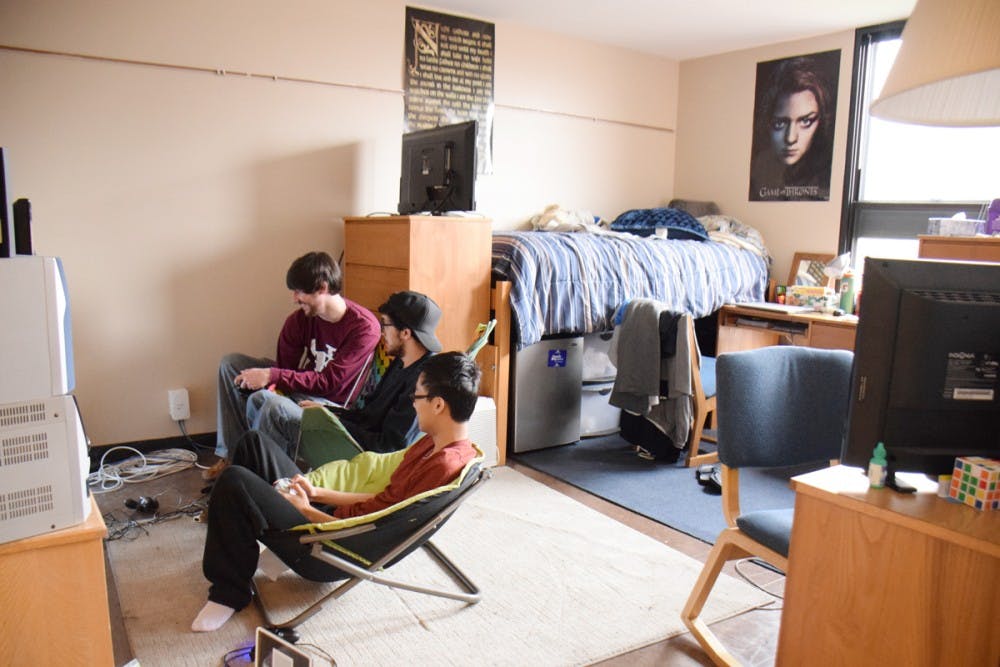
For so many college students, moving in with a roommate is a standard aspect of the college experience. Some find lifelong friends, but others aren’t so lucky and often find themselves stuck in uncomfortable and sometimes hostile living situations.
Naima Galeas, a sophomore majoring in Legal Studies, described her off-campus roommate experience as tense from the very beginning.
She said she originally knew her roommate as more of a casual friend, so she didn’t expect many issues, her opinion quickly changed.“I put my stuff in a cabinet, and she was like, ‘Actually, we’re splitting up all the cabinets,’ and she took my stuff out,” Galeas said. “I was like, ‘Oh, my fault,’ but after that it just turned into more drama.”
For her, a lot of the problems came down to boundaries and adjusting to living with other people, as they don’t know how to share space.
Even though the situation didn’t affect her personally or her academics, it made her day-to-day life more frustrating.
“When you pay to live somewhere, you want it to be a good space,” she said, “coming home to a bad living environment is just unfortunate.”
As she lives off-campus, Galeas said she felt limited in her options once problems started, and it wasn’t an easy task to easily leave.
“Unless you can find someone to take over your lease, you still have to pay,” she said, “so, you’re kind of stuck.”
Looking back, she believes clearer communication could have made a difference. “I wish I made more clear boundaries when I moved in,” she said." We didn’t agree on things, and that made it harder.”
Katherine Herrada, a sophomore studying health and human services, described a kind of roommate conflict, one that was less confrontational but just as exhausting.
“I realized it was becoming a serious problem when I started to avoid my room,” Katherine said. “It didn’t feel like my space anymore — it felt like it belonged to my roommate.”
Herrada said the issues weren’t always direct arguments, but instead a constant sense of discomfort and lack of communication. “She was always in the room, and it just felt super awkward, especially when friends were over and there was no interaction.”
Over time, that environment began to take a toll on her mental well being.
“I felt very drained mentally and felt like I didn’t have my own space to go when I was struggling,” Herrada said.
When she attempted to address the situation, the conversations didn’t go anywhere. “she didn’t want to be part of the conversation,” she said. “Eventually, I just left and transferred to a different room.”
Despite leaving, she said the experience made her realize how serious roommate conflicts can become.
“I felt stuck because I thought roommate issues were something small that I could handle,” she said. “But I learned how mentally draining it is to be in an environment that doesn’t feel like your own.”
Looking back, she said she would have acted sooner.
“My advice is to reach out the second something feels off — you’re paying to live there, and you deserve respect and privacy.”
Her experience is not unusual. According to Evans Hall Resident Assistant (RA), Antonia Lestariadi, a sophomore studying business administration, roommate conflicts are especially common at the beginning of the school year.
“It’s a lot more during the first semester… when everything is a clean slate,” Lestariadi said. “People are just meeting each other for the first time, so those boundaries aren’t really established yet.”
Lestariadi said most conflicts don’t start with one major issue but instead build over time.
“Most common [issues are] definitely boundaries and miscommunication,” Lestariadi said. “People have different sleep schedules or come back at different times, and their roommate isn’t aware.”
When those small issues go unaddressed, they quickly escalate.
“It creates tension, and then the big argument happens after.”
In some cases, the lack of communication can completely break down a living situation. There have been cases where one of the roommates will move out without telling anyone.
Lestariadi said students don’t need to wait until situations reach that point before asking for help.
“Honestly, you can come to an RA anytime,” they said. “It doesn’t have to be something big. We can help you prepare for the conversation or even mediate it.”
She also emphasized that many conflicts can be avoided with simple steps early on.
“Communication and boundaries — I know it sounds repetitive, but it’s really that important,” Lestariadi said. “Talking about expectations early can prevent a lot of tension.”
For many students, roommate issues may seem small at first, but as these experiences show, they can quickly turn into something much more overwhelming. Whether it’s constant tension, lack of communication, or feeling like you don’t have a space of your own, these situations can take a real toll. At the end of the day, having a place to come to that feels comfortable and safe matters, and speaking up early can make all the difference.
The features desk can be reached at features@ubspectrum.com

 Photo: Wikimedia Commons | Courtesy of Quintin Soloviev