
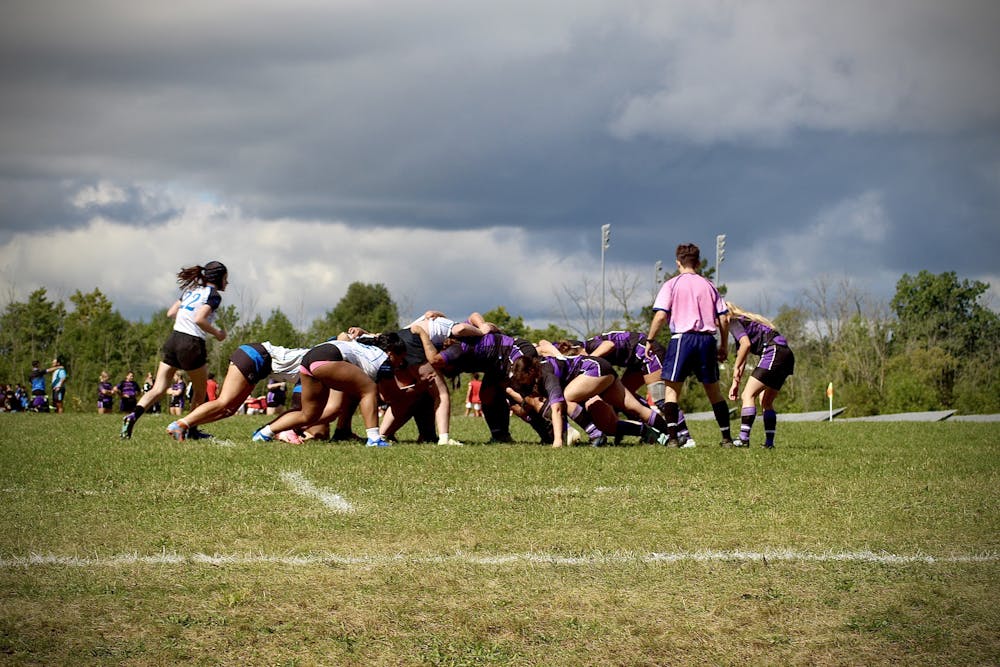
Although it may not be immediately visible, Western New York is brimming with rugby opportunities for athletes of all ages — some beginning as early as middle school. Yet across the country, the surge has been even more dramatic in flag football. Over just the past few years, opportunities for young girls in flag football have expanded rapidly, fueled by the sport’s sanctioning in high schools across 17 states, its inclusion in NCAA competition and, most notably, its addition to the Olympic program.
The rapid expansion of flag football has raised questions about its impact on girls’ rugby programs and the factors driving families and schools to favor flag football over rugby. While the lack of contact and football’s widespread popularity are often cited as key factors, The Spectrum examined these explanations more closely, by exploring their underlying assumptions and effects through conversations with rugby coaches and administrators across the United States.
“NFL has poured millions in flag for girls…[the] biggest obstacles for getting rugby in schools has been insurance, funding, and people resources. Money jumps those hurdles quickly,” explained Lauren Barber, the director of girls rugby in the state of Washington.
Other coaches expressed this same sentiment.
High school girls coach from McMinnville, OR, Christine Bader wrote to The Spectrum: “It's hard to compete with the awareness that Nike & NFL support bring, when we're scrambling to introduce people to rugby, and secure field space and funding, and oh yeah, coach”
Founder and president of SAFA Rugby Academy in Colorado, Rob Quickfall told The Spectrum: “Flag football has opened the door for more girls to identify as athletes, which is a net positive. However, because it’s CHSSA/ school-supported and more visible, it can pull athletes away from rugby, especially those new to sport who default to what’s most accessible.”
Looking to Western, NY, a local high school coach Ingrid Peralta echoed Barber, Bader, and Quickfall.
“I think the lack of contact helps, but the funding provided definitely helps. The fact that it [flag football] is considered an athletic team vs club is a big deal,” said Peralta.
Peralta went on to claim that her players’ “flag football coaches have asked them not to play rugby” even though she cites that “more of my players were injured at a flag football game vs rugby game.”
These coaches’ remarks highlight how corporate funding and institutional recognition give flag football a major advantage over girls’ rugby. Many coaches and administrators that The Spectrum reached out to believe that this reveals deeper inequities and gendered assumptions about which sports deserve visibility and support.
Long time girls rugby coach and educator from the City of Buffalo, Matt Frank, when approached by The Spectrum, had a lot to say on this specific topic.
“My general problem with flag football… is you've created a sport for girls that says girls aren't tough enough to play real football… it's all just an NFL move to get more eyes on the product,” said Frank.
Many coaches highlighted the fact that rugby has the same exact rules for the mens and womens side of the game, which goes against the idea that girls need a watered down version of a contact sport.
“With flag football there's no blocking, there's no hitting, there's not really any contact at all, the key is to be really fast,” said Frank.
The rugby community and the confidence it instills is also a huge aspect of the sport that has effects far beyond the pitch.
“Look at any rugby team, you have all ranges of body types and skills needed in order to succeed… making it a much more accepting sport, where anybody has a place on the field,” said Frank.
“I have noticed my girls have felt more confident in their bodies after playing,” said Peralta.
Western New York’s rugby community runs deep, with three women’s teams, numerous middle and high school clubs and year-round opportunities to play. Yet despite their consistent success — including state titles and national appearances — these programs remain unrecognized as varsity sports, underscoring the gap between achievement and institutional support.
Amidst these struggles, rugby coaches made it clear that they do not want to see flag football disappear in any way.
“I have been actively encouraging coaches and clubs to engage with their local flag football team. This is a massive benefit for everyone in skills and recruitment,” explained Barber. “How many flag players would play contact if they could? How many rugby players bring skill to flag?” These were some of the questions Barber raised in support of a continued growth of both sports.
Barber’s perspective reflects a broader trend across high school and college rugby programs, where many teams rely on hybrid and transfer athletes from sports such as soccer and flag football. Flag football players bring valuable skills that often strengthen rugby rosters, highlighting how even limited rugby development pipelines shape the sport’s growth; but right now the US is not a global rugby powerhouse, even though in comparison to the rest of the world, we spend the most money on women’s sports. And it’s no coincidence that the world’s top women’s rugby teams come from places with strong, well-supported grassroots programs that sustain talent and community investment.
Physical activity and girls playing sports will never not be an amazing thing, but rugby coaches from around the country have made a clear case as to why their sport deserves the recognition and expansion that girls flag football is seeing. Rugby’s expanding scholarship opportunities, strong community support, and focus on female empowerment underscore why the sport deserves broader recognition and growth, offering girls not just athletic participation, but pathways to leadership, confidence and equality in competition.
Ciah Courtney is the Senior Sports Editor and can be reached at sports@ubspectrum.com


