
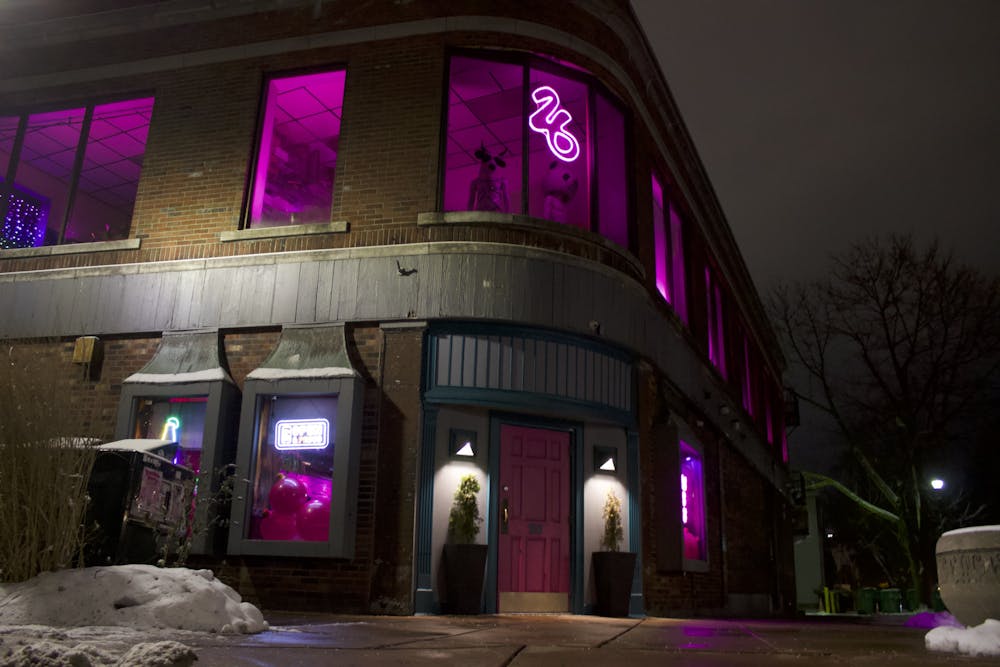
The current amount of existing gay oriented bars, especially lesbian bars, has been in a decline for years. While a few gay bars exist in the city of Buffalo, there are no bars catering specifically to queer women. Buffalo’s shortage of sapphic spaces is representative of a decline that can be seen in almost every city in America, and even in foreign countries. The current number of lesbian bars remaining in the U.S., according to various sources — including The Lesbian Bar Project — is somewhere between 33-38. At one point in the 1980s, this number was closer to 200.
While many believe that queer communities can only be found in large cities — thanks to a concept known as “metronormativity” — it is true that there have been thriving queer communities in Buffalo in the past. There have even been major academic studies and literature devoted to Buffalo’s queer past.
One local figure, Madeline Davis, was one of the people responsible for creating what is now recognized as the Global Gender and Sexuality Studies (GGS) Department at UB and is the namesake of the queer focused Madeline Davis archive located at Buffalo State University. Aside from these accomplishments, Davis was one of two authors responsible for a novel titled “Boots of Leather Slippers of Gold: The History of a Lesbian Community.” One main source of community discussed in this novel is the lesbian bar, and Davis discusses this history in Buffalo dating all the way back to the 1930s.
The book explores the nuances of lesbian bar history, including the fact that lesbian bars weren’t always welcoming to lesbian women of color, who often opted to host or attend house parties instead. This was often the case until establishments like “Winter’s” or the “Little Harlem” opened in the 1930s-1940s. Instead, the typical crowd in lesbian bars were white, working class, industrial workers.
Additionally, many of the true lesbian bars didn’t remain open for very long, and often, when lesbian bars couldn’t thrive, some straight bars became makeshift lesbian gathering places; lesbian patrons were often forced to gather in the back of the bars. This was common from the 1930s-1950s, considering that gay people rarely had the power to open bars on their own. According to The Buffalo-Niagara LGBTQ History Project, bars like “The Kitty Kat” or “Pink Pony” were 1950s bars that fit within this category.
People who weren’t queer often owned bars patronized by lesbian and other queer people, and the mafia was often responsible for keeping the bars open, given that the law wouldn’t protect any LGBTQ folk. Throughout much of lesbian bar history, bribes were given to police in order to prevent the bars from being raided by police.
Another queer writer from Buffalo, Leslie Feinberg, wrote the novel “Stone Butch Blues,” which is a semi-autobiographical book about the lesbian community in Buffalo, and groundbreaking work in the genre of queer literature.
Throughout the story, which takes place in the middle of the 20th century, lesbian bars are continuously raided by police, who commit heinous acts of brutality and sexual abuse against the patrons, and the protagonist, Jess.
The first time Jess enters a lesbian bar, after hearing about it from word-of-mouth, she describes the freedom that she immediately feels on entering. “What I saw there released tears I’d held back for years: strong, burly women, wearing ties and suit coats… some of them were wrapped in slow motion dances with women in tight dresses and high heels who touched them tenderly…this was everything I could have hoped for in life.”
This rare feeling of belonging motivates Jess to continue to frequent the bars, for a chance at finding love and community, despite the horrendous treatment she receives time and time again during raids.
A group dedicated to preserving LGBTQ history in Western New York, the Buffalo-Niagara LGBTQ History Project offers a walking tour that centers around former locations of lesbian bars in Buffalo, focusing on the 1940s-1960s.
One founder of the group, Adrienne Hill, explained that these bars were highly unpopular with many residents, especially when it came to urban planning. In the early 1960s, there was a demand for parking lots to be built to accommodate commuters who lived in suburbs and worked in the city. The buildings housing lesbian bars were the first to be demolished.
Hill explained that few people defended the bars. “If the newspapers at that time are any indication, they are manufacturing consent for that kind of demolition by saying ‘we have to get rid of these buildings, deviants hang out there.’”
While lesbian bars were occasionally raided from the 1930s-1950s, there was an uptick in raids in the 1960s partly due to former governor Nelson Rockefeller. According to Hill, Rockefeller wanted to lessen “corruption” by discouraging police from taking bribes. This included bribes from the mafia that kept lesbian bars open, so the 60s included both the shutting down of lesbian bars, and more of the raids described in “Stone Butch Blues.”
Though operating in smaller numbers from the late 20th into the beginning of the 21st century, lesbian bars continued to persevere in Buffalo from the 1970s until to the early 2010s. As mentioned before, there was a renaissance of lesbian bars in the 1980s-1990s, with bars like The Lavender Door or M.C. Compton’s in Buffalo, the latter a lesbian bar finally run by lesbians. After the peak, there was a very gradual decline of lesbian bars in the 2000s and 2010s. The last lesbian bar in Buffalo closed around 2012.
In a time when third spaces and communities are vanishing, this shortage of queer spaces makes it more difficult for LGBTQ people to connect. Queer identity can often feel alienating, and by having places centered around a shared identity, it becomes easier to feel less alone.
Additionally, while lesbian bars can offer a place to form romantic connections and friendships, these connections can also help in the formation of activism groups. Davis writes in the introduction to “Boots of Leather…” that “by forming community in a public setting outside of the protected and restricted boundaries of their own living rooms, lesbians also began the struggle for public recognition and acceptance.”
There has been an increase in lesbian bars launching in the U.S. since the beginning of the decade, with just over 20 being reported in 2021. Perhaps with the slow uptick in lesbian bars opening in the U.S. this trend may one day lead to a return in Buffalo.
Nadia Brach is the senior features editor and can be reached at nadia.brach@ubspectrum.com
 Photo: Credit: Kishaun Proctor


