
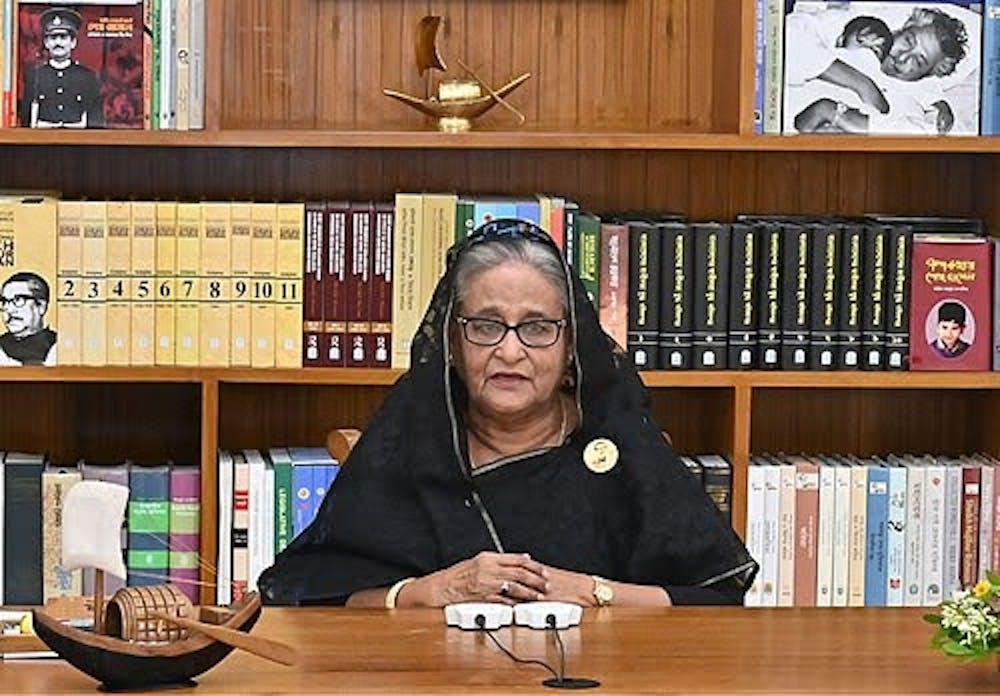
Student-led movements have played a crucial role in advocating for social progress and pushing for a more inclusive and cognizant nation. The July Revolution of 2024 marked a pivotal moment in Bangladesh’s political landscape, as members of Students Against Discrimination and other groups came together to demand change — most notably changes to the country’s quota system, which led to violent protests, the deaths of thousands and, more recently, a death sentence being issued for former Prime Minister Sheikh Hasina.
The quota system was introduced in 1972 by Sheikh Mujibur Rahman, the founding father of Bangladesh. It reserved a portion of government jobs for the children and grandchildren of those who fought in the 1971 War of Independence from Pakistan. Under the system, 44% of government jobs are merit-based, while 56% are reserved for specific groups. Notably, 30% of jobs are held for descendants of freedom fighters. Complaints and frustration fell on empty ears as Sheikh Hasina, the former prime minister of Bangladesh, defended the quotas and used violence to back her decision.
Through countless protests and a rising death toll, the Sheikh Hasina government was ultimately overthrown, and the quota system was revised, placing a heavy emphasis on merit over familial ties. Although the protesters ultimately achieved their primary goal, actions taken under Sheikh Hasina’s leadership contributed to the deaths of more than 1,400 people and left thousands injured.
In place of Hasina, Nobel Laureate Muhammad Yunus led the interim government to restore order and aid in recovery following the protests. Yunus felt obligated to ensure accountability for the crimes committed during Hasina’s reign and worked with the interim administration to deliver his promise.
On Monday, Nov. 17, the International Crime Tribunal convicted Sheikh Hasina of crimes against humanity and sentenced her to death, a decision that promised justice for the protesters who were killed. Hasina is currently in exile in India after student protesters forced her party out of power. In addition to this, former Home Minister Asaduzzaman Khan was also given the death sentence for being an accomplice and ordering the use of deadly force on unarmed protesters. Hasina commented on the verdict, saying the charges were unjustified and biased, with a firm belief that she did everything in her power to minimize the loss of life.
India has refused to send the pair back to Bangladesh, leading to rising tensions between the neighboring countries. Bangladesh’s Foreign Ministry released a statement saying it would be “extremely unfriendly” for a country to grant asylum to individuals convicted of crimes against humanity. Amid the tensions, citizens of Bangladesh have flooded the streets of Dhaka, relieved that the new interim government has taken action to address the atrocities that occurred in July. Although citizens believe this verdict is a step in the right direction, instability remains in Bangladesh as human rights and political unrest continue to rise following Hasina’s outing.
As Bangladesh continues to navigate through a fragile political transition, the coming months will determine whether the interim government can uphold justice and grant the citizens of Bangladesh a nation built on equality. The interim government of Bangladesh believes that the sentencing of Sheikh Hasina is a crucial step in rebuilding public trust.
The features desk can be reached at features@ubspectrum.com
 Photo: Credit: Kishaun Proctor


