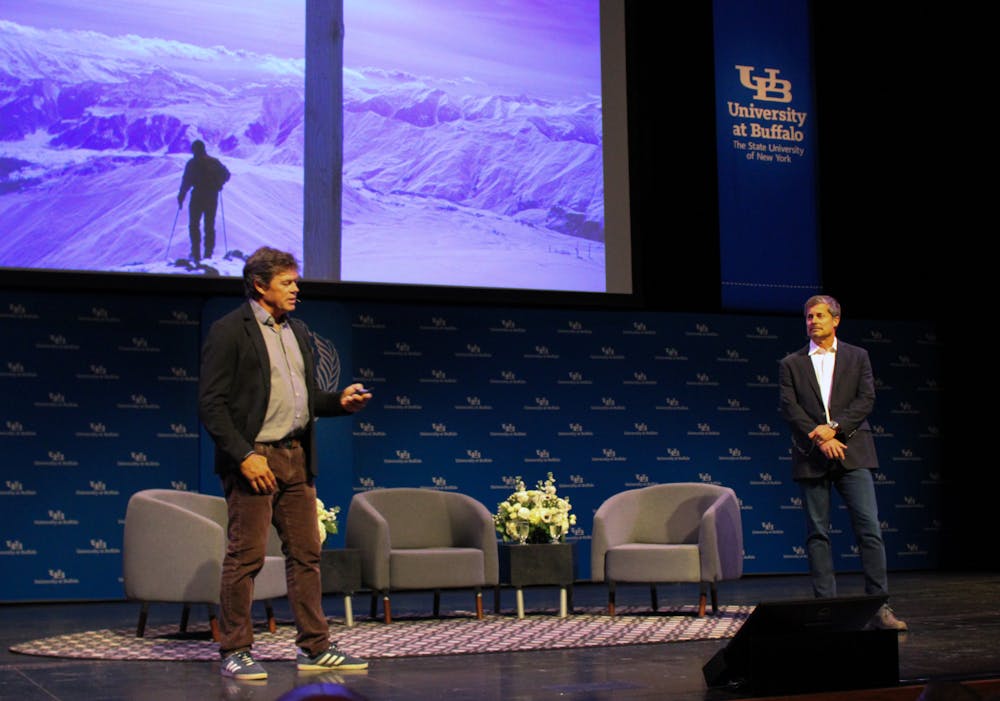
Award-winning nature journalists Pete McBride and Kevin Fedarko are the antithesis of each other.
“I’m an introverted writer. A person who is deeply uncomfortable in public; prefers to be spending his time alone by himself, staring at a screen,” Fedarko said. “I sometimes like to think of Pete as a creature of light, not just because he works in the medium of light as a photographer, but because it gets to a central tent of the philosophy by which he lives his life, determined to milk each and every moment for its natural dividend in terms of humor and enjoyment.”
The core of the two’s relationship is a series of several National Geographic magazine assignments — or “debacles” as Fedarko dryly calls them — which stemmed from McBride’s “litany of incredibly bad ideas” Fedarko also says.
A trip to the Caucasus Mountains ended in a retreat to a defunct bank with meals as brains. A month-long search for a herd of approximately 123,000 Porcupine caribou at the Firth River became fruitless, barring a photo of a skeleton set of moose antlers. The promised “home-run” of a story about the Sherpas at Mount Everest had a cloud of ice crystals avalanche down onto the two.
Yet those trips may not completely compare to the 14-month and 780-mile trek through the Grand Canyon. The story of the trek is already published by the two — McBride’s documentary, “Into the Canyon,” was nominated for an Emmy in 2020 while Fedarko’s New York Times bestseller book, “A Walk in the Park: The True Story of a Spectacular Misadventure in the Grand Canyon,” won the 2024 National Outdoor Book Award and the 2025 Andrew Carnegie Medal for Excellence in Nonfiction.
The tale was recounted on the Center for the Arts’ mainstage as part of UB’s 2025-26 Distinguished Speakers series Tuesday night.
“This whole concept of this story wasn’t about thumping our chests,” McBride said. “The hype was just the backbone to talk about this place and how important it is.”
The scorching temperatures, rundown yet fragile terrain and hostile plants and insects already made the Grand Canyon a formidable foe.
Compound those factors by McBride’s penchant for “bad ideas.”
The first lie McBride told Fedarko was that “it’s going to be chill.”
“I said, ‘Kevin, this isn’t going to be that hard. We’re going to walk these beautiful stretches of beach along the Colorado River for a few hours and you can write all the prose and anything you want in the marmalade light,’” McBride said.
The second was that the “hike itself was going to get us in shape for the hike.”
And so, by poor preparation, the two nearly found their end in less than half the distance of the first leg through the Grand Canyon. While they were accompanying an experienced team of hikers, McBride and Fedarko were driven into the dirt to the point of having to go back to Flagstaff — the canyon’s closest major city.
“We spent that drive bickering over which one of us was going to call up our editor in the National Geographic and tell them that we couldn’t complete the assignment,” Fedarko said. “It was at that point that both of us were staring down the barrel of giving up.”
But a group of people passionate about the canyon — backpackers, boaters, park officials and scientists — got the two back up again.
“They did that not just because they are kind people, but because they perceived that we were — in our own fumbling way — trying to tell a story that had some importance, a story about this magnificent landscape and the threats that loom over it,” Fedarko said.
The thread of the communities around the Grand Canyon continued.
Through days of rappelling up and down ledges, searches for water amidst a bare desert and tireless walking, the two found themselves at the intersection of the Colorado river and its tributary the Little Colorado river. Waiting right at the edge was Renae Yellowhorse — a 12th generation Navajo from the community that lives above the rivers’ intersection at the canyon’s east rim. She and 11 other grandmothers were fighting — and later successfully killed— a billion-dollar development project that would build a tourist resort on their land.
“The confluence — where the Little Colorado meets the Colorado river. Where they meet, this is where life begins,” Yellowhorse said during a clip of the “Into the Canyon” documentary that played Tuesday night. “It is a sacred space and we don’t want to see Disneyland on the edge of the canyon.”
The next stop was the canyon’s Horn Creek which seemingly looked like a dehydrated hiker’s salvation. Yet, the clear water is undrinkable because of an active, radioactive uranium mine that pierced the watershed. Another indigenous community that lives on the frontlines of the mine — the Havasupai tribe — have been protesting against its use. Through efforts from multiple tribes, the Baaj Nwaavjo I’tsh Kukveni national monument was established in August 2023 that protects up to a million acres of land from future uranium mining.
Just as the two approached the end of their journey, the sounds of solitude and stillness shifted into helicopters whirring at ‘Helicopter Alley’ — a section on the canyon’s west rim — as captured by McBride’s time-lapse photo.
“From this point forward, everywhere we went, no matter how high we climbed, no matter how deeply we descended into the tributaries of the slot canyons, the sound of those machines stayed with us each and every day,” Fedarko said.
The pair finally completed the trek in November 2016.
“We went through eight pairs of shoes. We collectively sprained four ankles; broke two fingers. My heart went into a-fib. I had open heart surgery. I can’t even begin to count the number of cactus needles’ infections,” McBride said. “But again, it was not about us thumping our chests. That was a way to talk about this place and the metrics of the amazing wonder that is your park. Our park.”
Mylien Lai is the senior news editor and can be reached at mylien.lai@ubspectrum.com.
The news desk can be reached at news@ubspectrum.com.

Mylien Lai is the senior news editor at The Spectrum. Outside of getting lost in Buffalo, she enjoys practicing the piano and being a bean plant mom. She can be found at @my_my_my_myliennnn on Instagram.