
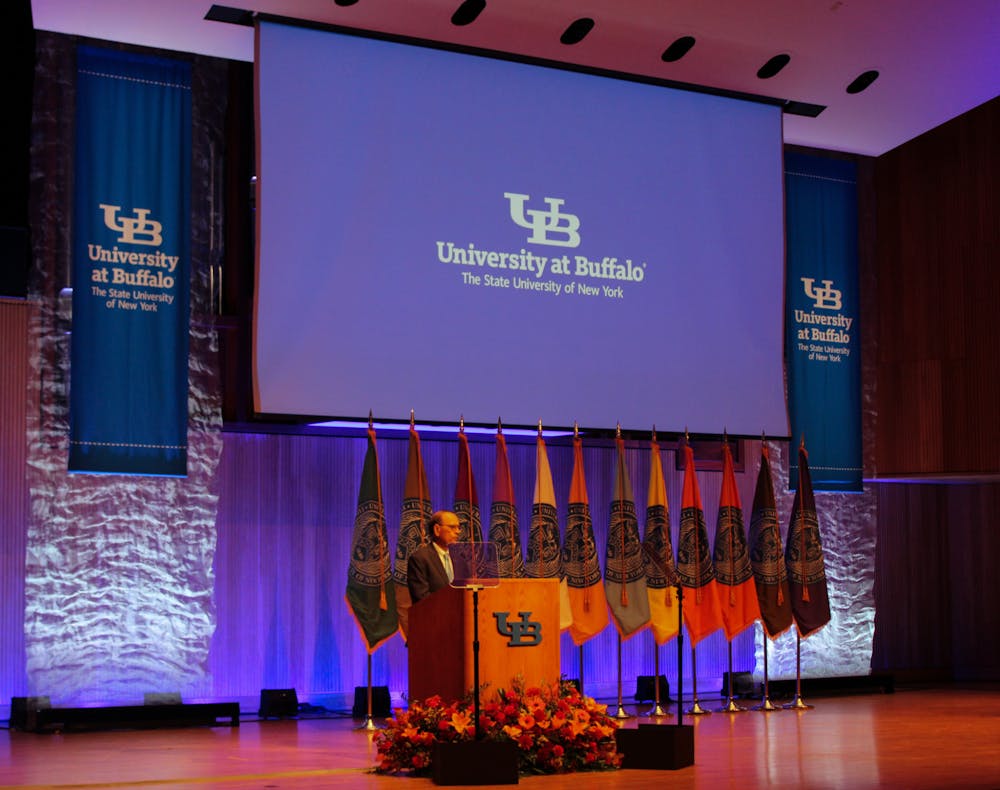
Satish Tripathi, UB’s 15th president, highlighted a 14-year legacy of transformations in the university’s research, academic programs and campuses in his last State of the University address Friday at Lippes Concert Hall.
The 14th annual address comes a week and a half after Tripathi announced his plans to step down from the presidency next July and transition into a full faculty position in UB’s School of Engineering and Applied Sciences in the fall. Tripathi’s 15-year tenure is the longest served at UB since the presidency was established in 1962.
At a press conference after the address, Tripathi told reporters that “the president’s job is not forever.”
“I think it’s a great time because it’s 15 years; by the time I step down, it’s more than 15 years,” Tripathi said. “I think it’s time to change and as I said, it’s not a job for life.”
Plans on what Tripathi will do as a faculty member are still up in the air.
“That’s a question people are asking me. I have no clue,” he said, laughing.
Throughout his term, Tripathi spearheaded the university’s ambition to become one of the top 25 public research universities, driving a rapid growth of faculty hires and addition of several interdisciplinary programs. UB had become a leader in artificial intelligence research and development, with millions of state and federal dollars invested into initiatives such as Empire AI and the recently launched AI and Society department.
“Today, our researchers are harnessing AI to develop personalized medicine, cutting edge cyber security and educational tools for young learners,” Tripathi said at the address.
UB — in addition to multiple universities nationwide — continue to face threats of massive cuts in research funding under the Trump administration, with Sen. Kristen Gillibrand and Rep. Tim Kennedy warned that UB researchers stand to lose approximately $47 million in funding from potential cuts to the National Institutes of Health’s (NIH) budget last fall.
The Supreme Court upheld the Trump administration’s campaign to cut at least $783 million in NIH grants linked to diversity, equity and inclusivity initiatives.
“The university is strong and can withstand any kind of things that come in,” Tripathi says.
“If you look at the current proposed budgets both by the Senate and the House, they almost totally restore the funding for the major funding agencies,” Tripathi said at the press conference. “If you look at the agenda for where the funding is coming from, it’s all about technology, AI and a few other areas, and we are very well positioned to compete nationally and get those grounds.”
Tripathi also oversaw the restructuring of the university’s campuses under the Campus Master Plan. Multiple buildings — including the Hayes and Crosby halls and Student Union — had undergone renovations and UB’s medical school moved from South Campus to downtown Buffalo through the construction of the Jacobs School of Medicine and Biomedical Sciences. Four more — including the Russell L. Agrusa Hall and AI & Society Building — are set to be added under the plan.
“Transformation serves as a physical manifestation of UB’s emergence as a public research university,” Tripathi said at the address. “Today our scholars are learning in classrooms upgraded with the latest technology.”
Mylien Lai is the senior news editor and can be reached at mylien.lai@ubspectrum.com
Nadia Bangaroo is the assistant news editor can be reached at nadia.bangaroo@ubspectrum.com
The news desk can be reached at news@ubspectrum.com

Mylien Lai is the editor-in-chief at The Spectrum. Outside of getting lost in Buffalo, she enjoys practicing the piano and being a bean plant mom. She can be found at @mylien.lai on Instagram.


 Photo: Courtesy of Wikimedia Commons
