16th Supreme Allied Commander James Stavridis oversaw The North Atlantic Treaty Organization’s (NATO) operations in Afghanistan, Libya, Syria and the Balkans, including a 2011 intervention in Libya that helped end Moammar Gadhafi’s dictatorial and violent regime. He led NATO’s creation of an international naval force to disrupt piracy attacks along Africa’s east coast and was a prominent advocate for cybersecurity.
Stavridis was simultaneously vetted for vice president by former Secretary Hillary Clinton and offered a cabinet position in President Donald Trump’s administration during the 2016 presidential elections.
Now Stavridis has transitioned into being a partner and vice chair in global affairs of The Carlyle Group, a private equity global investment firm, and is set to become the organization’s vice chairman in Jan. 2026.
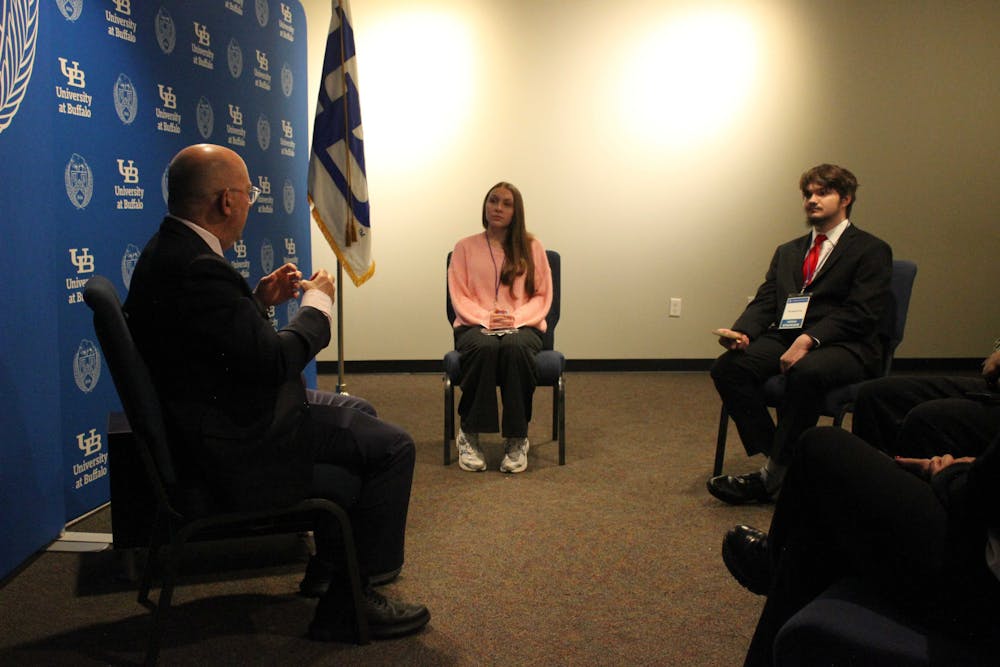
Stavridis sat down for an interview with The Spectrum before kicking off UB’s 2025-26 Distinguished Speakers Series Tuesday night. He spoke on the impacts of NATO in Libya, U.S. interventions in the Israel-Hamas conflict and finding unity in a divisive political period.
The interview has been edited for length and clarity.
The Spectrum: A lot of your platform is founded on building bridges rather than walls for global security. We are currently in a divisive political period, especially within the Trump administration. A massive campaign promise was to physically build a wall between the US and Mexico, and just a few years ago, President Trump wanted to pull out of NATO. From your perspective, how can people come together domestically and internationally under an administration that argues for the very opposite?
James Stavridis: “I'll give you three things that are important in terms of trying to bring the country together. Number one is service. I did 37 years in the military. Every veteran appreciates that, but there are a lot of ways to serve the country: our police, firefighters, diplomats, Peace Corps, Teach for America, Volunteer for America. How about teachers? You know what a teacher makes starting salary in my home state of Florida? $37,000 a year. You think she's serving the country? Boy, I do. Point one is where to celebrate service. We're going to incentivize it in our tax systems. We ought to do all we can to encourage service because service is nonpartisan. It's bipartisan by definition.
Point two is simple and human, but it's respect. We have hit a point where both sides — particularly at the political extremes — are all too happy to engage in personal attacks, anger, yelling. That is not going to work. In our daily lives, we need to take a beat and realize that anger is not the answer. There’s a personal component that falls upon all of us. Third and finally, we need to use the ballot box to vote for candidates who are willing to reach across the aisle, and that is admittedly hard to do at times. I am a registered Independent; always have been neither Republican nor Democrat. I was vetted for vice president by Hillary Clinton. I was offered a cabinet post by Donald Trump's administration. I think we can find candidates who are willing to work with others. So in the midst of all our hand-wringing about our challenges and problems, recognize, look in the mirror and say we ought to find candidates who are willing to cross the aisles.”
TS: You played a key role in NATO's intervention in Libya in 2011. At the time, you called it a “model intervention.” Since then, Libya has had a six-year civil war. It was used as a hub for terrorist organizations such as the Islamic State in Iraq and Syria (ISIS), and continues to be in a state of political instability. To what extent do you think the intervention played a role and should anything have been done differently? What should NATO have done?
JS: “I stand by my comment. It was a model intervention. The military aspect was flawlessly executed. NATO’s role was not to invade Libya and not to conquer Libya. NATO’s mission assigned to it by the UN Security Council was to create an arms embargo so weapons could not flow to Moammar Gaddafi, who had pledged to make the streets of Benghazi run with blood. He indicated he was going to massacre much of the population of Libya. We put up an arms embargo. We put up a no-fly zone overhead so he could not use his air force effectively. Those were the NATO goals. That intervention allowed the people of Libya to overthrow this 40-year dictator who had ran torture chambers and was threatening mass genocide of his population. The intervention worked. What failed was that, after the intervention, the world just walked away and said, ‘Okay, Gaddafi is gone. Everything's going to be great. Now have at it, Libyans.’ It descended into chaos that continues to this day. The irony is that Libya has a population of only 5 million. It has enormous hydrocarbon wealth. It ought to be Dubai on the Mediterranean. It has failed because of bad leadership. Thus the lesson for us today is, if you are going to intervene and be engaged, you need to stay the course.”
TS: Do you think that the Gaza cease-fire deal that President Trump brokered between Israel and Hamas will work long term? Did the US intervene correctly?
JS: “I think the deal has about a 60% chance of working long-term. There are a lot of countervailing forces, starting with the bitter hatred. Hamas, a terrorist organization and effectively a death cult, is willing to die at a moment's notice and willing to fight to the last Palestinian. On the Israeli side, there's enormous anger and hatred over the events of Oct. 7, which were horrific for the State of Israel. The reason it has a better than even chance of succeeding is not so much because of President Trump. It's because of the Arab world. The Saudis, the [United Arab Emirates], Qatar, Egypt and Jordan, have finally said, “We will participate in stabilizing the Gaza Strip. The thing to determine whether it's going to work or not, is whether the Israelis are willing to allow the Arabs to put a peacekeeping force there. And more importantly, are the Arabs willing to actually put a force in? My estimate is it'll take 30,000 Arab peacekeepers to subdue or to provide stability in the Gaza Strip. They can do it. Hamas is down to 5,000 effective fighters, but they're bitter-enders who are willing to fight to the very end. So there are arguments on both sides as to whether it'll succeed. And did the US intervene intelligently? I think so. There are plenty of things I disagree with President Trump about, but his intervention here put pressure on Israel appropriately, put pressure on Hamas through Qatar and Egypt and created the framework that got the hostages out. Now the hard part begins. I'll quote Henry Kissinger, who said to me once, ‘Admiral, every solution in the Middle East is merely a key to the next problem.’”
TS: What do you think the US did wrong over the past few years, since Oct. 7?
JS: “I'll give you the good, the bad and the ugly. The good is the strike against Iran. I think that was professionally conducted. Very low collateral damage, minimal civilian deaths. Knocked the Iranians back at least a year, maybe two years, but most importantly, it sent a signal that the US is willing to use military force against Iran. In terms of the bad, where the United States has performed less perfectly since Oct. 7, is setting out clear goals for what the end state is for the Palestinians. And I think it has to be, my opinion, a two-state solution. We're falling away, at least somewhat, from this idea of the two-state solution. In so many ways, we have, as usual, failed to appreciate the cultural depth, the languages and the history of the region. As Americans, we tend to be very much in the moment. We should spend more time deeply understanding the challenges and problems, the languages and the history on both sides of the conflict in the Middle East.”
TS: You now serve as the Global Affairs Vice Chair and partner of the Carlyle Group. What prompted the move into the private sector, and how do you see your expertise applied in your role?
JS: “I had spent 37 years in the military. Truly enjoyed that. Then I spent five years in higher education. I was dean of the law school at Tufts University. Really enjoyed that. I had one more third act I would like to try, and that's international business because it was so different from the other things I had done. One was military, one was education and I wanted to see what the world of business and finance was like. I do three principal things at the Carlyle Group. Number one, most importantly, I give internal geopolitical advice that impacts our investments. Number two, I do client-facing events. ‘So Admiral, can you fly to Paris and meet with this group of potential investors, talk to them about what's going on in the firm, what's going on in the world?’ Thirdly, I do individual business deals and negotiations that are in my wheelhouse. So if Carlyle is considering investing in cyber security, for example, that's an area of expertise of mine. I'll be part of a team that looks at particular investments. Then the most fun thing I do at Carlyle is I do internal leadership training for our younger executives as they're coming along.”
Jacob Wojtowicz is the assistant features editor and can be reached at jacob.wojitowicz@ubspectrum.com
The news desk can be reached at news@ubspectrum.com

 Photo: Wikimedia Commons | Courtesy of Quintin Soloviev