
In 2007, at the height of the label “emo” being a cultural buzzword, music journalists Leslie Simon and Trevor Kelley published their book Everybody Hurts: An Essential Guide to Emo Culture. The authors lay out the emo value system, consisting of depression, effort (lessness), empathy, faith, insecurity and non-athleticism. The book essentially gave instructions on how to be “emo.” Who are the kids who identify as emo, goth, or alt and what do they all have in common?
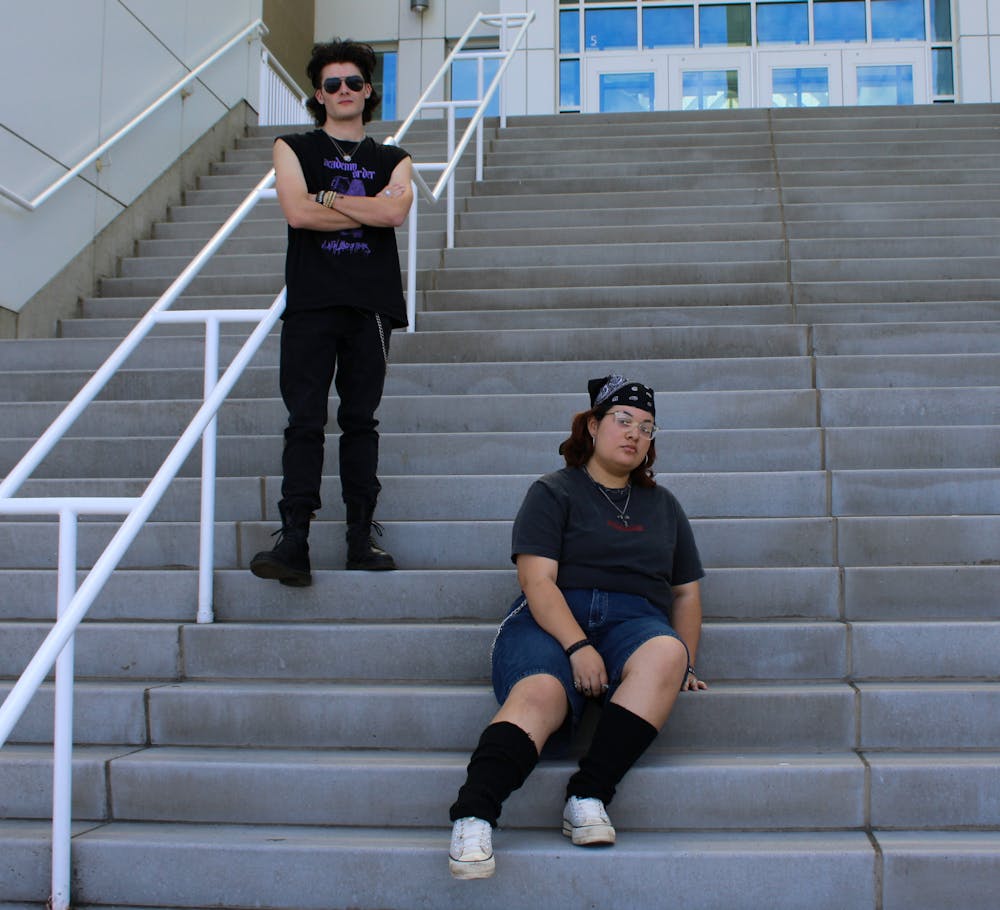
I interviewed six UB students who identify either as emo, goth or are generally interested in alternative fashion. Two decades after the apex of the emo cultural explosion of the 2000s, these students are keeping the scene alive by going to local shows, darkening UB’s hallways and proving that it’s not a phase.
Caleb Ehrens, a junior graphic design major, has bipolar disorder. Growing up, he felt like an outcast and didn’t have the creative outlets that he does now to express his emotions. He says he’s found his community and feels a strong sense of belonging with like-minded people.
“It's one of the most welcoming communities that I've been in because we bonded over the darker things, the darker emotions, the darker stories in our lives. I think that just really sets the stage for a more profound relationship with each other,” he said.
He says the music he listens to has allowed him to express an alternative view of masculinity.
“It's almost like they intentionally go against the mold just because tying back into the emotional aspect of it, we're already going against the grain that society wants us [to]... we address our sadness and sometimes revel in it. And that's the same way with the alternative fashions. It's almost like a political statement of sorts,” Ehrens said.
Being alternative is to be weird — and to openly embrace it. Milo Lauria, a junior double majoring in graphic design and communications, described her personality as “a little twisted, a little strange,” with a smile on her face.
“At the end of the day, it's just expressing who you truly are and just like going against societal norms.”
Violet Tsakiris, a junior double majoring in law and global gender studies, is a self-described “emo.” She was introduced to the genre through her father, who is a huge fan of Alkaline Trio, Bayside, Motion City Soundtrack and Say Anything.
Tsakiris describes herself as having “a bit of an attitude.” She attributes that to her friends in the alternative community, who possess a more cynical perspective toward life. Underneath it all, she admits that a lot of that cynicism boils down to social anxiety.
“I think in person, I will often come off as rude or something because I'm almost nervous about being judged,” she said.
While she was never bullied, she gets the sense that many other emo and “alt” kids were, which causes people to perceive them as mean because they’re purposefully standoffish.
Contrary to popular opinion, emo and goth are completely separate subcultures. Luke Carey, a senior history and philosophy major, says music is the underlying connection for goth culture.
“I think a lot of people would agree with me on this, it's very much a musical thing. If you don't appreciate goth music, you probably may be missing the point a little bit.”
He is a huge fan of goth classics like The Cure, Joy Division, Bauhaus,Voodoo Church and Christ vs. Warhol. However, similar to emos, goths tend to share a more pessimistic view on life.
“My own sort of interpretation of it is an appreciation of sort of like finding some sort of joy or happiness in sort of what seems to be a depressing world.”
Citing novels like The Secret History by Donna Tartt, he says goths share what he refers to as an appreciation for “macabre things.”
True to the stereotype, Carey says most alternative kids are generally neurotic individuals.
“Most sort of alternative people, broadly speaking, that I've met are suffering from an anxiety disorder,a personality disorder or depression disorder.”
Describing her childhood, Lee Burrell, a sophomore geology major, said she was the “weird kid.” According to her, there is a direct pipeline between being the “weird kid” and becoming involved in alternative scenes. Since coming to college, she has had the opportunity to dress more “alt” because her high school environment wasn’t the most accepting.
Not everybody who dresses “alt” listens to emo, punk or metal. Carrie Cardenas-Morales, a criminology major who likes nu metal and punk, is also a huge fan of K-pop.
“I was pretty insecure about myself. I thought that nothing would look good on me. And so I just kind of stuck with the basic sweater, T-shirt. I didn't know how to dress or express myself,” she said.
That changed in her senior year of high school.
“I wanted to look nice. So I wore this nice plaid skirt, this white top, nice sneakers. And I did my hair… for once I felt good about myself. And I felt like that I looked really good,” she said.
Coming from a more conservative family, she used to dress up when her mother wasn’t home, then switch back to pajamas when she returned. Like Burrell, going away to college has been a transformation in self-expression.
“Being away from home and being surrounded by so many students who have so many different clothing styles, it kind of inspired me to look for my own style.”
What they all share is a strong sense of commitment to self-expression, as well as proudly owning the term “weird.” With TikTok, a new wave of alternative fashion has sprung up in the 2020s, and countless UB students are eager to continue the traditions of subcultures from decades prior.
Jacob Wojtowicz is the assistant features editor and can be reached at jacob.wojtowicz@ubspectrum.com

 Photo: Courtesy of SUNY
