As the plan to expand Buffalo’s Metro Rail subway system to Amherst and UB’s North Campus passes an important regulatory milestone, the divide between the line’s potential riders and many of its suburban neighbors is becoming increasingly stark.
The Amherst Metro Rail expansion, which has been in various stages of planning since the late 1960s, has taken a more concrete shape in recent years, with a precise route, a set of stations and even the 10-minute interval between trains planned out by the Niagara Frontier Transportation Authority (NFTA), which operates the system. ‘UB 2020’ — a comprehensive master plan released in 2009 to further the university’s ambitions to become a “model 21st century university” — supported the Metro Rail expansion to North Campus.
In July, the agency released a draft Environmental Impact Statement, or EIS, for the line. The EIS, which analyzes everything from runoff and noise to wildlife and land use, is a significant — and costly — step in the process for federal funding.
The draft EIS was the topic of a public hearing Tuesday evening at Sweet Home Middle School, coming one day after the NFTA released the results of a Siena College poll showing 72% public support for the Metro Rail extension.
But many of the voices at Tuesday’s hearing, held a week before most of UB’s 30,000 students return for the fall semester, were strongly against the project.
Gary Heckman, an Amherst resident for 42 years, said there are “too many people in the area,” and that UB students “have no vested interest in this area.”
He was echoed by Kimberly Gabel, an Amherst Republican Committee official, who called UB a “microcosm town.”
“For UB, why would they give up an expedited, direct and free transport between campuses and a Metro Rail they have to pay for and that would slow down their commute?” Gabel said.
Amherst insurance adjuster Stephen Steinberg took a more extreme tone, comparing the Metro Rail project to Nazi Germany’s invasion of Poland.
“When my grandfather was your age, September 1939, one population decided they had a better way and moved in on another one,” Steinberg said. “We all know how bad it is. It’s the same strategy: start with the little things, and you thrust your way into a community, and you ruin it for other people.”
Several residents spoke in favor of the project.
Edward King, a second-year UB law student and a summer law clerk intern at the NFTA, said that the expansion would be an incentive for UB graduates to stay in Buffalo.
“We’ve got an opportunity now to do something that’s going to be sustainable, not just in the immediate future but the long-term future,” King said. “How do you make people want to stay?”
Morgan Henneberg, a junior civil engineering major at UB, said that the expansion would significantly improve mobility around the Buffalo area.
“I realized that when you give people options they haven’t seen before, there’s benefits you don’t see,” Henneberg said.
North Campus hosts the majority of undergraduate dorms and academic programming, and a growing sphere of near-campus student apartments — but public transit to the campus is currently limited. Only the hourly 35 Sheridan and 44 Lockport buses run to the campus, with most students driving or riding the university’s student fee-funded Stampede buses between campuses.
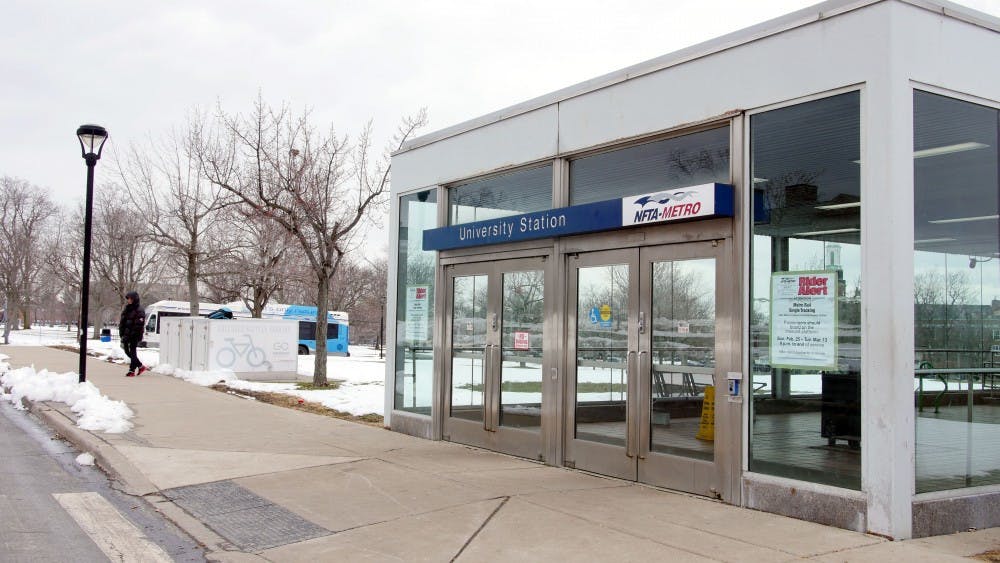
Stampede riders traveling downtown, including to UB’s Jacobs School of Medicine and Biomedical Sciences, currently transfer from bus to train at South Campus’ University Station, which sits on the Buffalo side of the Amherst town line.
The NFTA’s planning includes two proposed options for the expansion: an extension of the Metro Rail’s light rail or the addition of bus rapid transit, or BRT, which includes increased bus service.
Both options continue seven miles past University Station and include ten stations, following a path largely along Niagara Falls Boulevard through the towns of Amherst and Tonawanda. Similar to the Stampede, stops would include the North Campus’ Flint and Lee loops and Ellicott Complex.
The NFTA estimated that the light rail plan would cost about $2 to 2.5 billion to construct, serving about 3.5 million riders annually, while the BRT plan would cost about $0.9 to 1.1 billion with 2.1 million riders annually.
The public comment period on the expansion plans ends Monday, Sept. 8. Comments can be submitted through this form, calling the NFTA and leaving a voicemail at 716-855-7382, emailing transitexpansion@nfta.com or mailing the NFTA at its address: 181 Ellicott Street.
Mylien Lai is the senior news editor and can be reached at mylien.lai@ubspectrum.com.

Mylien Lai is the editor-in-chief at The Spectrum. Outside of getting lost in Buffalo, she enjoys practicing the piano and being a bean plant mom. She can be found at @mylien.lai on Instagram.

 Photo: Wikimedia Commons | Courtesy of Quintin Soloviev