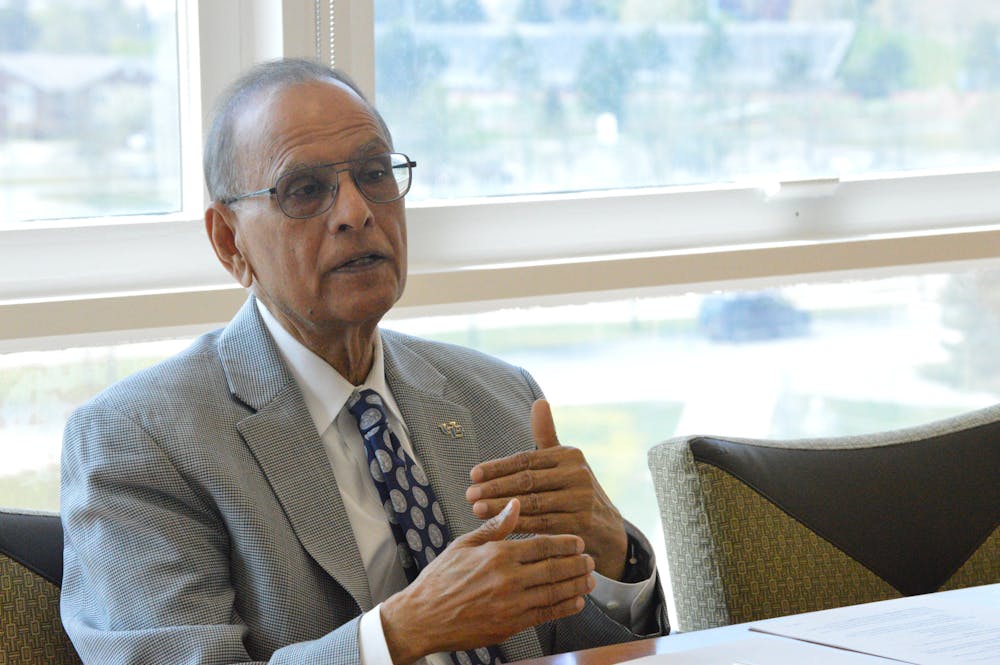
President Satish Tripathi is UB’s longest-serving president, surpassing William Greiner’s tenure of 13 years as of last April, with fourteen years now spent at the university.
But Tripathi is not leaving anytime soon.
“We get good students that succeed, our faculty do research that's helpful to society and I'm just a person who tries to see how we can improve it. This is a great place and this is the longest I've been anywhere since I was born,” Tripathi said. “A day will come, I will let you know, but I'm not thinking [about that] right now,” he said.
Tripathi sat down with The Spectrum for a 30-minute interview Wednesday morning to speak on increasing student fees, the expenses that go into higher education and the changing federal landscape.
This interview has been edited for length and clarity.
The Spectrum: From your perspective, what is the biggest issue facing UB right now?
Satish Tripathi: So there's a bigger issue for higher education. If you think about the issue of research, we are a research university where we really hope that our students get a chance to work with the faculty who do cutting edge research, who work on the problems of the society and work on things that can solve major issues. That's one of the major issues right now, what kind of research is supported, how much research support they're gonna need. So that actually I would say is one of the major issues, the whole country, not just us, and we are working with AAU, APLU and double AMC. These are alphabet soup for you, but these are the national organizations. And we are lobbying with our elected officials to make sure that we continue to do research and they support our research. We are a research university, as I said, and we want to provide that opportunity for undergraduate students as well, not just the graduate professionals to continue to do research. This is an issue that we are trying to really work with our elected, work nationally with our associations to make sure that there's enough research funding for us to be able to continue research here. Research is not just for research sake, as I said the things that we have done here and think about the pacemaker. That would not have been possible without the work that was done here, just one example from here.
TS: While we're talking about the changing federal landscape surrounding universities across the nation, several students and groups have criticized the university for its silence when 17 international students got their visas revoked and are frustrated with the university’s lack of a stance on the Trump administration's actions. Is there a particular reason for this?
ST: There was no silence. We contacted the students. We talked to the students and we have the international office actually working individually with the students. So if you think about it, there were about 17 students, right? Seven were current students, 10 who were on OPT [Optional Practical Training]. We contacted every one of the students, we provided them support.
Support comes in different ways. We pointed them to legal support where it's available, working with them to give you advice — whatever advice we could give — and working in the background with other institutions to go to court. So our AG [Attorney General] from New York was one of the AGs working with SUNY to make sure that we're going to court and getting restraining orders and so on. If you look at the change in the immigration, some of those pressures have changed now and everybody has been reinstated. It's not really just making a statement that works, it's working the people who are affected and giving them the advice and support that's needed, and that's what we're doing.
TS: Students have been voicing their concerns about the limited parking options over the last few years. Does the university have a plan in place to address those concerns?
ST: It's a great question, and I think a better response could come from the parking, but they are doing a major survey and doing a comprehensive plan in terms of the parking. There's also, as you might know, there's a plan to bring light rail here on the campus. There's a sort of planning going on in the city to look at and that would provide some level of connectivity to the city and to the region as well, so we have to look at this as a comprehensive plan. Parking is always a problem. Every campus I've been to, sometimes it's the walking problem, not the parking problem, but it is a problem that exists. I can tell you this is the same parking problem when I go to the faculty meeting, I have the same thing. If you compare our institution, I'm not saying we're perfect, but if you compare our institution with many other institutions with respect to parking, we have more parking spaces here. But I understand it would always be a problem no matter where I am. And I think we can get you more information about the survey that's going on with respect to parking and the comprehensive plan with respect to parking.
TS: What is the justification for the five year increase on student fees?
ST: Student fees cover certain aspects of the operation. There's the people who are working in those areas. There's a cost of living increase that comes with it. So the students are paying for certain things. It's usually paying for services that university provides for everybody, for and especially students. Those increases are consulted first by the students here. It's approved by the SUNY Board of Trustees at the end, and these are really in line.
Usually you would find that it's not more than what the cost of living has been, the higher education cost of living. So it’s really to support and pay fair wages to people who are working on those aspects of the services. You do the budget, you see what's gonna cost you to do it. You don't always get what the particular organization might want. Then you have to look at the cost of living. Then you have to look at what is the reasonable thing that can be supported by the Board of Trustees, and they don't support it all the time, because they also look at the cost of education. So I think it's really fairly regulated, but also very conscious about how much we can increase it. It's not that we just want to increase it.
TS: Meal plan prices will be going up, but the dining points with each plan is going down. Why is this the case?
ST: If you look at the meal plans, it's run by FSA [Faculty Student Association], a separate organization, they run it so they don't lose money and they're at least at the zero level. They don't have to make money, except [when] they have to do some kind of renovation [or something to plan for], but it's not really something we run. Based on the prices for food, based on the labor cost, they [make a] budget, and that's how they submit and that's also approved by the SUNY as well. And if you compare it with the other campuses, I don't think we are going any faster in SUNY. We're going faster in terms of the cost than anybody else actually. They have to be self-supporting, so the cost for meals and dining and all that have to be supported by what people pay. And those are not fees, they are really in some sense those are dining options. Those are [what] people buy into. So there are mandatory fees which people have to pay, which I talked about before, and then there are of course the options for services like dining, which is different.
TS: Last spring, Dean Robin Schulze said that UB paused the undergraduate portion of the College of Arts and Sciences budget model and would review its enrollment plan, due to struggles in bringing in tuition revenue — has the CAS budget stabilized?
ST: Yeah, of course. It's always stabilized, the budget, but you always have to keep planning. I mean we are a tuition dependent institution. We get state support, but more than 2/3 of our money comes from tuition. So as the tuition money goes up and down, you always have to continuously plan, you have to think about how to manage. This year, we don't know exactly how many will show up, but numbers are pretty good, for the students coming in, really you have to, but you know it's, we can't run on every year's up and down, so we have to keep planning and seeing what would happen, how we manage. Every unit is stable, but we have to continuously change what we do, how we do, how many people we hire. If you look at the number of faculty hired in the last five years have been tremendous. So we still have to keep planning. As the enrollment shifts, as the people's interest shifts, what they want to study. You've been in the institution, we want to be really fairly broad, we do everything we need to do, but within that we have to balance and keep planning for it.
TS: Do humanities departments continue to face cuts?
ST: No, I mean, nobody is getting cuts actually, it's just that they may not be hiring more people. I don't think we have been cutting people. And, and we don't know what the budget would be in the future. But right now, things are good. The state has been very supportive.
TS: Do you have anything that you're looking forward to, in the coming years?
ST: There are fantastic things to [look] forward to. We got a new Department of AI and Society, a very special department. If you look at the proposal that was submitted to the faculty Senate to pass the proposal, there are, I think, seven or eight different new degree programs in Arts and Sciences. You could still do your philosophy degree or communication degree, but you could also combine with AI. These are very unique and provide students exposure in many cases to the tools that might be available, also giving them exposure to what are the ethical issues in AI, and what one can use it for, what really one has to worry about, what the data integrity aspect, what's the fake, those kind of things would be exposed not just to people in computer science, which is my area, but others as well to look at. So these degrees are getting approved and we can go through the process at the SUNY level and state level. This is gonna be a unique thing for the campus to look at. And it's not just the technical aspect, but I think the aspects of ethics, the aspect of really thinking about how it's gonna impact different communities and how do we avoid that right the biases that might come in. And thinking about data integrity and other things, and that's gonna be very, very important… There's a lot of exciting things going on, but at the end of the day, the basic mission really is to expose these things, educate the next generation of students… We do all these things, all kinds of exciting things and research and other things at the end of the day that have to be exposed to our students.
Ricardo was the Editor in Chief and can be reached at ricardo.castillo@ubspectrum.com
Ricardo Castillo is the editor-in-chief of The Spectrum.

 Photo: Wikimedia Commons | Courtesy of Quintin Soloviev