
Close your eyes and imagine you are wearing a black tuxedo. Now, I want you pee in that tuxedo. You are going to feel a warm feeling now. This is what it means to play offensive line.
Head coach Jeff Quinn told this to his offensive line.
Being an offensive lineman is like “a warm feeling no one else sees,” said senior center Trevor Sales.
They’re the guys who set up the play. But they don’t get the yards – and often, they don’t get the glory either.
But this “warm” feeling for these somewhat unnoticed players was frequent last season. Buffalo’s offense set numerous school records. Current San Diego Chargers’ running back Branden Oliver didn’t run for 1,535 yards without having holes to run through when he was Bull. Junior quarterback Joe Licata wouldn’t have the time to complete 233 passes for 2,824 yards last season if he was constantly feeling pressure. And wide receiver Alex Neutz certainly wouldn’t have had enough time to beat the defenders and become Buffalo’s only receiver to record back-to-back double-digit touchdown seasons.
And isn’t it fitting that even in a story focused on offensive linemen, the glamorous positions – and even urination – are referred to before getting to the five men most responsible for creating playmaking opportunities.
“We don’t care about the newspaper articles because if it wasn’t for us, they wouldn’t have those accolades, so that’s the way we see it,” said senior offensive guard Andre Davis.
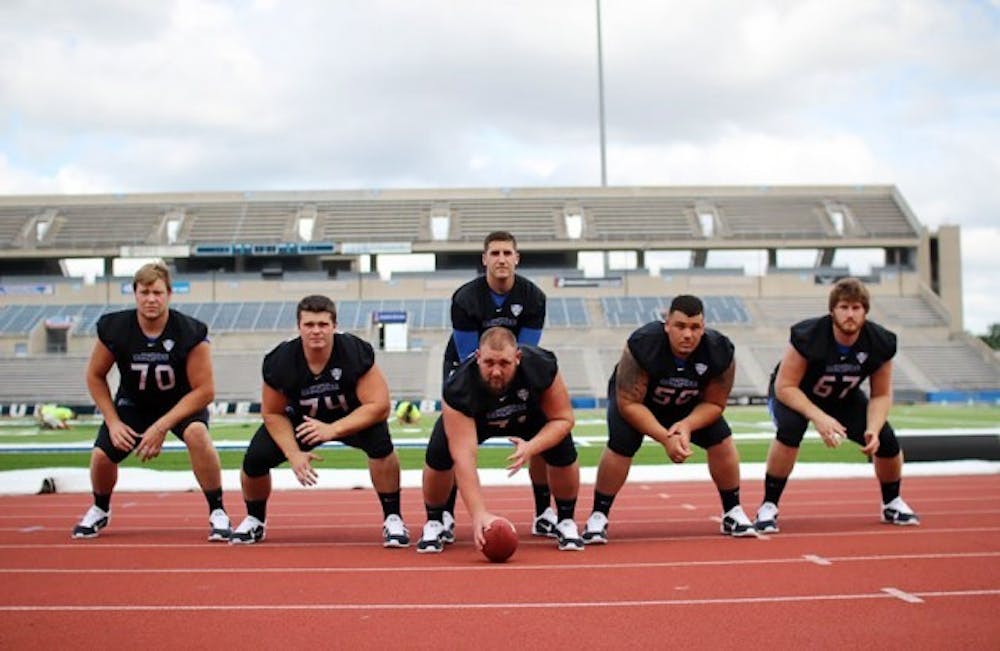
Seniors Jake Silas, Sales and Davis along with juniors John Kling and Robert Blodgett make up this season’s starting line. It is one of the most experienced offensive lines Buffalo’s had in years – which could prove vital for the Bulls. The team won’t return a single-player who totaled 500 yards last season. Sales, Silas and Davis started all 13 games for the Bulls last season with Kling and Blodgett combining for another 13 starts.
“With a bunch of new faces, it makes me feel very comfortable that I’ll be protected every Saturday because I really think we have the best offensive line in the [Mid-American Conference],” Licata said.
Maybe the lack of notoriety is because there are no offensive linemen in fantasy football. They are rarely on billboards, red carpet events or magazine covers. The offensive linemen are the busboys who set up your table before the waiter comes and brings over your food.
“It’s a bittersweet kind of thing,” Blodgett said. “You know you are a main piece of the offense, but you don’t get a lot of credit.”
It seems the only time linemen are shown on TV is when they are fighting at training camp. The need for Johnny Manziel apparently squashes the allure of pancake blocks and zone blocking.
“It’s the 50 percent of the game that nobody ever watches,” said Quinn, a former offensive lineman himself.
The personality
Senior offensive lineman Dillon Guy offered Sales $50 if he didn’t shave his beard from the beginning of 2013 spring practice in April to the beginning of preseason camp in August. Sales gladly accepted.
“I play line, I don’t really care about how I look that much, so it was whatever,” Sales said.
Sales didn’t shave his face again until the season ended in December. Despite his position’s potential to go unobserved, Sales found ways to stand out.
His beard was discussed by broadcasters nearly every game the Bulls had on the ESPN family of networks.
But then, something else overtook the beard. Something bigger. Sales, who was listed at 6-foot-2, 327 pounds last season, often practiced with his gut hanging out. His teammates told him if he did this in practice, he had to in the games as well.
Fortunately for his teammates, his 2XL-sized jersey agreed. It’s difficult to find a play from last season where his stomach was covered up.
"I have this big keg down here,” Sales said.
Unfortunately – or maybe fortunately, depending on your view – Sales “trimmed the fat” down to 303 pounds and cleaned up his beard for this season.
Sales has an alter ego some on campus many may not be aware of. In 2012, Sales dropped his first 12-song mixtape Can you feel me? under the artist name Big T the MC. His “funknasty underground” genre is a mixture of funk and rap in which Sales is both the vocal artist and mixes the beats.
It began as a hobby in eighth grade, but grew even large at college. His favorite song from his mixtape is “Funknasty funk.”
“It helps me take a step from football, from school and I can actually say the things that I want to say,” Sales said.
He’ll sometimes perform in the locker room and has even written songs inspired by last year’s and this year’s team.
He wants to drop another mixtape in winter 2015.
His personality and willingness to supply a laugh hasn’t disappeared with his beard and gut. When Quinn took part in the “ALS Ice Bucket Challenge” this offseason, Sales was the first one to grab a bucket to pour on his head coach. Licata tweeted a picture on Aug. 10 of Sales waiting around a corner with a super soaker, ready to greet anybody who was at the wrong place at the wrong time.
“He draws everybody, he draws attention because he’s a funny guy and he’s not afraid to make fun of himself or act like an idiot at times,” Blodgett said.
But don’t let these antics give off the wrong impression. Sales is not someone you want to run into on the field. He’s labeled as the strongest offensive lineman by his teammates and has the ability to bench press 405 pounds.
Sales won the “National Underclassman Strong Man” the summer between his junior and senior years of high school. His performance was highlighted by 31-reps of 185 pounds.
Sales hasn’t missed a game since earning the starting job as a sophomore. A level of consistency is critical at the center position, which Sales referred to as the “quarterback of the O-line.”
"You need to know the ins and outs of every play,” Sales said. “You have to have everyone on the same page and knowing what they are doing on every play.”
Sales’ actions off the field are just as important as on the field for the Bulls’ success.
“Big T the MC, he makes it fun,” Quinn said. “He makes it fun to come out here and coach.”
These kids are too big
It’s no surprise that Davis, listed at 6-foot-4 and 318 pounds, was always bigger than the other kid’s his age.
Davis’ father forced him to play football when he was 9. But he wasn’t playing with other 9-years-old. He was playing in the 140-pound weight class, which consisted of 13-year-olds.
When he arrived at Buffalo, Davis went from his attacking position at defensive line to a protecting one at offensive line. The switch was far from easy.
“Offensive line is very foreign to the human body,” Davis said. “Trying to defend yourself as you are backpedaling, it’s kind of hard to grasp that concept.”
Davis underwent his first of three knee surgeries after tearing his ACL senior year of high school and redshirted his freshman year at Buffalo. When he recovered, he didn’t have much time to work on his craft before being thrown into the Bulls’ starting lineup. Davis was inserted into a starting spot due to another Buffalo injury and started all 12 games.
He even played parts of the past two seasons with a torn meniscus that required offseason surgery, but has never missed a start. Those knees don’t seem to be a major issue right now – Davis squatted 585 pounds this summer.
Blodgett, similarly to Davis, was told at 10 years old he was too big to play – the weight limit was 120 pounds. Unlike Davis, Blodgett wasn’t offered the opportunity to play with older kids. He had to wait until the seventh grade.
Instead of playing football in leagues with kids his own age, he spent time working on his farm in Lima, New York. Hauling barrels made one thing clear: He wanted to get off that farm.
“You have to work for what you want to get and I knew I didn’t want to have that life forever,” Blodgett said. “So I wanted to get out of there and football kind of helped take me there and to college.”
Blodgett is a health and human service major with a focus in community mental health.
When he first arrived at Buffalo, he earned the nickname “Bobby Biceps,” because “the joke was that all I did here was work on my biceps in the weight room,” Blodgett said.
Blodgett started eight of the Bulls’ final nine games last season.
Kling, who lines up next to Blodgett on the offensive line, experienced a growth spurt many dream of during the summer between his sophomore and junior year of high school. Kling grew five inches to his current height, 6-foot-7.
The Depew, New York native grew up around Western New York football. Kling’s father was a coach and Kling always wanted to draw up plays for his father to use in games.
Kling used to attend games at UB Stadium with family and friends when he was growing up. He never thought he’d eventually be wearing the uniform.
Now, he’s one of the Bulls’ most vital players.
It’s hard to imagine Silas, Buffalo’s other 6-foot-7 tackle, as the little brother. But when he was 11 years old and his brother played Friday nights in Portland, Michigan, Silas felt “overwhelmed” watching high school football.
“I wanted to be like my big brother, but I became the big brother,” Silas said.
Silas’ always dreamed to play D-I football, but he didn’t want to sacrifice his education. Silas, an engineering student, verbally committed to D-II Michigan Tech until he received a phone call from the Bulls one week before national signing day.
A week later, he was on a plane to Buffalo. He wasn’t offered a scholarship, but he was told he could compete for a spot on the team. Buffalo’s prestigious engineering program along with the opportunity to play D-1 football was too much for him to turn down.
Silas started all 13 games for Buffalo last season after playing sparingly his first two years.
“That’s the key, the big fellas up front,” Quinn said. “It’s not talk. It’s more about their actions, understanding they are going to play a significant role in how this season goes.”
The unit
Football players usually set goals for themselves in the thousands. Running backs and receivers often strive for at least 1,000 yards. Quarterbacks are in the range of 2,000 to 3,000 yards. The offensive linemen are thinking smaller.
The Bulls averaged six plays for a loss per game last season. That’s a number the offensive line takes personally. Their goal is to cut this number in half, and if that’s the case, the rest of the players will be more likely to achieve their goals.
At the same time, it could put a major dent in Licata’s wallet. Licata and his starting offensive line made a deal that every game he doesn’t get sacked, Licata will buy the offensive line dinner for the week.
“Hopefully I don’t get sacked at all and I’m spending a lot of money on dinners,” Licata said.
And they can eat. To the surprise of little, many of their favorite hangouts include places with food. Davis said he’s seen Sales devour 50 wings in 10 minutes.
The offensive line has been together nearly the entire summer, both on and off the field, working toward limiting negative plays. They worked with the running backs on footwork Tuesdays and Thursdays. Sales hosts barbeques when he can. If they watch NFL games together, they are watching the linemen while everybody else is looking for the ball carrier and their fantasy football superstars.
They believe the more time they spend off the field makes their bond stronger. And with this bond comes trust – the most important quality of a dominant offensive line.
Their average size is 6-foot-5, 316 pounds. The average size of a D-I offensive lineman is 6-foot-4, 298 pounds, according to Athnet Sports Recruiting’s website.
They have the size; all that remains to be seen is the final outcome.
“It’s a very selfless position to play because you are not carrying the ball, you are not getting your name in the newspaper, but you are doing everything that you need to help your team win the game,” Quinn said. “It’s the ultimate team position.”
email: sports@ubspectrum.com
 Photo: Courtesy of UB Women's Rugby


