
When entering a new place, it’s common to wonder ‘What was this place like before?’ Rather than asking your orientation leader hundreds of questions or searching the internet for hours, The Spectrum has a quick rundown from last year – including two student government resignations, Spring Fest and a visit from the current president of the United States.
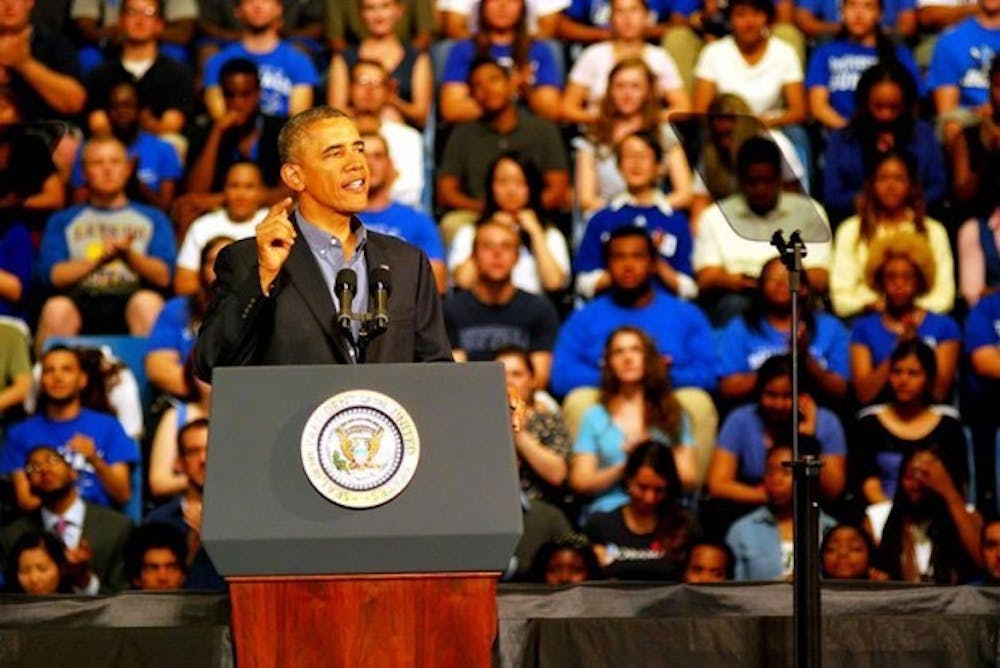
President Obama addressed higher education at UB’s Alumni Arena
When President Barack Obama visited UB just before the start of the school year last August, he spoke about the proposed reforms that he argued would “create better incentives for colleges to do more with less and deliver better value for students and their families.”
In order to strengthen the middle class, he said in the Aug. 22 speech, the system revolving around higher education in the United States would have to be changed. Obama proposed three ways to make it better: changing how colleges are ranked, creating competition for innovation and curbing immense student debt by making colleges more affordable.
The first part of the plan is meant to take the focus off the number ranking of colleges. He hopes the new system will create a ranking system that puts emphasis on the kinds of opportunities a college can bring to a student. Obama wants to implement the system by 2015.
The second leg of Obama’s plan addresses college affordability and quality. The president believes it is possible for colleges to find ways to help students graduate on time in a more cost-effective manner while keeping the level of education high.
The last point was an accumulation of the previous plans trying to lower tuition costs and student debt. Obama has already created a program called “Pay-As-You-Earn” that stops the amount a student owes at 10 percent of his or her income.
“Government shouldn’t see student loans as a way to make money,” he said. “It should be a way to help students.”
Obama said this three-step plan is meant to be the start of a revitalization of the middle class.
Student Association experiences scandal, resignations
Former Student Association President Nick Johns resigned from office on Sept. 18, just over three weeks into his term. Other SA leaders accused Johns of inappropriately accepting gifts, mishandling SA funds, hiring friends instead of qualified candidates, being absent from important events, falsifying documents, mistreating staff and harassing Chief of Staff Jennifer Merckel.
SA Vice President Lyle Selsky then took over as interim president.
On Oct. 9, Sam McMahon won the re-election for SA President with 1,087 votes. His closest opponent was SUNY delegate Mohammad Alwahaidy, who had 309 fewer votes than McMahon.
McMahon’s platform promised the services of a holiday shuttle that would run between campus and the Buffalo Niagara International Airport. The shuttle was established.
On Jan. 22, Selsky resigned as vice president. He said “family hardship” was the cause for leaving the office. McMahon appointed Judy Mai, a senior health and human services major and former SA office manager who has been involved in the organization for four years, to be vice president for the rest of the semester.
The senate agreed with the appointment with a vote of 13 yeses on Feb. 2.
UB offers winter classes for the first time
This past winter break marked the first winter session for UB, which ran from Jan. 6-24.
The three-week session offered the chance for students to take up to five credits or study abroad. Other SUNY schools like Stony Brook, Albany and Binghamton already had an established winter session. UB talked to these schools to help determine which winter classes to offer.
University Registrar Kara Saunders said the session gives students the ability to catch up on their major requirements. She said the program could also potentially help students stay on a four-year track to graduate.
The cost of a class during the winter session is based on $245 per credit hour for New York State residents and $742 for out-of-state residents. Students also had to pay $67.39 per credit hour as a part of the “Comprehensive Fee” and a $9.38 “Academic Excellence Fee.” There was also a one-time $7.89 “Student Activity Fee.”
A. Scott Weber, senior vice provost of academic affairs, said UB would survey winter session students as a way to better the program in the future.
Faculty Senate pushes to make UB Foundation budget public
As an organization that had a long history of not having enough members present to vote on any amendment, UB’s Faculty Senate passed an amendment during December of 2013. They wanted the budget of the UB Foundation, a private entity that handles UB’s endowment, to be made public.
But their request wasn’t answered until March 2014, when President Satish Tripathi said releasing the information was not in his “purview.” The UB Foundation manages nearly $1 billion in donations and some faculty members want to know exactly how that money is being allocated.
The director of the UBF, Ed Schneider, says that the UBF is more transparent than it is required to be under federal or New York State law.
But professors like Faculty Senator Kenneth Dauber, who originated the motion in the winter, were baffled by Triapthi’s decision and emphasized the importance of transparency at a public university.
The Buffalo Center Chapter of the United University Professions (UUP), UB's union representing academic and professional employees, also voted for the budget to be made public in an April meeting.
Country music comes to Spring Fest
The Band Perry, Gloriana and Citizen Cope performed for UB’s Spring Fest on May 2.
There were a lot of mixed feelings surrounding the decision for a country Spring Fest. Some students believed the large SA budget should have brought a better lineup. Others enjoyed the change of pace as opposed to the major rap/hip-hop themes of the past couple fests.
Many students took to Twitter or Facebook to voice their opinions.
SA Entertainment Coordinator Marc Rosenblitt said the budget for this year’s Spring Fest was less than previous years.
The cost of having these bands perform for fests is around $190,000 in talent fees, and about $125-150,000 in production costs but these amounts may vary, according to Rosenblitt.
McMahon said having Aziz Ansari perform at UB contributed to the smaller budget the SA had to work with for Spring Fest. He believed students would enjoy having the comedian perform.
Animal Heights: The Spectrum investigates illegal Greek Life
Former Spectrum Managing Editor Lisa Khoury launched a seven-month investigation into the illegal fraternities. The results were the types of antics you’d find in a “Van Wilder” movie.
Since the 1990s, illegal fraternities have flourished at UB. The groups aren’t recognized by the university or by their national chapters, but still continue to function. They’re tied to serious accounts of hazing and drug-selling operations. All of these fraternity houses are located in the University Heights, an area by UB’s South Campus.
When asked who should be responsible for stopping the illegal groups, the university or the national organizations themselves, both entities pointed to the other.
The students involved keep quiet about their activity, whether out of fear of retaliation or out of a sense of brotherhood they’re not willing to break.
“The culture is such that the students who are pledging are really taught to keep their mouths shut,” said Elizabeth Lidano, the director of UB's Judicial Affairs, who has spent years trying to get information about illegal groups and punish students who are involved. "They're taught how to lie to us. And they're afraid."
Forty-four percent of UB students told The Spectrum they were never warned about joining underground fraternities and 26 percent recalled being warned at freshman orientation.
The story ran in The Spectrum’s last issue of the spring semester.
email: news@ubspectrum.com



